
Discover the best prompt engineering techniques for ChatGPT in 2026 with practical examples, AI trends, expert tips, and real-world applications.
Introduction
Artificial intelligence is evolving faster than ever, and ChatGPT has become one of the most powerful productivity tools for businesses, developers, marketers, cybersecurity professionals, educators, and everyday users. However, getting exceptional results from AI isn’t just about asking questions—it’s about asking the right questions. That’s where the best prompt engineering techniques for ChatGPT in 2026 come into play.
Prompt engineering has become a valuable skill because modern AI models can generate highly accurate, structured, and context-aware responses when given clear instructions. Whether you’re writing code, analysing cybersecurity threats, creating marketing campaigns, summarising research papers, or automating customer support, effective prompting can dramatically improve both quality and efficiency.
In 2026, prompt engineering is no longer limited to AI enthusiasts. Organisations across industries are building prompt libraries, AI workflows, and internal best practices to maximise the value of generative AI. Understanding the best prompt engineering techniques for ChatGPT in 2026 helps users save time, reduce errors, and unlock advanced AI capabilities.
This guide explores proven prompting strategies, practical examples, industry applications, and emerging trends that can help beginners and professionals use ChatGPT more effectively.
What Is Prompt Engineering?
Prompt engineering is the practice of designing clear, structured instructions that guide AI models toward producing accurate, relevant, and useful outputs.
Instead of asking vague questions, effective prompts provide:
- Clear objectives
- Relevant context
- Desired output format
- Constraints or limitations
- Target audience
- Examples when needed
The better the prompt, the more useful the response.
Basic Prompt
Explain cloud computing.
Improved Prompt
Explain cloud computing to a small business owner with no technical background. Use simple language, real-world examples, and a comparison table.
The second prompt provides more context, resulting in a clearer and more targeted answer.
Why Prompt Engineering Matters in 2026
Generative AI has become deeply integrated into modern workplaces. Businesses use ChatGPT for software development, technical documentation, research, customer support, cybersecurity, education, content creation, and workflow automation.
Effective prompt engineering helps users:
- Improve response accuracy
- Reduce editing time
- Automate repetitive tasks
- Generate consistent documentation
- Improve coding productivity
- Create higher-quality marketing content
- Analyse business data faster
- Support decision-making
As AI models become more capable, prompt quality becomes increasingly important for achieving reliable outcomes.
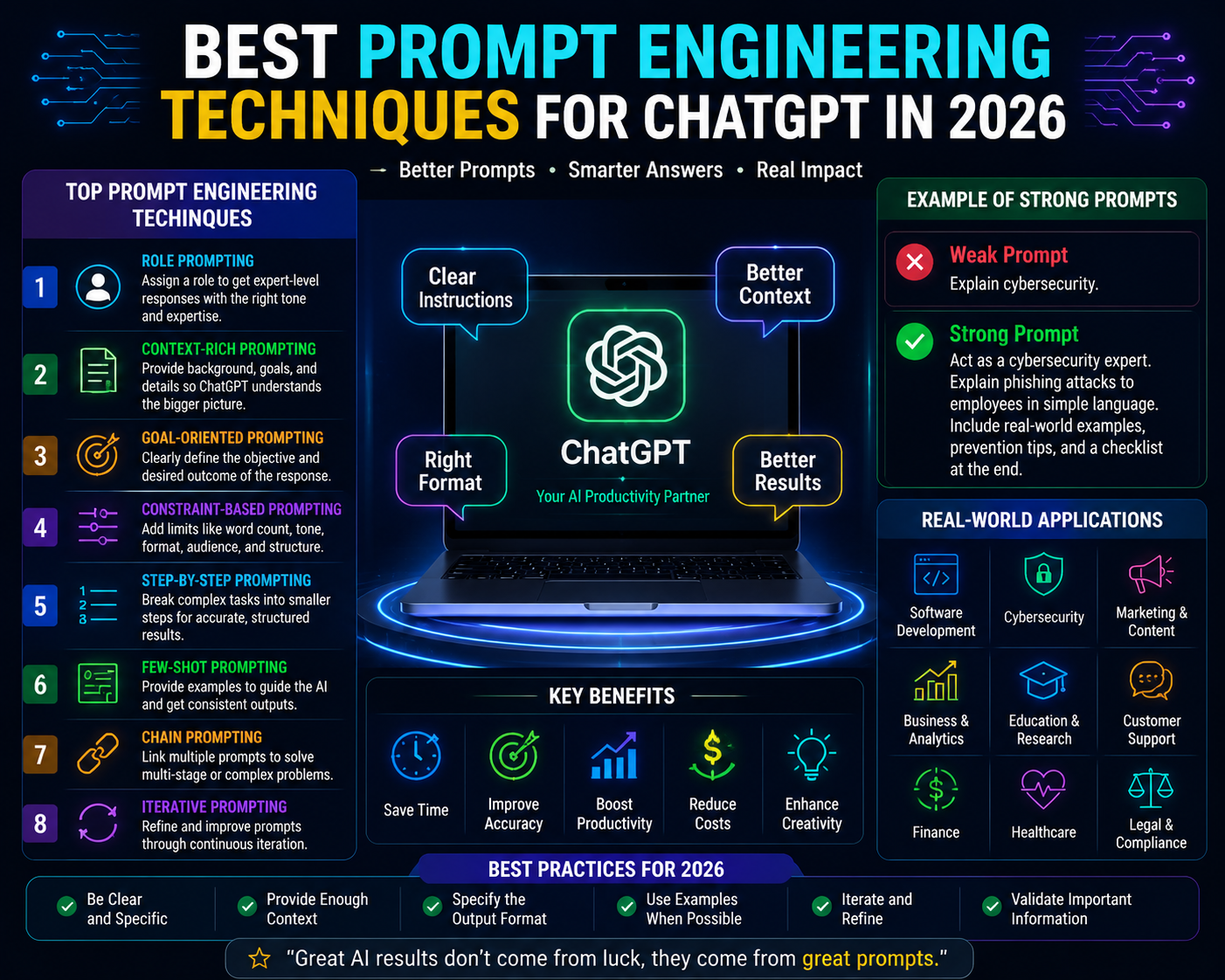
Best Prompt Engineering Techniques for ChatGPT in 2026
1. Role Prompting
One of the most effective techniques is assigning ChatGPT a specific professional role.
Instead of asking:
Explain phishing attacks.
Use:
Act as a senior cybersecurity consultant explaining phishing attacks to new employees during security awareness training.
Role prompting improves tone, expertise, and relevance.
Common roles include:
- Software engineer
- Cybersecurity analyst
- Technical writer
- Data scientist
- Financial advisor
- Marketing strategist
- Teacher
- HR consultant
2. Context-Rich Prompting
Provide background information before asking the main question.
Example:
Our company is a healthcare software provider serving hospitals. Create a cybersecurity awareness checklist suitable for non-technical employees.
Adding context allows ChatGPT to generate more relevant and practical responses.
3. Goal-Oriented Prompting
Always define the desired outcome.
Instead of:
Write about artificial intelligence.
Use:
Write a beginner-friendly blog post explaining artificial intelligence for small business owners. Include practical examples, FAQs, and a conclusion.
Specific objectives reduce ambiguity.
4. Constraint-Based Prompting
Adding constraints improves consistency.
Example:
Write a product description in under 150 words using professional language and include five bullet points.
Useful constraints include:
- Word count
- Tone
- Reading level
- Formatting
- Target audience
- Output style
5. Step-by-Step Prompting
Complex tasks become easier when broken into smaller steps.
Example:
Explain how to deploy a secure web application.
Improved version:
- Explain the architecture.
- Describe deployment.
- List security best practices.
- Identify common mistakes.
- Provide a deployment checklist.
This technique often produces more organised and actionable results.
6. Few-Shot Prompting
Provide examples before requesting new content.
Example:
Product Title:
Wireless Mouse
Description:
Compact, ergonomic, rechargeable.
Now create descriptions for these products…
Examples help AI understand the expected format and style.
7. Chain Prompting
Rather than asking one complex question, guide ChatGPT through a sequence of related tasks.
Example workflow:
- Analyse customer feedback.
- Identify common complaints.
- Categorise issues.
- Recommend improvements.
- Create an executive summary.
This technique is especially useful for research, planning, and business analysis.
8. Iterative Prompting
Rarely is the first response the final one.
Professional users improve results by refining prompts through multiple iterations.
Example:
Initial prompt:
Write a cybersecurity report.
Follow-up:
Add recent ransomware trends.
Next:
Include recommendations for small businesses.
Iterative prompting often produces significantly better results than a single prompt.
Real-World Applications
Software Development
Developers use ChatGPT to:
- Generate boilerplate code
- Explain algorithms
- Debug applications
- Create documentation
- Write unit tests
- Optimise SQL queries
Example prompt:
Act as a senior Python developer. Build a REST API using FastAPI with authentication, PostgreSQL integration, logging, and automated tests.
AI Cybersecurity
Security teams increasingly use AI for:
- Threat intelligence summaries
- Log analysis
- Incident response documentation
- Security awareness content
- Vulnerability assessments
Example:
Review this firewall configuration and identify potential security weaknesses using recognised best practices.
Business Productivity
Business leaders use ChatGPT for:
- Executive summaries
- Meeting notes
- Market research
- Financial analysis
- Business planning
Marketing
Prompt engineering supports:
- SEO articles
- Social media campaigns
- Email marketing
- Product descriptions
- Advertising copy
Example:
Create a LinkedIn post promoting a cloud security webinar aimed at IT managers.
Comparison Table
| Technique | Best For | Difficulty | Output Quality |
|---|---|---|---|
| Role Prompting | Expert advice | Easy | Excellent |
| Context Prompting | Business tasks | Easy | Excellent |
| Few-Shot Prompting | Consistency | Medium | Excellent |
| Constraint Prompting | Technical writing | Medium | High |
| Step-by-Step Prompting | Complex workflows | Medium | Excellent |
| Chain Prompting | Multi-stage projects | Advanced | Outstanding |
| Iterative Prompting | Refinement | Easy | Outstanding |
Industry Insights
Across industries, organisations are increasingly standardising how employees interact with generative AI. Development teams maintain reusable prompt libraries for coding tasks, marketing departments create templates for consistent brand messaging, and cybersecurity teams use structured prompts to speed up documentation and incident reporting.
Recent AI news also highlights growing investment in AI assistants that can manage multi-step workflows, making prompt engineering a foundational skill for professionals. As these systems become more capable, organisations that combine effective prompting with strong governance and human oversight are likely to achieve better productivity while maintaining quality and trust.
Benefits of Using the Best Prompt Engineering Techniques for ChatGPT in 2026
Learning the best prompt engineering techniques for ChatGPT in 2026 offers significant advantages for individuals and organisations alike. Well-crafted prompts improve AI performance, reduce manual effort, and help users achieve more reliable outcomes across a wide range of tasks.
Some of the key benefits include:
- Improved Accuracy: Clear prompts reduce ambiguity and help ChatGPT generate more precise responses.
- Greater Productivity: Automate repetitive tasks such as drafting emails, writing reports, summarising documents, and generating code.
- Time Savings: Spend less time editing AI-generated content by providing better instructions from the start.
- Better Decision-Making: AI can quickly analyse information and present structured insights for business or technical use.
- Enhanced Creativity: Generate fresh ideas for marketing campaigns, product development, content creation, and brainstorming sessions.
- Higher Coding Efficiency: Developers can accelerate debugging, documentation, code generation, and testing.
- Improved Customer Experience: Businesses can create faster, more consistent customer support responses.
- Scalable Workflows: Prompt templates allow teams to standardise AI usage across departments.
- Learning Support: Students and professionals can receive tailored explanations, study guides, and tutorials.
- Competitive Advantage: Organisations that master prompt engineering are better positioned to maximise the value of generative AI.
Challenges or Limitations
While prompt engineering is a powerful skill, it is not without challenges. Understanding these limitations helps users apply AI responsibly and effectively.
AI Can Make Mistakes
Even advanced AI models may generate inaccurate, outdated, or misleading information. Important outputs should always be verified using trusted sources.
Prompt Quality Directly Affects Results
Vague or incomplete prompts often produce generic answers. High-quality outputs require clear objectives, sufficient context, and well-defined constraints.
Privacy and Security Risks
Avoid entering confidential business information, personal data, passwords, or sensitive customer records into AI tools unless your organisation has approved secure enterprise solutions.
Human Expertise Is Still Essential
AI assists with analysis and content generation, but professionals remain responsible for reviewing outputs, making decisions, and ensuring compliance with legal and ethical requirements.
Continuous Learning Required
Prompt engineering evolves alongside AI technology. Techniques that work well today may need refinement as models become more capable.
Future Trends in Prompt Engineering
The field of prompt engineering continues to advance rapidly. Several trends are expected to shape how people interact with AI in the coming years.
AI Agents
Instead of completing individual tasks, AI agents will increasingly manage complete workflows, such as planning projects, writing code, testing software, analysing data, and generating reports with minimal human intervention.
Multimodal AI
Future AI systems will seamlessly combine text, images, audio, video, and structured data. Prompt engineering will expand beyond text-based interactions to support richer and more dynamic workflows.
Personalised AI Assistants
AI assistants are becoming better at adapting to user preferences, professional roles, writing styles, and recurring tasks, creating more personalised experiences.
Enterprise Prompt Libraries
Many organisations are developing internal prompt libraries that provide approved templates for coding, marketing, cybersecurity, customer support, and documentation. These libraries improve consistency and governance.
Responsible AI Practices
As AI adoption grows, businesses will place greater emphasis on transparency, privacy, fairness, and human oversight. Prompt engineering will increasingly include safeguards to reduce bias and improve trustworthiness.
Read More About:AI Prompt Engineering Examples for Real-World Applications
Frequently Asked Questions
1. What is prompt engineering?
Prompt engineering is the process of creating clear and structured instructions that guide AI models to produce accurate, relevant, and useful responses.
2. Why is prompt engineering important for ChatGPT in 2026?
Modern AI systems are capable of handling increasingly complex tasks. Effective prompt engineering helps users unlock these capabilities while improving accuracy, consistency, and efficiency.
3. Do I need programming skills to learn prompt engineering?
No. Prompt engineering is useful for developers, but it is equally valuable for writers, marketers, teachers, researchers, business owners, customer support teams, and general users.
4. Which industries benefit the most from prompt engineering?
Prompt engineering is widely used in software development, cybersecurity, healthcare administration, finance, education, marketing, legal services, customer support, manufacturing, and scientific research.
5. What are the most effective prompt engineering techniques?
Some of the most effective techniques include:
- Role prompting
- Context-rich prompting
- Few-shot prompting
- Constraint-based prompting
- Step-by-step prompting
- Chain prompting
- Iterative prompting
6. Can prompt engineering improve coding?
Yes. Developers use prompt engineering to generate code, explain algorithms, debug applications, create documentation, write unit tests, and optimise performance.
7. Is AI-generated information always accurate?
No. AI responses should always be reviewed and validated, especially when used for technical, legal, financial, healthcare, or cybersecurity purposes.
8. Will prompt engineering remain important as AI improves?
Yes. Although AI models are becoming more capable, users who provide clear objectives and detailed context will continue to achieve better outcomes than those relying on vague prompts.
Conclusion
The best prompt engineering techniques for ChatGPT in 2026 are no longer niche skills reserved for AI researchers—they have become essential for anyone seeking to work more efficiently with generative AI. Whether you’re developing software, improving cybersecurity workflows, creating marketing campaigns, analysing business data, or enhancing customer support, effective prompting enables ChatGPT to deliver more relevant and actionable results.
Successful prompt engineering combines clarity, context, structure, and iteration. Rather than expecting perfect results from a single question, experienced users refine prompts, provide additional information, and specify desired formats to guide the AI more effectively.
As AI continues to evolve, prompt engineering will remain a valuable capability that helps professionals unlock new opportunities while maintaining quality, security, and responsible AI practices. By mastering these techniques today, you’ll be better prepared to take advantage of the next generation of AI-powered tools and workflows.
Key Takeaways
- Prompt engineering is the foundation of effective AI interactions.
- Clear, context-rich prompts consistently outperform vague requests.
- Role prompting, few-shot prompting, constraint-based prompting, and iterative refinement are among the most effective techniques.
- ChatGPT supports productivity across software development, cybersecurity, marketing, education, customer support, and business operations.
- Human review remains essential for verifying AI-generated information.
- Organisations are increasingly adopting prompt libraries and governance frameworks for consistent AI usage.
- AI agents and multimodal systems will expand the role of prompt engineering in future workflows.
- Continuous learning and experimentation help users stay current as AI technology evolves.
- Responsible AI practices—including privacy, transparency, and oversight—are key to successful adoption.
- Mastering prompt engineering today will help individuals and businesses maximise the benefits of AI in 2026 and beyond.