
Learn how prompt engineering improves AI accuracy with proven techniques, practical examples, benefits, challenges, and future trends for businesses and AI professionals.
How Prompt Engineering Improves AI Accuracy
Artificial intelligence has rapidly evolved from simple automation tools into sophisticated systems capable of writing content, generating images, analysing data, coding software, and supporting business decisions. However, even the most advanced AI models are only as effective as the instructions they receive. This is where how prompt engineering improves AI accuracy becomes one of the most important topics in modern AI development.
Prompt engineering is the process of designing clear, structured, and context-rich instructions that guide AI models toward producing more accurate, relevant, and reliable outputs. Rather than relying on trial and error, prompt engineering uses proven techniques to minimise mistakes, reduce hallucinations, and improve consistency across various AI applications.
As organisations increasingly integrate AI into customer service, cybersecurity, healthcare, software development, education, and content creation, understanding prompt engineering has become an essential skill for developers, business leaders, and technology enthusiasts alike.
In this guide, you’ll learn how prompt engineering improves AI accuracy, why it matters, practical techniques, real-world applications, industry trends, challenges, and future opportunities.
What Is Prompt Engineering?
Prompt engineering is the practice of crafting effective prompts that help AI models understand exactly what users want.
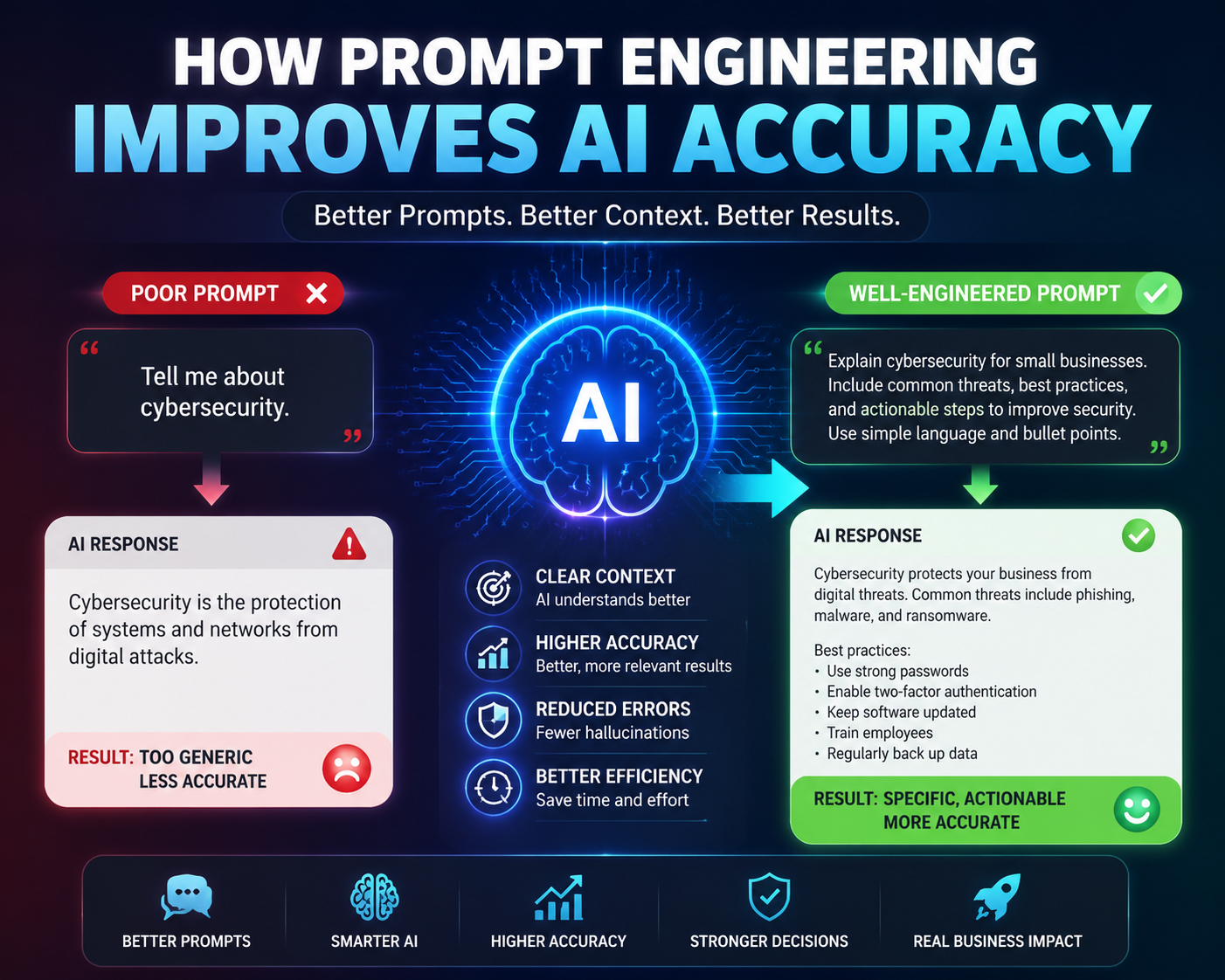
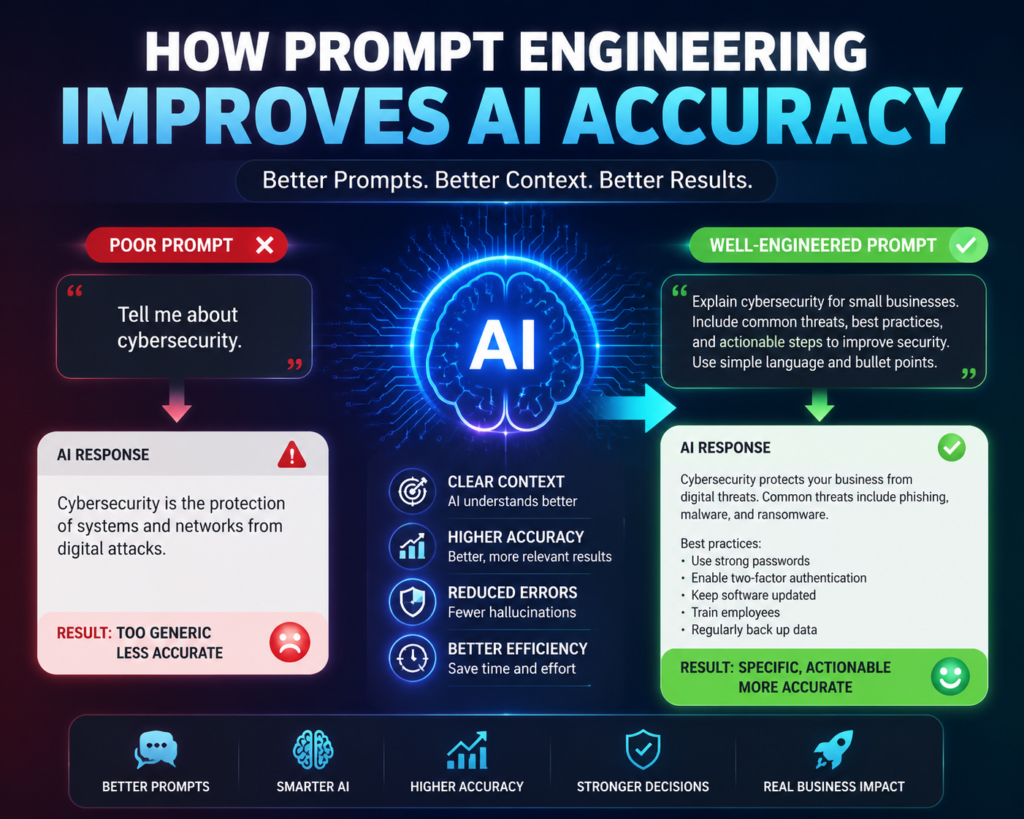
Instead of giving vague instructions like:
“Write about cybersecurity.”
A well-engineered prompt provides context, audience, purpose, tone, formatting requirements, and expected outcomes.
For example:
“Write a beginner-friendly 1,000-word article explaining ransomware prevention for small businesses. Include practical examples, prevention tips, and a FAQ section.”
The second prompt provides significantly more context, allowing the AI to generate a far more useful response.
Prompt engineering applies to:
- Large Language Models (LLMs)
- AI chatbots
- AI coding assistants
- Image generation models
- AI research assistants
- AI business automation
- AI-powered cybersecurity tools
Why AI Accuracy Depends on Prompt Quality
AI models predict responses based on patterns learned from enormous datasets. They do not “think” like humans or automatically understand hidden intentions.
Poor prompts often lead to:
- Incorrect answers
- Missing information
- Hallucinated facts
- Generic responses
- Inconsistent formatting
- Irrelevant content
Well-designed prompts significantly improve:
- Context understanding
- Response relevance
- Logical reasoning
- Consistency
- Accuracy
- User satisfaction
Simply put:
Better prompts produce better AI results.
How Prompt Engineering Improves AI Accuracy
Provides Clear Context
Context is one of the biggest factors influencing AI performance.
Instead of asking:
Explain machine learning.
A better prompt is:
Explain machine learning for high school students using simple examples and avoid technical jargon.
The AI now understands:
- Target audience
- Complexity level
- Writing style
- Expected format
This dramatically increases response quality.
Reduces AI Hallucinations
AI hallucinations occur when models confidently generate inaccurate or fabricated information.
Prompt engineering helps reduce hallucinations by:
- Specifying trusted sources
- Asking the AI to acknowledge uncertainty
- Limiting speculative answers
- Requesting evidence-based responses
Example:
If information is uncertain, clearly state that instead of making assumptions.
This simple instruction often improves factual reliability.
Improves Logical Reasoning
Modern AI models perform significantly better when tasks are broken into smaller logical steps.
Instead of:
Analyse this business.
Use:
- Identify strengths.
- Identify weaknesses.
- Recommend improvements.
- Summarise findings.
Breaking complex tasks into structured steps leads to more organised and accurate outputs.
Increases Consistency
Businesses frequently require consistent AI responses.
Prompt engineering standardises outputs by defining:
- Writing tone
- Formatting
- Length
- Structure
- Terminology
For customer support, this ensures every response follows company guidelines.
Enhances Domain-Specific Knowledge
Different industries require specialised language and expertise.
For example:
Healthcare prompts require medical terminology.
Legal prompts require legal language.
Cybersecurity prompts require technical precision.
Providing domain-specific context enables AI to generate more relevant responses.
Supports Better Decision-Making
Decision-support systems increasingly rely on AI.
Structured prompts encourage AI to evaluate multiple options instead of jumping to conclusions.
Example:
Compare three cybersecurity solutions based on cost, scalability, compliance, and deployment complexity.
This produces balanced recommendations.
Common Prompt Engineering Techniques
Zero-Shot Prompting
The AI performs a task without examples.
Example:
Summarise this article in three bullet points.
Suitable for straightforward tasks.
Few-Shot Prompting
Users provide examples before requesting a response.
Example:
Input:
Question: What is phishing?
Answer: A cyberattack that tricks users into revealing sensitive information.
Question: What is ransomware?
Answer:
Providing examples improves consistency.
Role Prompting
Assign the AI a specific role.
Examples include:
- Cybersecurity analyst
- Financial advisor
- Teacher
- Software engineer
- Marketing consultant
Example:
Act as a cybersecurity consultant reviewing this network policy.
This often generates more specialised responses.
Constraint-Based Prompting
Set clear rules.
Example:
- Maximum 500 words
- Use Markdown
- Avoid technical jargon
- Include examples
- Cite limitations
Constraints improve precision.
Step-by-Step Prompting
Ask AI to solve problems sequentially.
Example:
- Identify the issue.
- Explain causes.
- Recommend solutions.
- Provide implementation steps.
This improves reasoning accuracy.
Real-World Applications of Prompt Engineering
AI Cybersecurity
Prompt engineering helps security analysts:
- Detect suspicious activity
- Analyse malware reports
- Summarise threat intelligence
- Generate incident reports
- Explain vulnerabilities
Well-designed prompts reduce analyst workload while improving consistency.
Software Development
Developers use prompt engineering to:
- Generate code
- Debug software
- Explain algorithms
- Write documentation
- Review security vulnerabilities
Structured prompts produce cleaner and more reliable code suggestions.
Healthcare
Medical professionals use AI for:
- Clinical documentation
- Patient summaries
- Medical coding
- Research assistance
- Administrative automation
Carefully designed prompts reduce ambiguity while supporting human decision-making.
Education
Teachers use prompt engineering to create:
- Lesson plans
- Quiz questions
- Personalised learning
- Study guides
- Practice exercises
Students also benefit from AI explanations tailored to different learning levels.
Business Intelligence
Executives use AI to:
- Analyse reports
- Summarise meetings
- Forecast trends
- Generate insights
- Create presentations
Prompt engineering improves decision quality by ensuring relevant outputs.
Comparison Table: Poor vs Well-Engineered Prompts
| Feature | Poor Prompt | Well-Engineered Prompt |
|---|---|---|
| Context | Minimal | Detailed |
| Accuracy | Lower | Higher |
| Consistency | Variable | Reliable |
| Formatting | Unpredictable | Structured |
| Hallucinations | More common | Reduced |
| User Satisfaction | Lower | Higher |
| Business Value | Limited | Significant |
Benefits of Prompt Engineering
Prompt engineering offers advantages for both individual users and organisations.
Key benefits include:
- Higher AI accuracy
- More reliable outputs
- Reduced hallucinations
- Faster task completion
- Better customer experiences
- Improved productivity
- Lower operational costs
- Easier AI adoption
- Better decision support
- More consistent business communication
As AI adoption continues to grow, prompt engineering is becoming a valuable professional skill across industries.
Challenges and Limitations
Despite its advantages, prompt engineering is not a perfect solution.
Common challenges include:
Constant Model Updates
AI models evolve frequently.
Prompts that work today may require adjustments after model updates.
No Guaranteed Accuracy
Even excellent prompts cannot guarantee completely accurate answers.
Human verification remains essential for high-risk industries.
Domain Expertise Required
Creating highly effective prompts often requires deep subject knowledge.
Technical fields such as cybersecurity and healthcare demand precise terminology.
Prompt Complexity
Complex prompts can become difficult to maintain, especially in enterprise environments.
Organisations increasingly use prompt libraries and templates to solve this problem.
Data Privacy Concerns
Sensitive information should never be included in prompts unless appropriate security controls are in place.
Businesses should follow data governance policies when using AI.
Future Trends
Prompt engineering continues to evolve alongside AI technology.
Emerging trends include:
Automated Prompt Optimisation
AI systems will increasingly improve prompts automatically based on user goals and previous interactions.
Adaptive Prompting
Future AI assistants will dynamically adjust prompts during conversations to improve response quality.
Industry-Specific Prompt Libraries
Healthcare, finance, cybersecurity, education, and manufacturing are developing specialised prompt templates tailored to their unique requirements.
Multi-Modal Prompt Engineering
Users will combine text, images, audio, and video within a single prompt, enabling richer AI interactions.
AI Agents
Autonomous AI agents will generate, refine, and chain prompts together to accomplish complex workflows with minimal human intervention.
These developments will make AI systems more accurate, efficient, and user-friendly.
Industry Insights and Trends
The rapid growth of generative AI has significantly increased demand for prompt engineering expertise.
Several trends are shaping the industry:
- Businesses are integrating AI into everyday workflows to improve productivity.
- Developers are building reusable prompt libraries for consistent AI outputs.
- AI governance frameworks increasingly emphasise responsible prompt design.
- Organisations are investing in AI literacy and employee training.
- Prompt engineering is becoming a recognised skill in AI-related job roles.
As AI models become more capable, effective prompting will remain a key factor in achieving high-quality results.
Read More About:Best ChatGPT Prompts for Business Productivity (2026 Guide)
Frequently Asked Questions
1. What is prompt engineering?
Prompt engineering is the process of designing effective instructions that guide AI models to produce accurate, relevant, and high-quality responses.
2. Why does prompt engineering improve AI accuracy?
Clear prompts provide context, constraints, and objectives, enabling AI systems to better understand user intent and generate more reliable outputs.
3. Can prompt engineering eliminate AI hallucinations?
No. While prompt engineering can significantly reduce hallucinations, it cannot eliminate them entirely. Human review is still important, especially for critical applications.
4. Which industries benefit the most from prompt engineering?
Industries such as cybersecurity, healthcare, finance, software development, education, marketing, and customer service all benefit from improved AI accuracy through effective prompting.
5. Is prompt engineering only useful for developers?
No. Business owners, content creators, teachers, researchers, analysts, marketers, and general AI users can all improve their results by learning prompt engineering techniques.
6. Will prompt engineering remain important as AI evolves?
Yes. Although AI models are becoming more intuitive, providing clear objectives, context, and constraints will continue to play a vital role in achieving accurate and trustworthy outputs.
Conclusion
Prompt engineering has emerged as one of the most valuable skills in the era of generative AI. By providing clear instructions, relevant context, and structured guidance, users can significantly improve AI accuracy, reduce hallucinations, enhance consistency, and produce more reliable outcomes across a wide range of applications.
Whether you’re a developer building AI-powered software, a cybersecurity professional analysing threats, a business leader automating workflows, or a content creator seeking better results, mastering prompt engineering can dramatically increase the effectiveness of AI tools.
As artificial intelligence continues to evolve, prompt engineering will remain a cornerstone of responsible and efficient AI usage. Combining well-crafted prompts with human expertise and critical thinking will help organisations maximise the value of AI while maintaining accuracy, trust, and accountability.
Key Takeaways
- Prompt engineering is the process of creating structured instructions for AI models.
- High-quality prompts significantly improve AI accuracy and response relevance.
- Effective prompting reduces hallucinations and enhances logical reasoning.
- Techniques such as zero-shot, few-shot, role prompting, and constraint-based prompting improve output quality.
- Prompt engineering is widely used in cybersecurity, healthcare, software development, education, and business intelligence.
- Human verification remains essential for high-risk or sensitive applications.
- Future AI systems will increasingly automate and optimise prompt creation.
- Learning prompt engineering is becoming a valuable skill for professionals across industries.