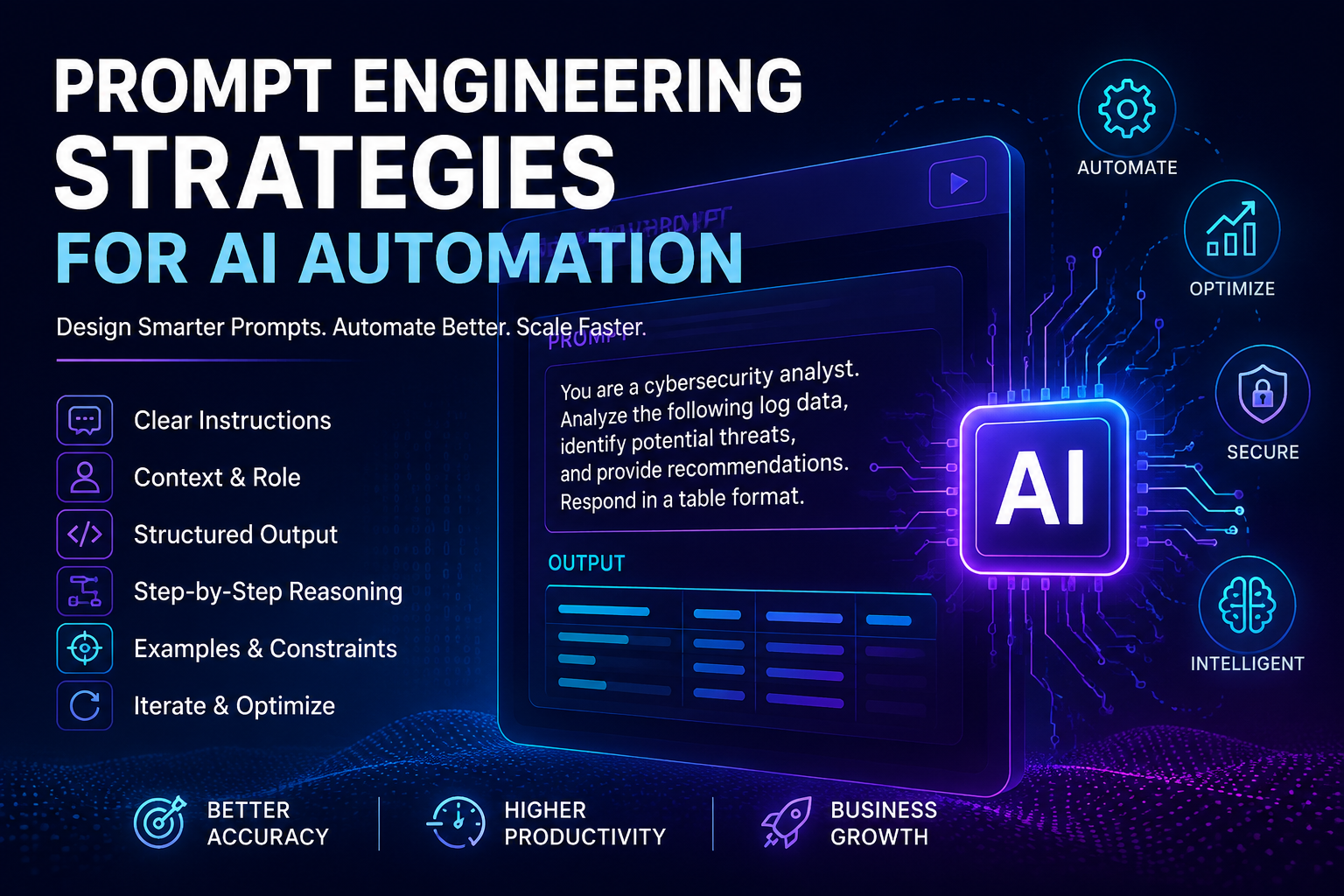

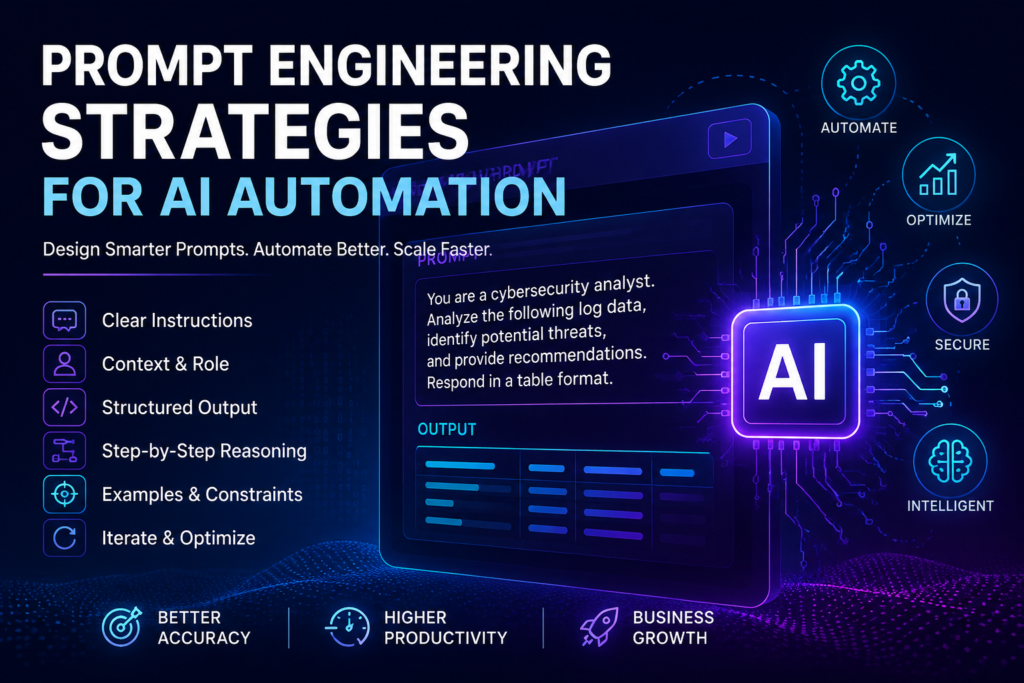
Discover the best prompt engineering strategies for AI automation, practical examples, expert insights, benefits, challenges, and future trends to maximize AI performance.
Introduction
Artificial intelligence has rapidly evolved from a futuristic concept into a powerful business tool that automates workflows, enhances productivity, and supports decision-making across industries. However, the quality of AI-generated results depends heavily on one critical factor: the prompt.
Prompt engineering strategies for AI automation have become an essential skill for developers, businesses, marketers, cybersecurity professionals, and AI enthusiasts who want to maximize the capabilities of modern AI models. Whether you’re automating customer support, generating content, analyzing data, writing code, or improving cybersecurity operations, well-designed prompts significantly improve accuracy, consistency, and efficiency.
As AI models become more sophisticated, prompt engineering is no longer just about asking better questions—it’s about designing structured instructions that guide AI toward predictable, reliable, and business-ready outputs.
This comprehensive guide explores proven prompt engineering strategies, practical applications, best practices, industry insights, benefits, limitations, future trends, and answers to frequently asked questions to help you build effective AI automation systems.
What Is Prompt Engineering?
Prompt engineering is the practice of designing, testing, and refining prompts that enable AI models to generate accurate, relevant, and useful responses.
A prompt can include:
- Instructions
- Context
- Examples
- Constraints
- Desired output format
- Tone
- Role assignments
Instead of asking:
“Write about cybersecurity.”
A better engineered prompt would be:
“Act as a cybersecurity consultant. Explain ransomware protection for small businesses using simple language. Include five prevention tips and a comparison table.”
The second prompt provides context, audience, format, and objectives—leading to significantly better output.
Why Prompt Engineering Matters for AI Automation
Automation relies on predictable outcomes.
Poor prompts often produce:
- Inconsistent answers
- Missing information
- Hallucinated facts
- Incorrect formatting
- Irrelevant content
Well-designed prompts improve:
- Accuracy
- Repeatability
- Speed
- Scalability
- User experience
For businesses automating thousands of AI tasks daily, prompt quality directly affects productivity and operational efficiency.
Core Prompt Engineering Strategies for AI Automation
1. Define a Clear Objective
The AI should understand exactly what you want.
Instead of vague requests, specify:
- Goal
- Audience
- Output type
- Length
- Style
Example:
“Create a beginner-friendly cybersecurity checklist for remote employees in bullet-point format.”
2. Assign a Role
Giving AI a professional role improves relevance.
Examples include:
- Software engineer
- Legal advisor
- Cybersecurity analyst
- Marketing strategist
- Medical educator
Example:
“You are a senior AI cybersecurity consultant.”
This often produces more domain-specific responses.
3. Provide Context
Context reduces ambiguity.
Instead of:
“Summarize this report.”
Use:
“Summarize this AI industry report for executives who need a five-minute overview.”
Context guides tone and detail.
4. Specify the Output Format
AI performs better when formatting expectations are explicit.
Examples include:
- Bullet lists
- JSON
- Markdown
- Tables
- HTML
- CSV
- Executive summaries
Example:
“Return the response as a Markdown table.”
5. Use Step-by-Step Instructions
Breaking complex tasks into smaller steps improves reliability.
Example:
- Analyze the dataset.
- Identify anomalies.
- Explain possible causes.
- Recommend solutions.
This strategy reduces skipped information.
6. Few-Shot Prompting
Provide examples before asking AI to perform a task.
Example:
Input:
Customer: My package is late.
Output:
“I’m sorry your package hasn’t arrived…”
Now continue with this customer message…
Examples teach AI the desired pattern.
7. Zero-Shot Prompting
Zero-shot prompting gives instructions without examples.
Example:
“Classify these emails as spam or legitimate.”
Modern AI models perform well with clear zero-shot prompts.
8. Chain-of-Thought Guidance
Encouraging structured reasoning often improves complex problem-solving.
Example:
“Work through the problem systematically before presenting the final answer.”
This strategy is especially useful for:
- Programming
- Mathematics
- Financial analysis
- Cybersecurity investigations
9. Add Constraints
Constraints improve consistency.
Specify:
- Word count
- Reading level
- Tone
- Audience
- Formatting
- Allowed sources
Example:
“Limit the answer to 300 words.”
10. Iterate and Optimize
Prompt engineering is an iterative process.
Successful teams continually:
- Test prompts
- Measure output quality
- Refine wording
- Compare results
- Build reusable prompt libraries
Continuous optimization significantly improves automation performance.
Advanced Prompt Engineering Techniques
Prompt Chaining
One prompt feeds another.
Example workflow:
Research → Summary → Blog Outline → SEO Optimization → Social Media Posts
Large automation systems frequently use prompt chains.
Retrieval-Augmented Generation (RAG)
Rather than relying solely on model memory, RAG retrieves relevant documents before generating answers.
Benefits include:
- Higher factual accuracy
- Reduced hallucinations
- Better enterprise knowledge access
Dynamic Prompting
Prompts automatically adapt based on:
- User preferences
- Previous interactions
- Business rules
- Customer history
This enables personalized AI automation.
Multi-Agent Prompting
Different AI agents specialize in separate tasks.
Example:
- Research agent
- Writing agent
- Fact-checking agent
- SEO agent
- Editing agent
Together, they create higher-quality outputs.
Prompt Engineering in Different Industries
AI Cybersecurity
Security teams automate:
- Threat analysis
- Malware classification
- Incident reports
- Vulnerability assessments
- Phishing detection
Example Prompt:
“Analyze these firewall logs and identify suspicious behavior.”
Customer Support
Businesses automate:
- FAQ responses
- Ticket routing
- Refund requests
- Product recommendations
Software Development
Developers use prompt engineering for:
- Code generation
- Debugging
- Documentation
- Unit testing
- API integration
Healthcare
Applications include:
- Clinical documentation
- Patient education
- Medical summarization
- Administrative automation
Human oversight remains essential.
Marketing
Marketing teams automate:
- Blog writing
- SEO optimization
- Email campaigns
- Product descriptions
- Ad copy generation
Comparison Table: Basic vs Advanced Prompt Engineering
| Feature | Basic Prompting | Advanced Prompt Engineering |
|---|---|---|
| Instructions | Simple | Structured |
| Context | Minimal | Extensive |
| Accuracy | Moderate | High |
| Examples | Rare | Frequently included |
| Output Consistency | Variable | Predictable |
| Automation Readiness | Limited | Excellent |
| Scalability | Low | High |
| Business Applications | Small tasks | Enterprise workflows |
Best Practices for Prompt Engineering
- Keep instructions specific.
- Use natural language.
- Test multiple prompt variations.
- Define success criteria.
- Include examples whenever possible.
- Request structured outputs.
- Review AI responses before deployment.
- Continuously improve prompts using real-world feedback.
- Maintain prompt documentation.
- Monitor performance metrics.
Real-World AI Automation Use Cases
Businesses increasingly rely on prompt engineering to automate complex workflows:
- Customer service chatbots answering thousands of queries daily.
- Cybersecurity platforms summarizing security incidents.
- HR departments generating job descriptions and interview questions.
- Financial institutions analyzing risk reports.
- Manufacturers automating maintenance documentation.
- E-commerce companies creating product descriptions at scale.
- News organizations drafting article summaries.
- Software companies generating technical documentation.
These examples demonstrate how effective prompts transform AI into a reliable productivity tool rather than a simple conversational assistant.
Benefits of Prompt Engineering Strategies for AI Automation
Prompt engineering delivers measurable advantages for organizations of all sizes.
Higher Accuracy
Clear prompts reduce misunderstandings and improve response quality.
Increased Productivity
Employees spend less time rewriting AI outputs.
Lower Operational Costs
Better automation minimizes repetitive manual work.
Improved Scalability
Standardized prompts enable consistent performance across thousands of tasks.
Better Customer Experience
Well-crafted prompts produce faster, more relevant, and personalized interactions.
Easier AI Integration
Organizations can integrate AI into existing workflows with fewer errors.
Enhanced Decision-Making
Structured prompts produce organized insights that support business decisions.
Challenges and Limitations
Despite its advantages, prompt engineering has several limitations.
Prompt Sensitivity
Minor wording changes can significantly affect AI responses.
Hallucinations
AI may still generate inaccurate or fabricated information if prompts lack sufficient context or rely on outdated knowledge.
Model Differences
A prompt that performs well on one AI model may not work equally well on another.
Continuous Maintenance
Prompts require ongoing testing and refinement as models evolve and business requirements change.
Security Risks
Sharing confidential information in prompts may expose sensitive data if appropriate safeguards are not in place.
Over-Reliance on AI
Organizations should maintain human oversight for critical decisions involving legal, financial, medical, or cybersecurity matters.
Future Trends in Prompt Engineering
Prompt engineering is evolving rapidly alongside advances in generative AI.
AI-Generated Prompts
AI systems are beginning to optimize prompts automatically based on task performance.
Autonomous AI Agents
Future AI agents will independently plan, execute, and refine complex workflows with minimal human intervention.
Voice-Based Prompt Engineering
Natural language voice interfaces will simplify AI automation for non-technical users.
Domain-Specific Prompt Libraries
Industries will develop standardized prompt collections tailored for healthcare, cybersecurity, finance, education, and legal services.
Integration with Enterprise Platforms
Prompt engineering will become embedded within CRM systems, productivity tools, and enterprise software, enabling seamless automation across organizations.
Prompt Governance
As AI adoption grows, businesses will establish governance frameworks to manage prompt quality, compliance, security, and version control.
Industry Insights and Trends
Recent industry developments indicate that organizations are increasingly investing in generative AI solutions to improve operational efficiency. Enterprises are moving beyond experimental AI projects toward production-ready automation, making prompt engineering a strategic capability rather than a niche skill.
AI-assisted coding, intelligent customer support, document processing, and cybersecurity automation continue to experience strong adoption. Organizations that invest in structured prompt engineering frameworks often report faster deployment cycles, improved consistency, and greater confidence in AI-generated outputs.
The growing demand for AI expertise has also created new career opportunities for prompt engineers, AI automation specialists, and generative AI consultants.
Read More About:How Prompt Engineering Improves AI Accuracy: A Complete Guide
Frequently Asked Questions (FAQ)
1. What is prompt engineering in AI?
Prompt engineering is the process of designing effective instructions that guide AI models to generate accurate, relevant, and useful responses.
2. Why is prompt engineering important for AI automation?
It improves accuracy, consistency, efficiency, and reliability, enabling AI systems to perform automated tasks with fewer errors and better scalability.
3. Is prompt engineering only for developers?
No. Business owners, marketers, writers, cybersecurity professionals, educators, analysts, and many other professionals can benefit from learning prompt engineering techniques.
4. What are the most effective prompt engineering strategies?
Some of the most effective strategies include assigning roles, providing context, using examples (few-shot prompting), specifying output formats, adding constraints, breaking tasks into steps, and continuously testing and refining prompts.
5. Can prompt engineering eliminate AI hallucinations?
No. While well-designed prompts can reduce hallucinations and improve factual accuracy, they cannot eliminate them entirely. Human review remains important for high-stakes applications.
6. How does prompt engineering support cybersecurity?
Prompt engineering helps automate threat analysis, malware classification, log analysis, incident response documentation, and security awareness content, enabling cybersecurity teams to work more efficiently.
7. Will prompt engineering remain important as AI evolves?
Yes. Although AI models are becoming more capable, the ability to provide clear objectives, context, constraints, and structured workflows will remain essential for achieving reliable, high-quality automation.
Conclusion
Prompt engineering has become one of the most valuable skills in the age of generative AI. Effective prompt engineering strategies for AI automation empower organizations to unlock greater accuracy, efficiency, and scalability across a wide range of applications—from cybersecurity and software development to marketing, customer support, and enterprise operations.
Success depends on more than asking better questions. It requires thoughtful prompt design, clear objectives, contextual guidance, structured outputs, and continuous optimization. Organizations that establish prompt engineering best practices and governance frameworks will be better positioned to deploy trustworthy AI solutions that deliver measurable business value.
As AI technology continues to advance, prompt engineering will evolve alongside it, becoming increasingly integrated into intelligent workflows, autonomous agents, and enterprise platforms. By mastering these strategies today, businesses and professionals can build more reliable AI systems, improve productivity, and stay competitive in an AI-driven future.
Key Takeaways
- Prompt engineering is the foundation of reliable AI automation.
- Clear objectives and detailed context significantly improve AI output quality.
- Structured prompts increase consistency, accuracy, and scalability.
- Few-shot prompting, prompt chaining, and retrieval-augmented generation are powerful advanced techniques.
- Prompt engineering benefits industries including cybersecurity, healthcare, software development, customer service, and marketing.
- Continuous testing and refinement are essential for maintaining prompt effectiveness.
- Human oversight remains necessary for critical decisions and sensitive applications.
- Future innovations such as AI-generated prompts and autonomous agents will further expand automation capabilities.
- Organizations that invest in prompt engineering today will be better prepared to leverage the next generation of AI technologies.