
Explore the future of prompt engineering in artificial intelligence, emerging AI trends, practical applications, industry insights, and expert predictions.
Introduction
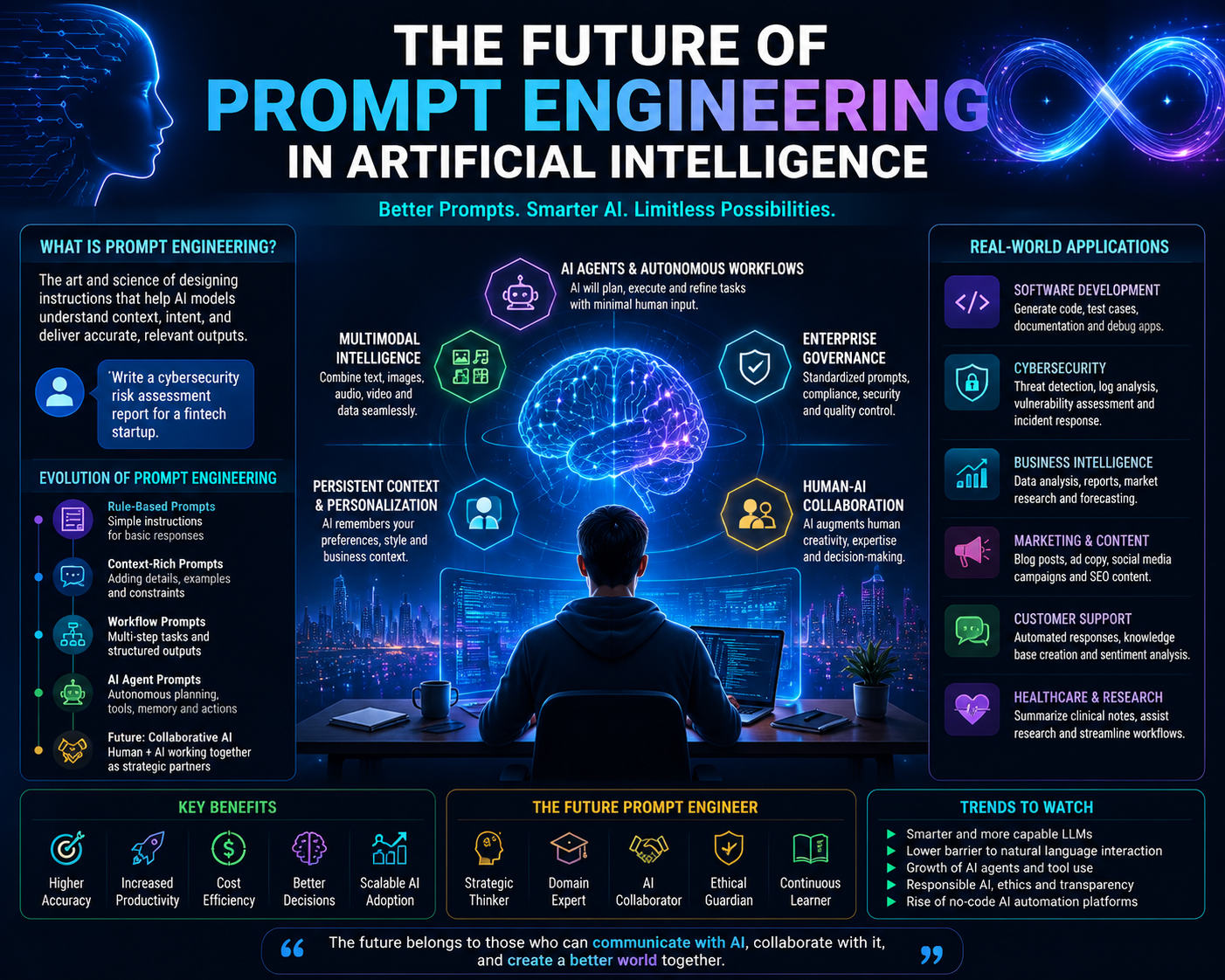
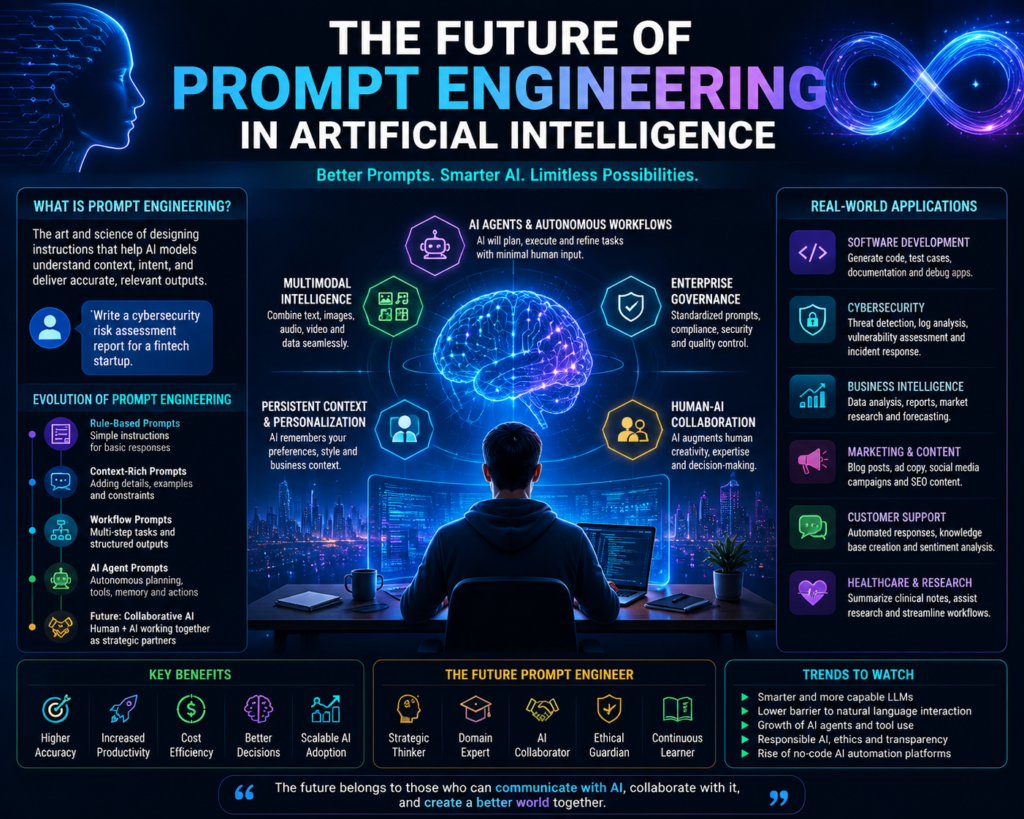
Artificial intelligence is advancing at an unprecedented pace, transforming how people work, communicate, develop software, analyse data, and solve complex business problems. At the centre of this transformation is prompt engineering—the practice of designing effective instructions that guide AI systems to produce accurate, useful, and context-aware responses.
Understanding the future of prompt engineering in artificial intelligence has become increasingly important as organisations adopt generative AI for software development, cybersecurity, customer service, education, healthcare, marketing, and business operations. While early AI systems relied heavily on carefully crafted prompts, newer models are becoming more capable of understanding context, managing complex workflows, and collaborating with users in more natural ways.
Despite these advances, prompt engineering remains a valuable skill. Instead of disappearing, it is evolving into a broader discipline that combines communication, problem-solving, workflow design, and AI governance. Professionals who understand how to interact effectively with AI systems will continue to gain a competitive advantage in an AI-powered economy.
This guide explores the future of prompt engineering in artificial intelligence, the technologies shaping its evolution, practical industry applications, emerging trends, and why prompt engineering is expected to remain a core skill for years to come.
What Is Prompt Engineering?
Prompt engineering is the process of creating structured instructions that help AI systems generate accurate, relevant, and useful responses.
A prompt may include:
- Clear objectives
- Background information
- Context
- Desired output format
- Constraints
- Examples
- Target audience
For example:
Basic Prompt
Explain artificial intelligence.
Improved Prompt
Explain artificial intelligence to small business owners using simple language, real-world examples, and a comparison table.
Providing additional context helps AI generate more useful and targeted responses.
Why Prompt Engineering Is Evolving
The rapid advancement of large language models (LLMs) is changing how people interact with AI.
Earlier AI systems often required highly specific prompts to achieve reliable results. Modern models can understand natural language much more effectively, reducing the need for overly complex instructions.
However, as AI becomes capable of managing larger and more sophisticated workflows, users must learn how to communicate goals, define constraints, and review AI-generated outputs responsibly.
Prompt engineering is therefore evolving from simple question writing into workflow design and AI collaboration.
Future of Prompt Engineering in Artificial Intelligence
Prompt Engineering Will Become More Strategic
Rather than focusing only on writing prompts, professionals will increasingly design complete AI workflows.
For example, instead of asking ChatGPT to write a report, users may instruct AI to:
- Collect information
- Analyse data
- Generate visual summaries
- Identify risks
- Produce an executive report
- Recommend business actions
This shift transforms prompt engineering into AI workflow engineering.
AI Agents Will Handle Multi-Step Tasks
AI agents are becoming capable of completing complex sequences of work independently.
Future prompt engineering will involve defining:
- Objectives
- Boundaries
- Success criteria
- Business rules
- Review checkpoints
Instead of issuing individual prompts, users will supervise AI systems performing extended workflows.
Multimodal Prompt Engineering
Future AI systems will process multiple types of information simultaneously.
Users will increasingly combine:
- Text
- Images
- Video
- Audio
- Documents
- Structured data
Example:
Analyse this security camera image, compare it with today’s incident report, summarise the findings, and generate a response plan.
Prompt engineering will extend far beyond text.
Personalised AI Assistants
AI assistants are becoming increasingly personalised.
Future assistants may remember:
- Writing preferences
- Coding style
- Business terminology
- Preferred formatting
- Industry knowledge
- Workflow habits
This will reduce repetitive prompting while improving productivity.
Enterprise AI Governance
Large organisations are developing standardised prompt libraries and governance frameworks.
These include:
- Approved prompts
- Security guidelines
- Compliance checks
- Human review processes
- Data privacy policies
Prompt engineering will become part of organisational AI governance strategies.
Technologies Driving the Future
Larger Language Models
Each new generation of AI models demonstrates stronger reasoning, better context awareness, and improved instruction following.
These capabilities reduce the need for overly complicated prompts while enabling more advanced tasks.
Retrieval-Augmented Generation (RAG)
Many enterprise AI systems now combine language models with trusted knowledge bases.
Instead of relying solely on model training data, AI retrieves relevant documents before generating responses, improving accuracy and reducing hallucinations.
AI Automation Platforms
Businesses increasingly connect AI models with workflow automation tools.
Examples include:
- Customer support
- Document processing
- Report generation
- Data analysis
- Software deployment
Prompt engineering will focus on designing reliable end-to-end automation rather than isolated prompts.
AI Cybersecurity
Cybersecurity professionals are using AI for:
- Threat intelligence
- Vulnerability assessments
- Security documentation
- Log analysis
- Incident summaries
Future prompt engineering will improve how AI supports security teams while ensuring that human experts validate critical decisions.
Real-World Applications
Software Development
Developers use prompt engineering to:
- Generate code
- Debug software
- Write documentation
- Create test cases
- Optimise performance
Example prompt:
Act as a senior software engineer. Develop a secure REST API with authentication, logging, automated testing, and deployment instructions.
Business Intelligence
Executives use AI to:
- Summarise reports
- Analyse trends
- Generate presentations
- Identify business opportunities
Prompt engineering helps ensure outputs are accurate, concise, and actionable.
Marketing
Marketing teams use AI to:
- Write blog posts
- Create social media campaigns
- Draft email sequences
- Perform SEO research
- Generate advertising copy
Structured prompts improve consistency across campaigns.
Healthcare Administration
Healthcare organisations use AI to:
- Summarise clinical documentation
- Assist with scheduling
- Generate patient communications
- Support administrative workflows
Human oversight remains essential for clinical decision-making.
Comparison Table: Today’s Prompt Engineering vs Future Prompt Engineering
| Feature | Today | Future |
|---|---|---|
| Primary Focus | Individual prompts | AI workflow design |
| AI Interaction | Question and answer | Multi-step collaboration |
| Context | User supplied | Persistent and personalised |
| Automation | Limited | Highly autonomous AI agents |
| Media Types | Mostly text | Text, image, audio, video, documents |
| Human Role | Prompt creator | AI supervisor and strategist |
| Governance | Emerging | Enterprise standard |
Industry Insights
Across industries, prompt engineering is transitioning from an individual productivity skill into an organisational capability. Businesses are investing in AI governance frameworks, prompt libraries, and employee training to improve consistency, reduce operational risks, and maximise the value of generative AI.
Recent AI news also highlights rapid progress in AI agents capable of planning and completing multi-step tasks with limited supervision. As these systems become more capable, professionals who understand prompt engineering, workflow design, and responsible AI practices will be well positioned to lead successful AI adoption initiatives.
Benefits of the Future of Prompt Engineering in Artificial Intelligence
The future of prompt engineering in artificial intelligence promises significant advantages for individuals, businesses, developers, and entire industries. As AI systems become more capable, prompt engineering will evolve from a technical skill into a strategic business capability.
Key benefits include:
- Higher AI Accuracy: Better prompts help AI generate more relevant, reliable, and context-aware responses.
- Greater Productivity: AI can automate repetitive tasks, allowing professionals to focus on higher-value work.
- Improved Decision-Making: AI-assisted analysis enables faster interpretation of business data, research, and reports.
- Enhanced Software Development: Developers can accelerate coding, debugging, documentation, and testing through well-structured prompts.
- Smarter Cybersecurity Operations: Security teams can use AI to assist with log analysis, threat intelligence, vulnerability assessments, and incident reporting.
- Personalised AI Experiences: Future AI assistants will adapt to individual users, making interactions faster and more effective.
- Business Process Automation: Prompt engineering will enable organisations to automate complex workflows with greater consistency.
- Reduced Operational Costs: Automation and AI-assisted productivity can lower manual effort and improve efficiency.
- Scalable AI Adoption: Prompt libraries and governance frameworks will help organisations deploy AI responsibly across teams.
- Continuous Innovation: Effective prompt engineering encourages experimentation, creativity, and rapid problem-solving.
Challenges or Limitations
Despite its growing importance, the future of prompt engineering in artificial intelligence also presents several challenges.
AI Hallucinations
Even advanced AI models can occasionally produce inaccurate or fabricated information. Human verification remains essential, particularly in high-stakes fields such as healthcare, finance, and cybersecurity.
Data Privacy and Security
Prompt engineering must account for privacy regulations and organisational security policies. Sensitive information should only be used with approved enterprise AI platforms.
Model Limitations
Although AI systems continue to improve, they may still struggle with ambiguous instructions, highly specialised knowledge, or rapidly changing information.
Ethical and Regulatory Concerns
As AI adoption increases, organisations must address issues such as transparency, fairness, bias, accountability, and compliance with emerging AI regulations.
Skill Development
Prompt engineering is becoming more sophisticated. Professionals will need continuous learning to keep pace with evolving AI capabilities and best practices.
Future Trends
The next generation of prompt engineering will be shaped by several transformative developments.
AI Agents and Autonomous Workflows
Future AI systems will increasingly manage complete workflows rather than responding to individual prompts. Users will define objectives, constraints, and review checkpoints while AI executes multi-step tasks.
Multimodal Intelligence
AI models will seamlessly combine text, images, audio, video, code, and structured data. Prompt engineering will evolve to orchestrate these different input types within a single workflow.
Persistent Context
Future AI assistants will retain more contextual understanding across sessions, enabling more personalised and efficient interactions while respecting user controls and privacy settings.
Enterprise Prompt Management
Businesses are expected to expand the use of centralised prompt libraries, quality standards, governance policies, and review processes to ensure consistency and reduce operational risks.
Human-AI Collaboration
Rather than replacing professionals, AI will increasingly function as a collaborative partner. Prompt engineering will emphasise communication, supervision, and responsible decision-making.
Read More About:How to Write Effective AI Prompts for ChatGPT
Frequently Asked Questions
1. What is the future of prompt engineering in artificial intelligence?
Prompt engineering is expected to evolve from writing individual prompts into designing AI workflows, supervising autonomous AI agents, and integrating AI into business operations.
2. Will prompt engineering remain important as AI becomes smarter?
Yes. Although AI models are becoming better at understanding natural language, users who provide clear goals, context, and constraints are likely to achieve more reliable and higher-quality results.
3. Which industries will benefit the most?
Industries expected to benefit include:
- Software development
- Cybersecurity
- Healthcare administration
- Finance
- Marketing
- Education
- Customer service
- Manufacturing
- Research
- Legal services
4. Can AI replace prompt engineers?
AI may automate some aspects of prompt creation, but human expertise will remain essential for defining objectives, validating outputs, ensuring compliance, and designing effective AI workflows.
5. How will AI agents change prompt engineering?
Instead of issuing isolated prompts, users will increasingly guide AI agents through broader objectives, allowing them to complete multi-step tasks with limited supervision.
6. What skills will future prompt engineers need?
Future prompt engineers are likely to benefit from skills in communication, workflow design, critical thinking, domain expertise, AI governance, ethics, and data literacy.
7. Is prompt engineering only useful for ChatGPT?
No. Prompt engineering principles apply across a wide range of generative AI systems, including coding assistants, image generation tools, research platforms, enterprise AI solutions, and multimodal models.
8. How can businesses prepare for the future?
Businesses can prepare by investing in AI literacy, creating prompt libraries, establishing governance frameworks, training employees, and implementing responsible AI practices.
Conclusion
The future of prompt engineering in artificial intelligence is about far more than writing better instructions—it is about enabling meaningful collaboration between humans and increasingly capable AI systems. As generative AI evolves into autonomous agents capable of handling complex workflows, prompt engineering will become a strategic discipline that combines communication, workflow design, governance, and human oversight.
Organisations that embrace prompt engineering as part of their AI strategy will be better positioned to improve productivity, automate routine work, strengthen cybersecurity, and deliver more consistent business outcomes. At the same time, responsible AI practices—including privacy, transparency, validation, and accountability—will remain essential for building trust and ensuring reliable results.
Whether you are a developer, business leader, cybersecurity professional, marketer, educator, or technology enthusiast, developing prompt engineering skills today will prepare you for an AI-driven future where effective human-AI collaboration is a critical competitive advantage.
Key Takeaways
- Prompt engineering is evolving from simple prompt writing into AI workflow design.
- Future AI systems will rely more on autonomous agents and multi-step task execution.
- Multimodal AI will combine text, images, audio, video, code, and documents within unified workflows.
- Personalised AI assistants will reduce repetitive prompting while improving productivity.
- Enterprise prompt libraries and governance frameworks will support consistent and secure AI adoption.
- Human oversight will remain essential for validating AI outputs and making informed decisions.
- Software development, cybersecurity, marketing, healthcare, and business intelligence will continue to benefit from advanced prompt engineering.
- Ethical AI, privacy, transparency, and regulatory compliance will become increasingly important.
- Continuous learning will help professionals adapt to rapidly evolving AI capabilities.
- Mastering prompt engineering today will help individuals and organisations succeed in the next generation of artificial intelligence.