
Learn how to write effective AI prompts for ChatGPT with proven techniques, practical examples, expert tips, and real-world AI applications.
Introduction
Artificial intelligence has transformed the way people work, learn, and create. From writing articles and generating code to analysing cybersecurity risks and automating business tasks, ChatGPT has become one of the most widely used AI tools. However, the quality of its responses depends heavily on one important factor: the prompt you provide.
Learning how to write effective AI prompts for ChatGPT is one of the most valuable skills in today’s AI-driven world. A well-crafted prompt helps ChatGPT understand your goals, context, audience, and preferred format, leading to more accurate, relevant, and actionable responses. In contrast, vague or incomplete prompts often result in generic answers that require additional editing.
Whether you’re a developer, business owner, marketer, cybersecurity professional, educator, or simply curious about AI, mastering prompt writing can significantly improve your productivity and the quality of AI-generated content. This guide explains the fundamentals of prompt engineering, provides practical examples, and shares proven strategies that anyone can use to get better results from ChatGPT.
What Are AI Prompts?
An AI prompt is the instruction, question, or request you give an AI model to generate a response.
Prompts can range from a simple question to a detailed set of instructions that includes context, formatting requirements, and specific objectives.
Basic Prompt
Explain cloud computing.
Effective Prompt
Explain cloud computing to a small business owner with no technical background. Use simple language, real-world examples, and a comparison table.
The second prompt gives ChatGPT more context, allowing it to produce a clearer and more useful answer.
Why Effective AI Prompts Matter
Understanding how to write effective AI prompts for ChatGPT helps users unlock the platform’s full potential. Well-designed prompts improve accuracy, reduce unnecessary revisions, and make AI a more reliable productivity tool.
Benefits include:
- Higher-quality responses
- More accurate information
- Better organisation
- Faster task completion
- Improved creativity
- Reduced editing time
- Consistent formatting
- More relevant recommendations
Professionals across industries rely on prompt engineering to improve efficiency in software development, cybersecurity, content creation, research, customer service, and business operations.
Core Principles of Writing Effective AI Prompts
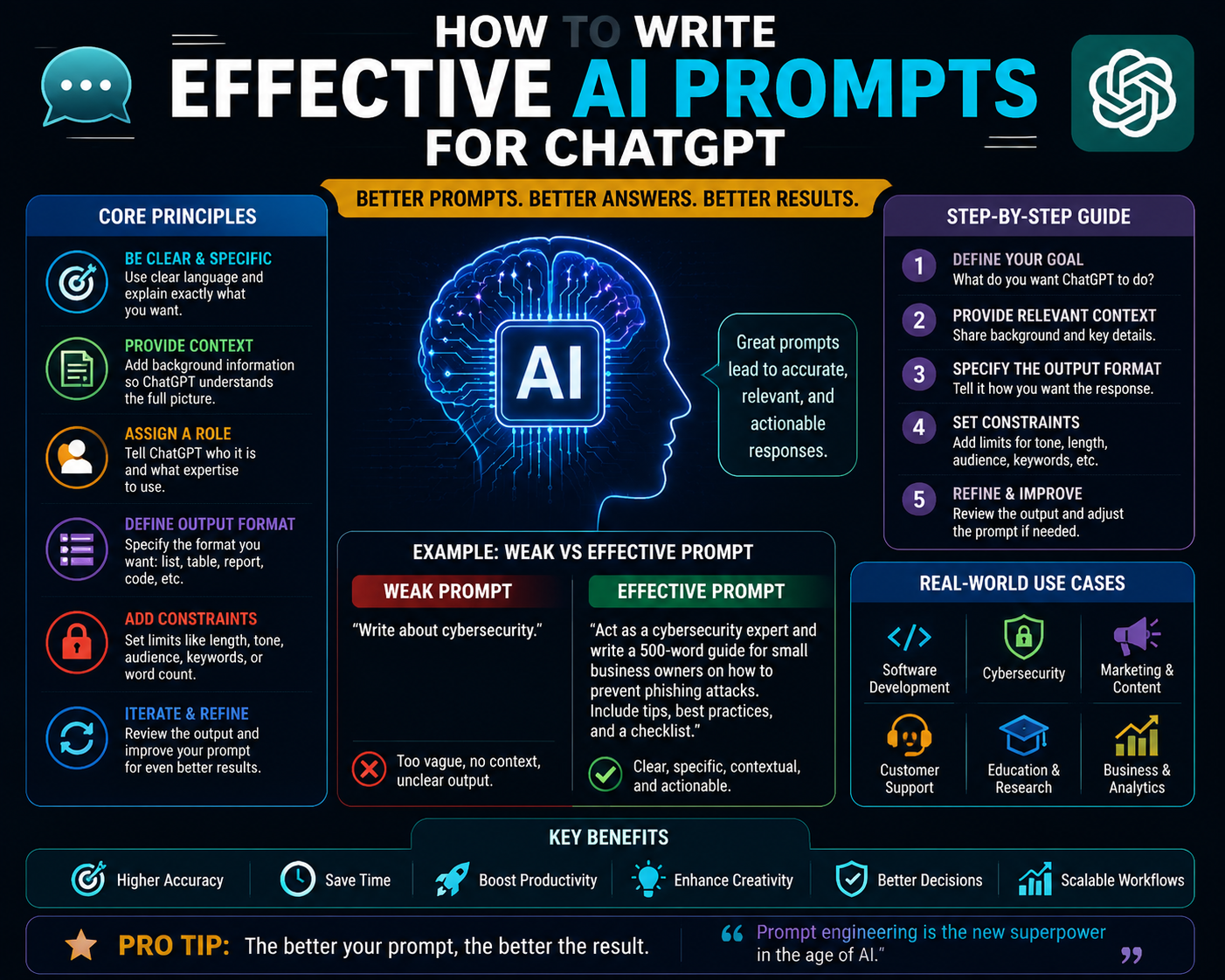
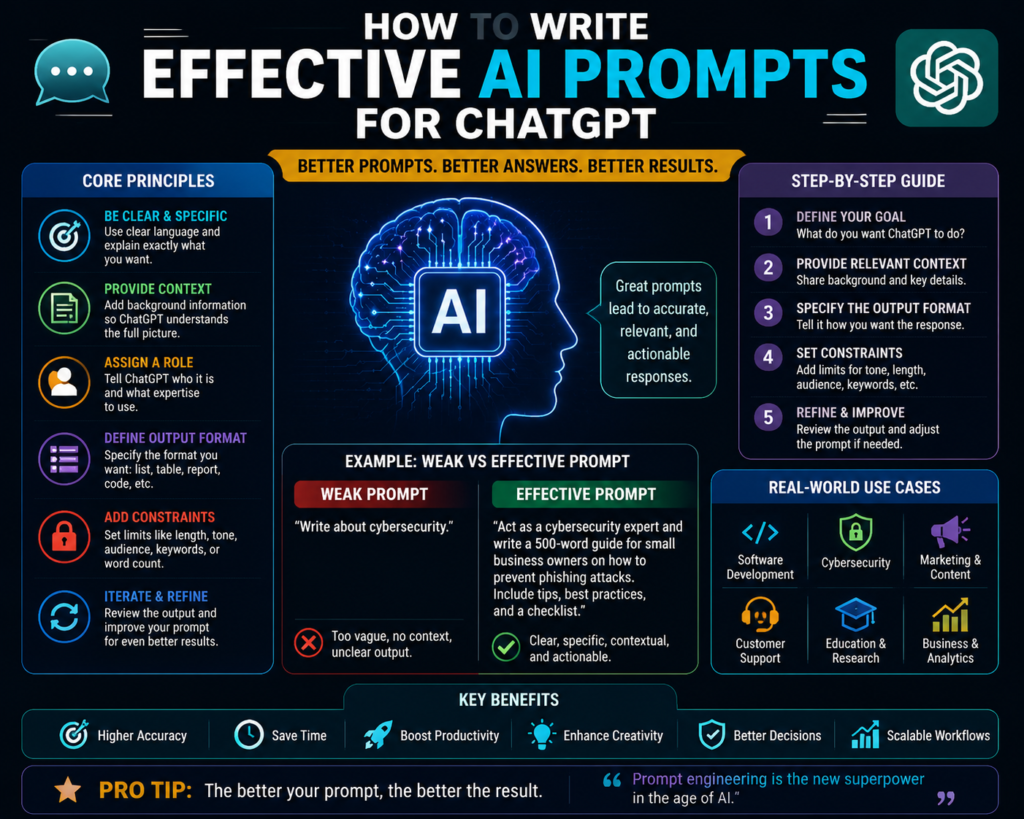
Be Clear and Specific
Avoid vague instructions. Instead, explain exactly what you want ChatGPT to do.
Weak Prompt
Write about AI.
Better Prompt
Write a 1,000-word beginner-friendly article explaining artificial intelligence in healthcare. Include examples, benefits, challenges, and a conclusion.
Specific prompts reduce ambiguity and improve the quality of the response.
Provide Context
Context helps ChatGPT understand the background and purpose of your request.
For example:
Our company provides cybersecurity services to small businesses. Create a phishing awareness email suitable for non-technical employees.
Adding context leads to more relevant and practical outputs.
Assign a Role
Role prompting encourages ChatGPT to respond from a particular perspective or area of expertise.
Examples include:
- Software engineer
- Cybersecurity analyst
- Marketing strategist
- Technical writer
- Financial consultant
- Teacher
- HR manager
Example prompt:
Act as a senior cybersecurity consultant and explain ransomware prevention for healthcare organisations.
Define the Desired Output
Tell ChatGPT how you want the information presented.
Common formats include:
- Bullet points
- Numbered lists
- Tables
- Reports
- Checklists
- Executive summaries
- Markdown
- JSON
For example:
Summarise the following report using five bullet points and include three actionable recommendations.
Add Constraints
Constraints guide ChatGPT towards producing content that matches your specific requirements.
Examples:
- Maximum word count
- Reading level
- Tone of voice
- Target audience
- Formatting rules
- Keywords to include
Example:
Write a professional LinkedIn post under 200 words promoting an AI webinar for software developers.
Step-by-Step Guide: How to Write Effective AI Prompts for ChatGPT
Step 1: Define Your Goal
Ask yourself:
- What do I want ChatGPT to produce?
- Who is the audience?
- What problem am I trying to solve?
A clear objective leads to better prompts.
Step 2: Provide Relevant Background
Include information that helps ChatGPT understand the situation.
Example:
I’m creating a beginner’s guide for small business owners who have no prior knowledge of cybersecurity.
Step 3: Specify the Output Format
Instead of asking for “an article,” specify the exact format you need.
Examples:
- Blog post
- Comparison table
- FAQ
- Checklist
- Product description
- Lesson plan
Step 4: Set Constraints
Include any limitations such as:
- Tone
- Length
- Reading level
- Keywords
- Sections to include
Step 5: Refine the Prompt
If the first response isn’t perfect, improve the prompt by adding more context or clarifying your requirements.
Prompt engineering is an iterative process.
Practical AI Prompt Examples
Content Writing
Prompt
Write a 1,500-word SEO-friendly blog post about cloud security for small businesses. Include H2 headings, FAQs, and actionable tips.
Software Development
Prompt
Act as a senior Python developer. Create a REST API using FastAPI with JWT authentication, PostgreSQL integration, logging, and unit tests.
Cybersecurity
Prompt
Review the following firewall configuration and identify potential vulnerabilities. Explain each issue and recommend secure alternatives.
Customer Support
Prompt
Respond as a friendly customer support representative. Resolve the issue professionally, apologise for the inconvenience, and provide clear next steps.
Marketing
Prompt
Create a Facebook advertisement promoting a new AI productivity tool for freelancers. Keep the tone conversational and include a strong call-to-action.
Education
Prompt
Explain machine learning to a 14-year-old using simple language, everyday examples, and a short quiz at the end.
Comparison Table: Weak vs Effective AI Prompts
| Feature | Weak Prompt | Effective Prompt |
|---|---|---|
| Clarity | Low | High |
| Context | None | Detailed |
| Role | Not specified | Clearly assigned |
| Format | Undefined | Clearly defined |
| Accuracy | Variable | Higher |
| Relevance | Generic | Targeted |
| Editing Required | High | Minimal |
Industry Insights
As generative AI adoption continues to grow, organisations are placing greater emphasis on prompt engineering as a core digital skill. Software development teams are building reusable prompt libraries for coding tasks, while marketing departments use structured prompts to maintain consistent brand messaging. Cybersecurity professionals are also using AI-assisted prompting to speed up documentation, incident reporting, and threat analysis, although expert review remains essential.
Recent AI news also highlights the increasing use of AI agents capable of handling multi-step workflows, making prompt quality more important than ever. Businesses that invest in effective prompt engineering practices are better positioned to improve productivity while maintaining accuracy, governance, and responsible AI use.
Benefits of Writing Effective AI Prompts for ChatGPT
Learning how to write effective AI prompts for ChatGPT is one of the most valuable AI skills you can develop. Well-crafted prompts not only improve the quality of AI-generated responses but also help individuals and businesses work more efficiently.
Here are the key benefits:
- Higher Accuracy: Clear prompts help ChatGPT understand your intent, resulting in more precise and relevant responses.
- Time Savings: Reduce the need for multiple revisions by providing detailed instructions from the start.
- Increased Productivity: Automate repetitive tasks such as writing emails, generating reports, creating code, and summarising documents.
- Better Content Quality: Produce well-structured articles, marketing copy, presentations, and technical documentation.
- Improved Coding Assistance: Developers can generate code snippets, debug applications, explain algorithms, and write documentation more effectively.
- Enhanced Customer Support: Businesses can create faster, more consistent responses to customer enquiries.
- Better Decision-Making: AI can analyse data, summarise information, and provide actionable insights when guided by effective prompts.
- Greater Creativity: Brainstorm ideas, generate content outlines, and develop innovative solutions across various industries.
- Scalable Workflows: Organisations can build prompt libraries to standardise AI usage across departments.
- Improved Learning: Students and professionals can receive personalised explanations, study guides, and tutorials tailored to their knowledge level.
Challenges or Limitations
Although understanding how to write effective AI prompts for ChatGPT offers many advantages, users should also be aware of its limitations.
AI Responses May Be Incorrect
Even advanced AI models can occasionally generate inaccurate or misleading information. Important outputs should always be verified using reliable sources.
Prompt Quality Matters
Vague or incomplete prompts often produce generic responses. Achieving high-quality results requires practice and experimentation.
Privacy Concerns
Avoid entering confidential business information, passwords, customer records, or sensitive personal data into AI systems unless you are using approved enterprise solutions with appropriate safeguards.
Human Oversight Is Essential
AI should support—not replace—human expertise. Professionals must review AI-generated content, especially in fields such as healthcare, finance, cybersecurity, and legal services.
Continuous Improvement
Prompt engineering is an evolving discipline. As AI technology advances, users should continue refining their prompting techniques to stay current with new capabilities.
Future Trends
The future of prompt engineering is closely tied to advances in generative AI. Several emerging trends are expected to shape how people interact with AI systems.
AI Agents
AI agents are becoming capable of handling multi-step workflows, such as planning projects, generating code, analysing data, and preparing reports with minimal human intervention.
Multimodal Prompting
Future AI systems will increasingly accept combinations of text, images, audio, video, and structured data. Prompt engineering will extend beyond text-based interactions to support richer, more versatile workflows.
Personalised AI Assistants
AI assistants are becoming more context-aware, adapting to users’ preferences, professional roles, writing styles, and recurring tasks to deliver more personalised experiences.
Enterprise Prompt Libraries
Businesses are creating centralised prompt libraries that provide approved templates for software development, customer support, cybersecurity, marketing, and documentation. These libraries improve consistency and governance across teams.
Responsible AI
Future prompt engineering will focus more on transparency, fairness, privacy, and ethical AI use. Organisations will continue developing governance frameworks to ensure AI is used responsibly.
Read More About:Best Prompt Engineering Techniques for ChatGPT in 2026
Frequently Asked Questions
1. What is an AI prompt?
An AI prompt is a question, instruction, or request given to an AI model such as ChatGPT to generate a response.
2. Why are effective prompts important?
Effective prompts provide clear objectives and context, enabling ChatGPT to generate more accurate, relevant, and useful responses.
3. Who should learn prompt engineering?
Anyone who regularly uses AI can benefit, including software developers, marketers, educators, researchers, business owners, cybersecurity professionals, students, and content creators.
4. What makes a good AI prompt?
A strong prompt typically includes:
- A clear objective
- Relevant context
- A specific role (if appropriate)
- Output format
- Constraints such as tone, length, or audience
- Examples when helpful
5. Can prompt engineering improve coding?
Yes. Developers use prompt engineering to generate code, debug applications, explain algorithms, create documentation, write unit tests, and optimise software.
6. Is ChatGPT always accurate?
No. ChatGPT can make mistakes or provide outdated information. Users should verify important facts and rely on trusted sources for critical decisions.
7. How can I improve my prompts?
Practice writing clear instructions, provide sufficient context, specify the desired output format, assign roles when appropriate, and refine prompts based on previous results.
8. Is prompt engineering only useful for ChatGPT?
No. Prompt engineering principles apply to many generative AI tools, including coding assistants, image generators, document summarisation systems, research tools, and enterprise AI platforms.
Conclusion
Understanding how to write effective AI prompts for ChatGPT is quickly becoming an essential digital skill. As generative AI becomes a routine part of software development, business operations, education, cybersecurity, and content creation, the ability to communicate effectively with AI can significantly improve productivity and the quality of results.
The most successful AI users recognise that prompt engineering is an iterative process. Clear objectives, detailed context, defined constraints, and continuous refinement consistently produce better outcomes than vague instructions. Whether you are writing code, creating marketing campaigns, analysing cybersecurity risks, or preparing business reports, effective prompts help ChatGPT deliver more relevant and actionable responses.
As AI technology continues to evolve, prompt engineering will remain a valuable capability for professionals and organisations seeking to maximise the benefits of artificial intelligence while maintaining accuracy, security, and responsible AI practices.
Key Takeaways
- Effective prompts lead to more accurate, relevant, and useful AI responses.
- Clear objectives and detailed context significantly improve ChatGPT’s performance.
- Role prompting, constraint-based prompting, few-shot prompting, and iterative refinement are among the most effective techniques.
- Prompt engineering has practical applications in software development, cybersecurity, marketing, education, customer support, and business operations.
- Human review remains essential for validating AI-generated content and making informed decisions.
- Organisations are increasingly adopting prompt libraries to standardise AI usage and improve efficiency.
- AI agents and multimodal systems will continue to expand the importance of prompt engineering.
- Responsible AI practices—including privacy, transparency, and oversight—are critical for long-term success.
- Continuous experimentation and learning will help users stay ahead as AI capabilities evolve.
- Mastering prompt engineering today prepares individuals and businesses to make the most of current and future AI technologies.