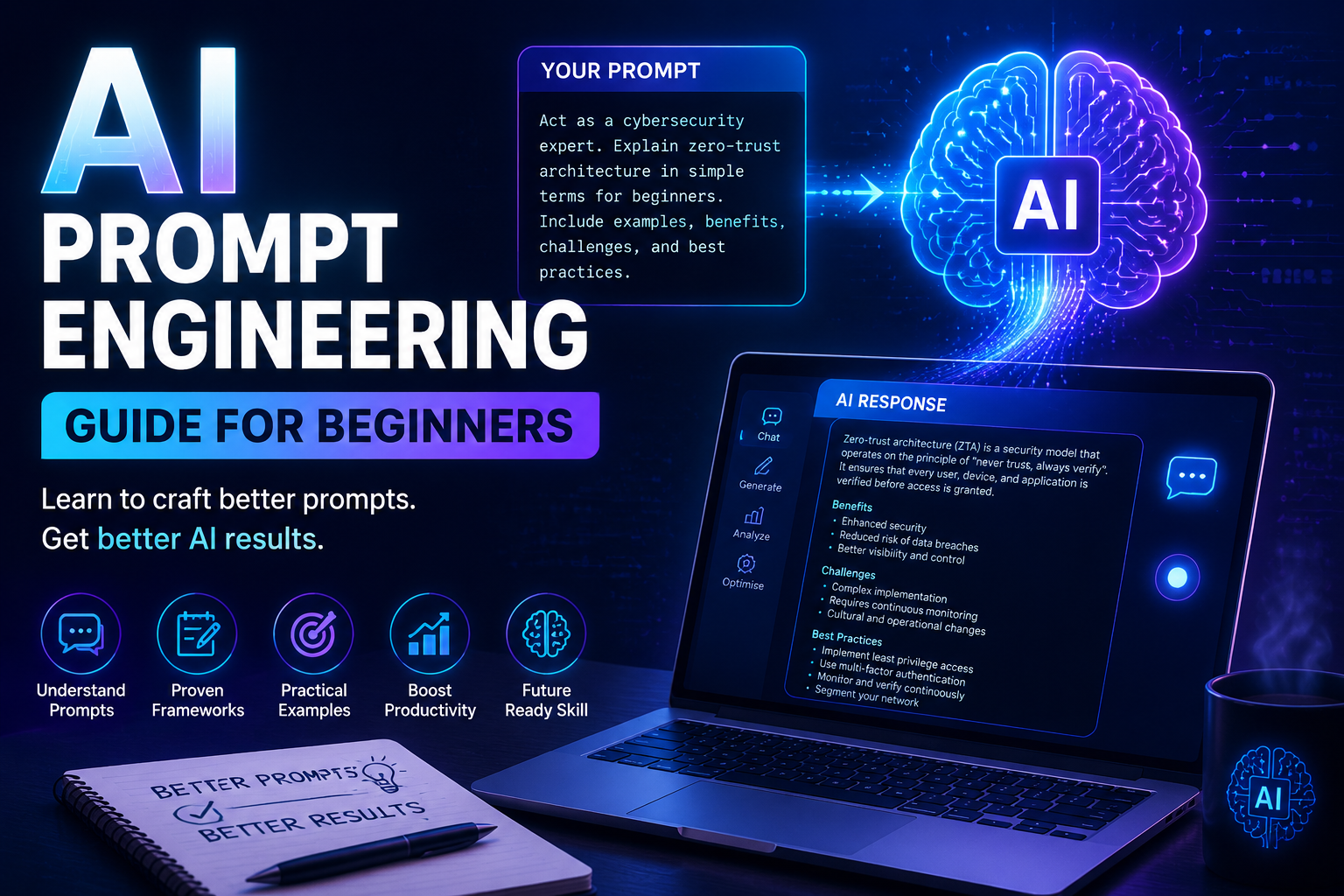

Learn the ultimate AI prompt engineering guide for beginners with practical examples, best practices, prompt frameworks, and the latest AI news to create better AI results.
Introduction
Artificial Intelligence (AI) has transformed the way people work, learn, create content, write code, analyse data, and solve complex problems. Whether you’re using ChatGPT, Claude, Gemini, Microsoft Copilot, or other large language models (LLMs), the quality of your results depends largely on one essential skill: prompt engineering.
This AI prompt engineering guide for beginners explains everything you need to know to communicate effectively with AI systems. Instead of treating AI like a search engine, prompt engineering teaches you how to provide clear instructions, context, examples, and constraints that help AI generate accurate, relevant, and useful responses.
As AI adoption continues to grow across industries—from healthcare and education to cybersecurity and software development—prompt engineering is becoming one of the most valuable digital skills. Businesses are investing in AI-powered workflows, while professionals are learning how to maximise productivity through better prompting.
In this comprehensive guide, you’ll learn what prompt engineering is, why it matters, proven prompting frameworks, practical examples, common mistakes, emerging trends, and the latest developments shaping the AI industry.
What Is AI Prompt Engineering?
Prompt engineering is the process of designing effective instructions (called prompts) that guide AI models toward producing accurate, relevant, and high-quality outputs.
A prompt can be as simple as:
“Write a blog post about renewable energy.”
Or as advanced as:
“Act as an experienced cybersecurity analyst. Explain zero-trust architecture for small businesses in simple language. Include practical examples, implementation steps, common challenges, and a comparison with traditional security models.”
The second prompt provides context, audience, role, formatting, and expectations—resulting in significantly better output.
Why Prompt Engineering Matters
Modern AI models are incredibly capable but cannot read your mind. They rely entirely on the information provided in your prompt.
Good prompts help AI:
- Understand your objective
- Identify your target audience
- Produce accurate information
- Maintain the desired tone
- Follow formatting instructions
- Reduce hallucinations
- Improve consistency
Poor prompts often produce vague, generic, or incomplete responses.
How Large Language Models Understand Prompts
Large Language Models (LLMs) predict the most likely sequence of words based on patterns learned during training.
Rather than “thinking” like humans, they interpret:
- Context
- Instructions
- Examples
- Conversation history
- Constraints
- Formatting requests
The more structured your prompt, the more predictable and useful the output becomes.
Example
Instead of asking:
Explain AI.
Try:
Explain artificial intelligence to a 14-year-old student using simple language and real-world examples. Limit the explanation to 400 words.
The improved prompt gives the AI a clear audience, scope, and writing style.
Core Components of an Effective Prompt
A high-quality prompt usually includes several essential elements.
1. Clear Objective
State exactly what you want.
Example:
- Summarise
- Translate
- Explain
- Compare
- Analyse
- Write
- Generate
- Brainstorm
2. Context
Provide background information.
Example:
This article is for small business owners with limited technical knowledge.
3. Role Assignment
Assign the AI a role.
Examples:
- Marketing expert
- Cybersecurity consultant
- Software engineer
- Data scientist
- Teacher
- Financial analyst
4. Output Format
Specify your preferred format.
Examples:
- Bullet list
- Table
- Markdown
- Blog article
- JSON
- Code
5. Constraints
Include limitations.
Examples:
- Maximum 500 words
- Beginner-friendly
- Professional tone
- Include examples
- Avoid jargon
Types of AI Prompts
Different tasks require different prompting techniques.
Zero-Shot Prompting
The AI receives instructions without examples.
Example:
Explain blockchain technology.
Best for:
- General questions
- Definitions
- Simple tasks
One-Shot Prompting
One example is provided.
Example:
Input:
Customer review:
“The delivery was late.”
Sentiment:
Negative
Now analyse:
“The product quality exceeded expectations.”
Few-Shot Prompting
Multiple examples teach the AI a pattern.
Ideal for:
- Classification
- Data extraction
- Structured outputs
- Consistent formatting
Chain-of-Thought Prompting
Encourages logical reasoning by requesting a structured explanation or step-by-step approach where appropriate.
Useful for:
- Mathematics
- Programming
- Business analysis
- Strategic planning
Role-Based Prompting
Assign a professional identity.
Example:
Act as an experienced HR manager.
This often improves relevance and consistency.
Practical Prompt Engineering Frameworks
Several frameworks help beginners write stronger prompts consistently.
RTF Framework
| Element | Description |
|---|---|
| Role | Who the AI should act as |
| Task | What the AI should accomplish |
| Format | Desired output format |
Example:
Role: SEO expert
Task: Write a product description
Format: Markdown with bullet points
CARE Framework
- Context
- Action
- Result
- Expectations
Ideal for business applications.
CO-STAR Framework
| Component | Purpose |
|---|---|
| Context | Background |
| Objective | Goal |
| Style | Writing tone |
| Tone | Professional or casual |
| Audience | Target readers |
| Response | Desired output |
This framework is popular among content marketers.
Real-World Applications of Prompt Engineering
Prompt engineering has become an essential skill across industries.
Content Marketing
Marketers use AI to:
- Generate blog ideas
- Write social media posts
- Create email campaigns
- Improve SEO
- Produce product descriptions
Software Development
Developers use prompts for:
- Code generation
- Debugging
- Documentation
- Testing
- API explanations
AI Cybersecurity
Cybersecurity teams increasingly use AI to:
- Analyse malware reports
- Summarise threat intelligence
- Generate incident reports
- Explain vulnerabilities
- Create phishing awareness materials
Human verification remains essential for security-critical work.
Education
Teachers use AI to:
- Create lesson plans
- Design quizzes
- Explain difficult topics
- Generate practice questions
- Personalise learning materials
Business Operations
Businesses automate:
- Customer support
- Internal documentation
- Report writing
- Meeting summaries
- Workflow automation
Comparison Table: Poor vs Good AI Prompts
| Poor Prompt | Better Prompt |
|---|---|
| Write about AI. | Write a 1,200-word beginner-friendly article explaining artificial intelligence, including practical examples and future applications. |
| Explain Python. | Explain Python programming for complete beginners using real-world analogies and code examples. |
| Write an email. | Write a professional follow-up email after a job interview in a polite tone with under 200 words. |
| Make a table. | Create a Markdown comparison table showing five cloud providers and their strengths. |
| Summarise this. | Summarise this report in five bullet points for senior executives. |
Common Prompt Engineering Mistakes
Many beginners make avoidable mistakes.
Being Too Vague
Bad:
Write something about AI.
Better:
Write a beginner-friendly guide explaining generative AI with practical examples.
Missing Context
Without context, AI guesses what you want.
Always explain:
- Audience
- Goal
- Industry
- Experience level
Asking Multiple Questions Simultaneously
Break complex tasks into smaller prompts.
Ignoring Output Formatting
Specify whether you want:
- Lists
- Tables
- Markdown
- JSON
- Code
- Reports
Not Refining Responses
Prompt engineering is iterative.
Ask follow-up questions like:
- Expand section three.
- Add more examples.
- Simplify the language.
- Rewrite for executives.
Prompt Engineering Best Practices
Follow these proven techniques.
- Be specific.
- Use clear instructions.
- Define your audience.
- Provide context.
- Assign a role.
- Include formatting requirements.
- Break complex problems into smaller tasks.
- Request examples.
- Fact-check important information.
- Refine prompts iteratively.
AI News and Industry Trends
The AI industry continues to evolve rapidly, making prompt engineering more valuable than ever.
Recent trends include:
- AI assistants becoming standard workplace productivity tools.
- Multimodal AI models understanding text, images, audio, and video together.
- Enterprise organisations investing heavily in AI governance and responsible AI.
- Businesses creating internal prompt libraries for consistent workflows.
- AI copilots being integrated into software development, design, finance, healthcare, and customer service.
Many organisations now recognise prompt engineering as a complementary skill alongside programming, data analysis, and digital literacy. As models become more capable, effective prompting remains crucial for obtaining reliable, context-aware outputs.
Benefits of AI Prompt Engineering
Learning prompt engineering offers numerous advantages.
Increased Productivity
Well-crafted prompts reduce editing time and improve efficiency.
Better AI Responses
Specific instructions lead to more accurate and useful outputs.
Improved Creativity
AI becomes a collaborative brainstorming partner for writers, designers, and innovators.
Cost Savings
Businesses reduce repetitive manual work through AI-assisted automation.
Easier Learning
Students and professionals receive personalised explanations tailored to their skill level.
Enhanced Decision-Making
Structured prompts can help analyse information, compare options, and generate actionable insights.
Challenges and Limitations
Despite its advantages, prompt engineering has limitations.
AI Hallucinations
AI may confidently generate incorrect or fabricated information.
Knowledge Cut-Offs
Some AI models may lack awareness of very recent events unless connected to live data.
Privacy Concerns
Avoid entering confidential business information or personal data into AI systems without understanding the platform’s privacy policies.
Prompt Sensitivity
Small wording changes can significantly affect outputs.
Human Oversight Is Essential
AI should support—not replace—critical thinking, especially in fields such as healthcare, finance, law, and cybersecurity.
Future Trends in Prompt Engineering
Prompt engineering will continue evolving alongside AI technology.
Natural Language Interfaces
AI models are becoming better at understanding conversational instructions, reducing the need for overly complex prompts.
Multimodal Prompting
Users will increasingly combine text, images, voice, and video in a single prompt to achieve richer outcomes.
AI Agents
Autonomous AI agents will perform multi-step tasks with minimal human intervention, relying on sophisticated prompt design and planning.
Domain-Specific Prompt Libraries
Industries such as healthcare, finance, legal services, and cybersecurity are building reusable prompt templates tailored to specialised workflows.
Prompt Optimisation Tools
AI-powered tools are emerging that automatically evaluate, refine, and optimise prompts for better performance, making advanced prompt engineering more accessible.
Read More About:Future of Prompt Engineering in Artificial Intelligence
Frequently Asked Questions (FAQ)
1. What is prompt engineering in AI?
Prompt engineering is the practice of designing clear, structured instructions that help AI systems generate accurate, relevant, and high-quality responses.
2. Do I need programming skills to learn prompt engineering?
No. Most prompt engineering techniques rely on effective communication rather than coding. Anyone who can write clear instructions can learn the fundamentals.
3. Which AI tools use prompt engineering?
Popular AI platforms include ChatGPT, Claude, Gemini, Microsoft Copilot, Perplexity AI, Midjourney, and many enterprise AI assistants.
4. Is prompt engineering a good career skill?
Yes. As AI adoption expands, professionals across marketing, software development, cybersecurity, education, and business increasingly benefit from strong prompting skills.
5. Can prompt engineering improve AI accuracy?
Yes. Providing context, clear objectives, formatting requirements, and constraints often results in more accurate, relevant, and consistent outputs. However, users should still verify important facts.
6. Is prompt engineering only useful for text generation?
No. Prompt engineering also supports image generation, coding assistance, data analysis, workflow automation, research, customer support, and multimodal AI applications.
7. How can beginners improve their prompting skills?
Start with simple prompts, add context, specify the desired output, experiment with different frameworks, review the AI’s responses, and refine your prompts through iteration.
Conclusion
Prompt engineering has become one of the most valuable skills in the modern AI era. Whether you’re a student, developer, marketer, cybersecurity professional, business owner, or technology enthusiast, learning how to communicate effectively with AI can significantly improve the quality of your results.
By understanding prompt structure, applying proven frameworks, providing clear context, and refining prompts through experimentation, you can unlock the full potential of today’s AI tools. While AI continues to evolve rapidly, the principles of effective prompting—clarity, specificity, context, and verification—remain essential.
As AI capabilities expand into multimodal systems, intelligent agents, and enterprise workflows, prompt engineering will continue to play a central role in helping humans collaborate efficiently with intelligent systems. Investing time in mastering this skill today will prepare you for the increasingly AI-powered future of work and innovation.
Key Takeaways
- Prompt engineering is the practice of creating effective instructions for AI systems.
- Clear, detailed prompts produce more accurate and relevant AI responses.
- Strong prompts include objectives, context, audience, role, formatting, and constraints.
- Popular frameworks such as RTF, CARE, and CO-STAR help structure prompts effectively.
- Prompt engineering is valuable across content creation, software development, education, business, and AI cybersecurity.
- Beginners can improve rapidly through experimentation and iterative refinement.
- Human oversight remains essential to verify AI-generated information and reduce errors.
- Multimodal AI, AI agents, and prompt optimisation tools are shaping the future of prompt engineering.
- Mastering prompt engineering is an increasingly valuable skill as AI adoption accelerates across industries.