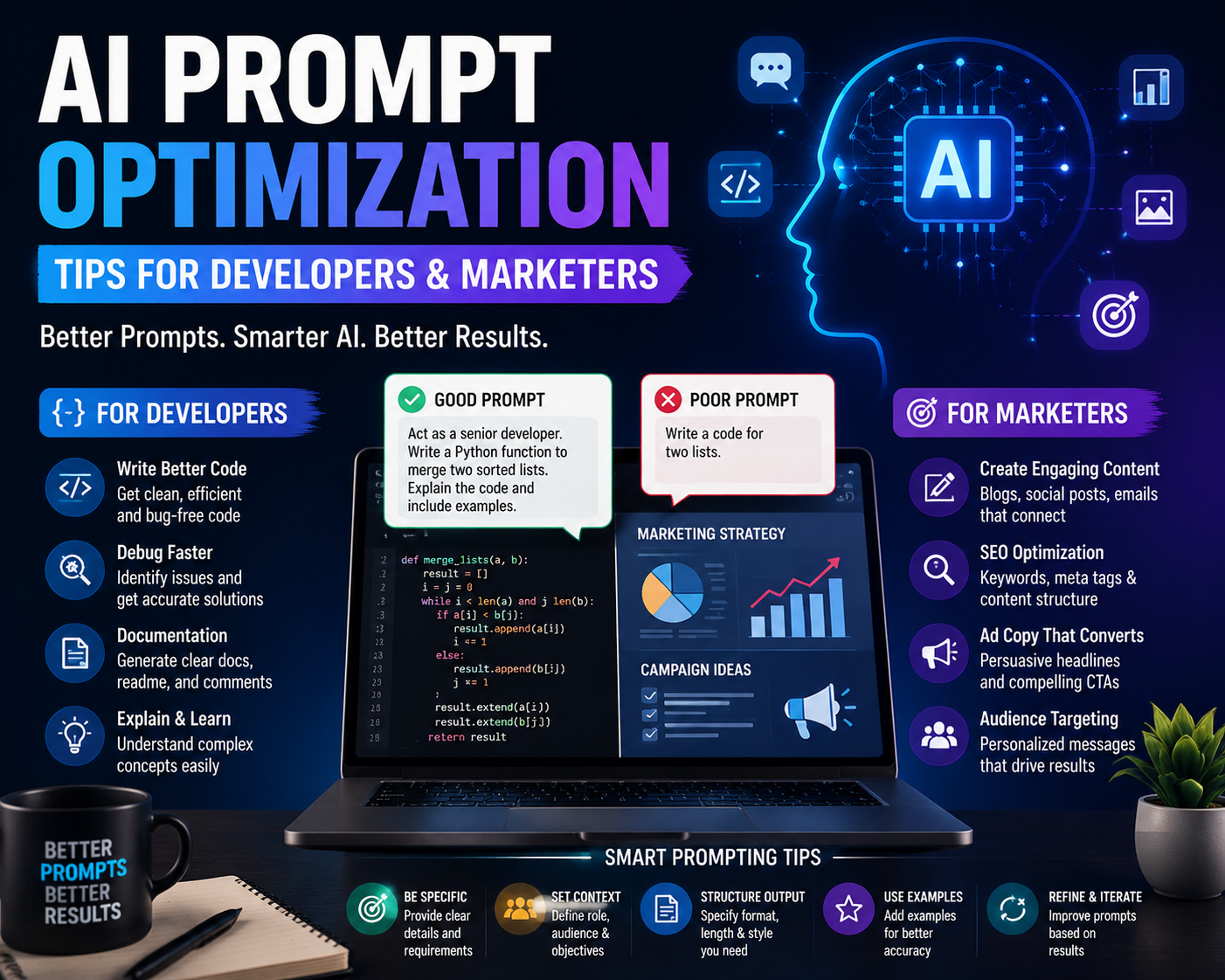

Discover the best AI prompt optimization tips for developers and marketers. Learn proven strategies, examples, and best practices to improve AI-generated content and productivity.
AI Prompt Optimization Tips for Developers and Marketers
Artificial intelligence has transformed how developers write code, marketers create campaigns, and businesses automate daily tasks. However, the quality of AI-generated results depends heavily on one critical factor—the prompt. Even the most advanced AI model cannot consistently deliver accurate, useful, or creative responses if the instructions are vague or incomplete. That’s why mastering AI prompt optimization tips for developers and marketers has become an essential skill in 2026.
Prompt optimization is the process of designing clear, detailed, and structured instructions that guide AI toward producing better outputs. Whether you’re generating blog articles, writing software code, creating marketing emails, analyzing data, or building customer support chatbots, optimized prompts save time, improve quality, and reduce unnecessary revisions.
Developers use prompt engineering to generate cleaner code, debug applications, and automate documentation, while marketers rely on optimized prompts to create SEO-friendly content, compelling advertisements, social media campaigns, and personalized email sequences. As AI continues to evolve, prompt optimization is becoming just as valuable as knowing how to use the tools themselves.
This guide explores the most effective AI prompt optimization tips for developers and marketers, practical techniques, real-world examples, and strategies to help you achieve better AI results consistently.
What Is AI Prompt Optimization?
AI prompt optimization is the practice of improving the structure, clarity, and context of prompts so artificial intelligence can generate more accurate, relevant, and useful responses.
Instead of asking AI a simple question like:
“Write a blog.”
An optimized prompt would be:
“Write a 1,500-word SEO-optimized blog for beginners about cloud cybersecurity. Use H2 and H3 headings, include examples, FAQs, and maintain a professional yet friendly tone.”
The second prompt provides clear expectations, resulting in significantly higher-quality output.
Why Prompt Optimization Matters
Whether you’re a developer or a marketer, optimized prompts can dramatically improve productivity and content quality.
Better Accuracy
Detailed prompts reduce ambiguity, helping AI understand exactly what you’re trying to accomplish.
Higher Productivity
Well-structured prompts reduce editing time and eliminate the need for multiple revisions.
More Relevant Results
Providing context enables AI to generate responses that better match your audience, goals, and industry.
Improved Creativity
Clear instructions encourage AI to generate innovative ideas while staying aligned with your objectives.
Consistent Outputs
Standardized prompts help teams maintain consistent tone, formatting, and quality across projects.
Core Principles of Effective AI Prompting
Successful prompt optimization follows several key principles.
Be Clear and Specific
Avoid vague instructions.
Instead of:
“Write about AI.”
Try:
“Write a beginner-friendly article explaining how AI improves email marketing automation for small businesses.”
Specific prompts produce better outcomes.
Provide Context
Tell AI who the audience is, what the purpose is, and how the response should be structured.
Example:
- Target audience
- Industry
- Reading level
- Desired tone
- Word count
- Output format
The more relevant context you provide, the more useful the response becomes.
Define the Role
Assigning a role helps AI tailor its response.
Examples include:
- Act as a cybersecurity analyst.
- Act as a senior software engineer.
- Act as an experienced SEO strategist.
- Act as a technical documentation writer.
- Act as a digital marketing consultant.
Role-based prompting often produces more focused and accurate outputs.
Specify the Output Format
Clearly define how you want the information presented.
Examples:
- Markdown
- Bullet points
- Comparison table
- Numbered list
- JSON
- HTML
- Python code
- Executive summary
Formatting instructions save time during editing.
AI Prompt Optimization Tips for Developers
Developers can use optimized prompts to improve coding efficiency, debugging, documentation, and testing.
Describe the Programming Environment
Always specify:
- Programming language
- Framework
- Library versions
- Operating system
- Dependencies
Example:
“Generate a REST API using Python Flask compatible with Python 3.12.”
This eliminates unnecessary assumptions.
Include Existing Code
When debugging, provide the relevant code snippet and explain:
- Expected behavior
- Actual behavior
- Error messages
- Constraints
This helps AI identify issues more accurately.
Define Performance Requirements
Mention requirements such as:
- Speed
- Security
- Scalability
- Memory efficiency
- Cross-platform compatibility
These details influence the quality of generated solutions.
Request Explanations
Instead of only asking for code, request explanations.
Example:
“Explain why each function is necessary and suggest optimization opportunities.”
This improves learning and code maintainability.
AI Prompt Optimization Tips for Marketers
Marketers can significantly improve campaign quality through better prompting.
Define the Target Audience
Specify:
- Age
- Industry
- Location
- Experience level
- Pain points
- Goals
Example:
“Write a LinkedIn post targeting SaaS founders interested in AI-powered marketing automation.”
Specify Brand Voice
Include guidance such as:
- Professional
- Friendly
- Conversational
- Technical
- Inspirational
- Luxury
- Casual
Consistent tone strengthens brand identity.
Include SEO Requirements
For SEO content, mention:
- Primary keyword
- Secondary keywords
- Meta description
- Heading structure
- FAQ section
- Internal linking opportunities
These instructions produce search-friendly content.
Request Multiple Variations
Instead of generating one version, ask AI to create several options.
Example:
- Three headlines
- Five CTAs
- Two introductions
- Multiple social media captions
This gives marketers greater flexibility.
Comparison Table: Basic vs Optimized Prompts
| Prompt Type | Basic Prompt | Optimized Prompt |
|---|---|---|
| Blog Writing | Write a blog about AI. | Write a 2,000-word SEO blog about AI in healthcare for beginners using H2s, FAQs, and examples. |
| Coding | Build a website. | Build a responsive React landing page using Tailwind CSS with accessibility best practices. |
| Marketing | Write an email. | Create a promotional email for B2B SaaS customers announcing a new AI feature with a persuasive CTA. |
| Social Media | Write a post. | Write three engaging LinkedIn posts targeting digital marketers interested in AI automation. |
| Customer Support | Answer customer questions. | Create professional support responses for subscription billing issues using an empathetic tone. |
Real-World Use Cases
Software Development
Development teams use optimized prompts to:
- Generate boilerplate code
- Debug applications
- Write API documentation
- Create automated tests
- Refactor legacy code
Content Marketing
Marketing agencies use AI prompts to:
- Produce SEO articles
- Generate social media calendars
- Write email campaigns
- Create ad copy
- Develop landing pages
Customer Support
Businesses automate responses by generating:
- FAQ answers
- Live chat responses
- Troubleshooting guides
- Product documentation
Business Intelligence
AI assists analysts by:
- Summarizing reports
- Explaining datasets
- Creating executive summaries
- Identifying trends
Common Prompting Mistakes
Even experienced users make prompting mistakes that reduce AI performance.
Common issues include:
- Writing vague or overly broad prompts.
- Omitting important context or objectives.
- Forgetting to define the target audience.
- Ignoring formatting requirements.
- Asking multiple unrelated questions in a single prompt.
- Not specifying the desired tone or style.
- Assuming AI knows project-specific details without providing them.
- Publishing AI-generated content without reviewing it for accuracy.
Avoiding these mistakes leads to more reliable, consistent, and valuable AI outputs.
Benefits of AI Prompt Optimization for Developers and Marketers
Applying AI prompt optimization tips for developers and marketers delivers measurable improvements in productivity, content quality, and overall workflow efficiency. Well-designed prompts help users get more accurate and relevant responses while reducing time spent on revisions.
Faster Task Completion
Clear prompts reduce back-and-forth interactions with AI. Whether you’re generating code, writing a blog post, or creating an email campaign, optimized prompts help you reach the desired result more quickly.
Higher-Quality Outputs
Detailed instructions enable AI to produce content that is more accurate, better structured, and aligned with your goals. Developers receive cleaner code, while marketers create more engaging campaigns.
Improved SEO Performance
For content creators, prompt optimization makes it easier to generate articles with:
- Well-organized heading structures
- Natural keyword placement
- Optimized meta titles and descriptions
- FAQ sections
- Readable formatting
These elements support better search engine visibility and user engagement.
Increased Consistency
Teams can create reusable prompt templates to maintain consistent writing style, formatting, and messaging across multiple projects and clients.
Better Collaboration
Standardized prompts make it easier for developers, marketers, designers, and project managers to work together efficiently and achieve predictable results.
Enhanced Learning
Requesting explanations alongside AI-generated answers helps users understand concepts, improve technical skills, and make better decisions over time.
Challenges and Limitations
Although AI prompt optimization tips for developers and marketers can significantly improve AI-generated results, there are still limitations to consider.
Prompt Quality Determines Output
AI follows the instructions it receives. Poorly written prompts often lead to incomplete, inaccurate, or irrelevant responses.
Hallucinations
AI models may occasionally generate incorrect facts or misleading information. Human review and fact-checking remain essential before publishing content or deploying code.
Limited Business Context
Unless provided with sufficient background, AI may not fully understand your organization’s products, customers, or internal processes.
Continuous Learning Required
AI technology evolves rapidly. Developers and marketers need to stay updated on new prompting techniques, platform capabilities, and best practices.
Ethical Considerations
Users should avoid generating misleading, plagiarized, or harmful content. Responsible AI usage includes transparency, human oversight, and compliance with applicable laws and industry standards.
Future Trends
The future of prompt optimization is evolving alongside advances in artificial intelligence.
Conversational Prompting
Future AI systems will rely less on perfectly crafted prompts and more on natural conversations, making interactions feel more intuitive while still benefiting from clear instructions.
Multimodal Prompting
AI platforms increasingly support prompts that combine text, images, audio, video, and documents. This allows users to create richer content and solve more complex tasks.
AI Prompt Libraries
Organizations are building centralized prompt libraries containing tested templates for common tasks such as coding, marketing campaigns, customer support, and technical documentation.
Personalized AI Assistants
AI systems will adapt to individual users by learning preferred writing styles, coding standards, workflows, and business objectives, reducing the need to repeat instructions.
Autonomous AI Workflows
Instead of completing single tasks, AI agents will manage entire workflows, including research, drafting, editing, testing, publishing, and reporting with minimal human intervention.
Expert Insights
Experienced AI users consistently follow several best practices to maximize results.
- Clearly define the objective before writing a prompt.
- Break complex tasks into smaller, manageable steps.
- Include examples whenever possible.
- Specify formatting requirements such as Markdown, HTML, JSON, or tables.
- Review AI-generated content for factual accuracy and relevance.
- Refine prompts based on previous outputs to improve future performance.
- Treat prompt engineering as an iterative process rather than a one-time task.
Organizations that document and reuse successful prompts often see significant gains in productivity and consistency across teams.
Read More About:AI Content Marketing Automation Tools for Agencies
Frequently Asked Questions
1. What is AI prompt optimization?
AI prompt optimization is the process of writing clear, structured, and detailed instructions that help AI systems generate more accurate, relevant, and useful responses.
2. Why is prompt optimization important?
Optimized prompts improve output quality, reduce editing time, increase productivity, and help AI better understand your goals, audience, and desired format.
3. Can prompt optimization improve SEO content?
Yes. Well-crafted prompts can instruct AI to include keyword optimization, proper heading structures, FAQs, metadata, readability improvements, and search intent alignment.
4. Do developers benefit from prompt engineering?
Absolutely. Developers use optimized prompts to generate code, debug applications, explain algorithms, create documentation, write tests, and improve software quality.
5. How do marketers use AI prompt optimization?
Marketers use optimized prompts to create blog posts, email campaigns, ad copy, social media content, product descriptions, landing pages, and marketing strategies more efficiently.
6. Is prompt optimization difficult to learn?
No. Beginners can quickly improve by focusing on clarity, context, audience, desired output, and specific instructions. Practice and experimentation lead to better results over time.
7. Can AI replace human creativity?
AI is a powerful productivity tool, but it cannot fully replace human creativity, strategic thinking, emotional intelligence, or industry expertise. The best outcomes come from combining AI assistance with human judgment.
8. What makes a good AI prompt?
A strong prompt clearly defines the task, audience, context, format, tone, goals, constraints, and expected output. Including examples can further improve response quality.
Conclusion
Mastering AI prompt optimization tips for developers and marketers is one of the most valuable skills in today’s AI-driven workplace. Whether you’re writing software, creating marketing campaigns, producing SEO content, or automating business processes, the quality of your prompts directly influences the quality of AI-generated results.
Effective prompt optimization goes beyond asking better questions. It involves providing context, defining objectives, specifying formatting requirements, and continuously refining prompts based on previous outcomes. This structured approach improves accuracy, saves time, and enables teams to work more efficiently.
As AI technologies continue to advance, prompt engineering will remain a critical capability for professionals across industries. Developers, marketers, business owners, and content creators who invest in learning prompt optimization techniques will be better equipped to leverage AI responsibly, improve productivity, and deliver greater value to their organizations.
Key Takeaways
- AI prompt optimization tips for developers and marketers help improve AI accuracy, relevance, and efficiency.
- Clear, detailed prompts reduce revisions and save valuable time.
- Providing context, audience details, tone, and formatting instructions leads to higher-quality outputs.
- Developers can use optimized prompts for coding, debugging, testing, and documentation.
- Marketers benefit from AI-assisted content creation, SEO optimization, email campaigns, and social media planning.
- Human review remains essential to ensure factual accuracy, originality, and ethical AI usage.
- Future AI systems will support conversational prompting, multimodal inputs, personalized assistants, and autonomous workflows.
- Organizations that develop standardized prompt libraries and continuously refine their prompting strategies will gain a lasting competitive advantage in the evolving AI landscape.