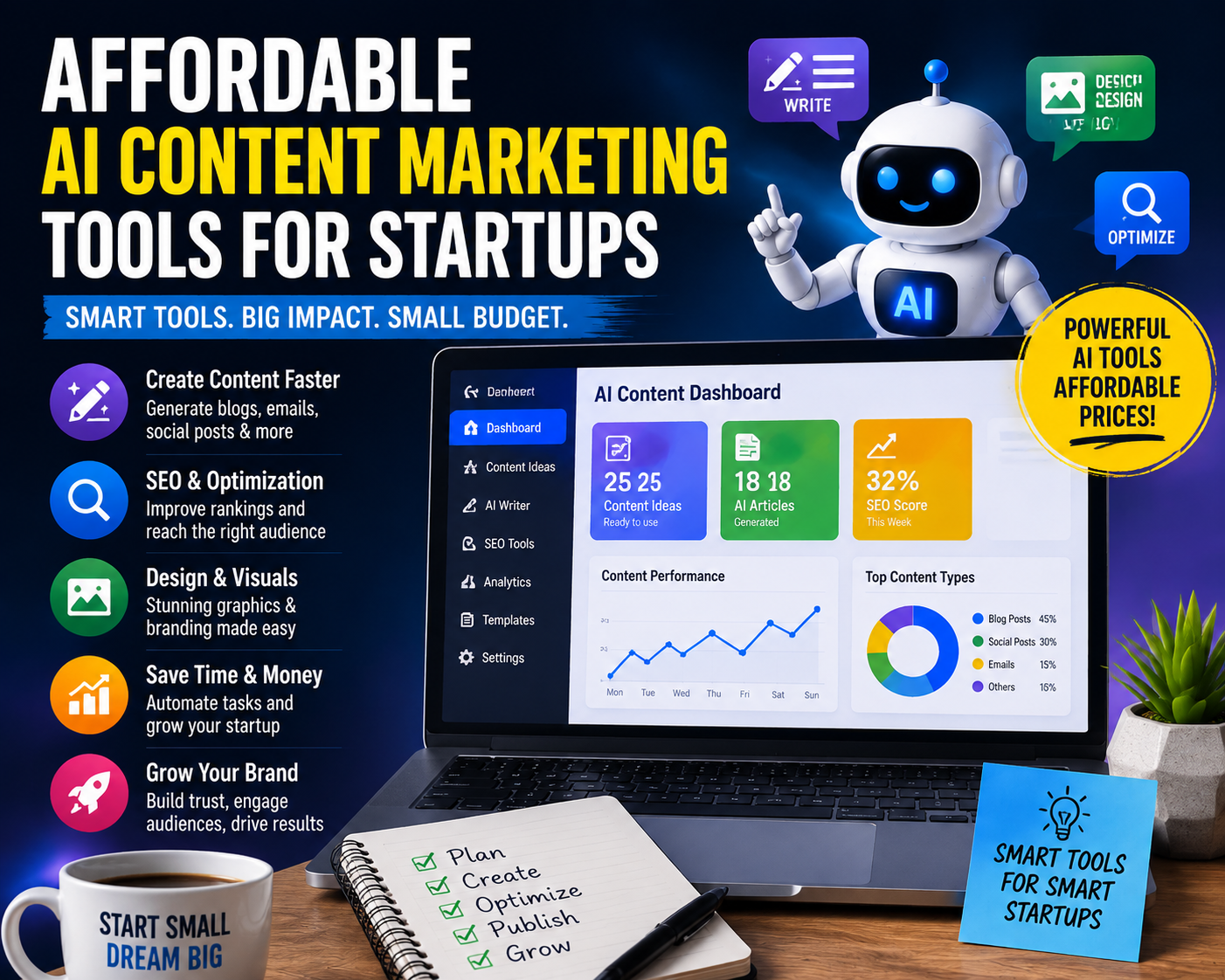

Discover affordable AI content marketing tools for startups that help create, optimize, and distribute quality content while saving time and marketing costs.
Introduction
For a startup, every marketing dollar matters. Small teams often need to publish blog posts, social media updates, email campaigns, landing pages, product descriptions, and visual content without having the budget to hire a large marketing department. This is where affordable AI content marketing tools for startups can make a meaningful difference.
Modern AI marketing software can help founders and small teams brainstorm ideas, create first drafts, improve existing copy, repurpose content, design graphics, and organize marketing workflows. However, the cheapest tool is not automatically the best choice. A startup needs software that saves time without creating more editing, fact-checking, or brand-management work.
The good news is that startups do not necessarily need an expensive collection of specialized platforms. A carefully selected combination of an AI writing assistant, content-management platform, design tool, and proofreading solution can cover many everyday marketing tasks.
In this guide, we’ll examine practical options, compare their strengths, explain where they fit into a startup workflow, and discuss the limitations you should understand before spending money.
What Are AI Content Marketing Tools?
AI content marketing tools use artificial intelligence to assist with tasks involved in planning, creating, editing, optimizing, and distributing marketing content.
Depending on the platform, an AI tool may help you:
- Generate blog outlines.
- Draft articles.
- Create social media captions.
- Write email campaigns.
- Rewrite landing-page copy.
- Develop advertising variations.
- Repurpose existing content.
- Improve grammar and readability.
- Create images and branded graphics.
- Research topics and customer questions.
- Optimize content for search.
- Build repeatable marketing workflows.
For startups, the main attraction is leverage. One marketer can potentially handle a wider range of tasks when AI takes care of repetitive first-draft and editing work.
However, AI should not remove human judgment from the process. A useful workflow is usually AI-assisted rather than AI-only. Human marketers still need to provide customer knowledge, product expertise, original examples, fact checking, positioning, and final editorial approval.
Why Startups Are Using AI for Content Marketing
Startups typically face three marketing constraints: limited time, limited people, and limited budget.
AI tools can address parts of all three.
Faster Content Production
Creating a first draft from a blank page can take much longer than editing a useful draft. AI can help generate outlines, headlines, introductions, social posts, email variations, and other starting points.
That does not mean the first output should automatically be published. Instead, it gives the marketer something concrete to improve.
More Content From Existing Assets
A startup may already have valuable material hidden inside:
- Product documentation
- Customer interviews
- Webinar recordings
- Sales calls
- Case studies
- Blog posts
- Founder presentations
- Research reports
AI can help transform one long-form asset into several smaller pieces.
For example, a 1,500-word product article could become:
- Five LinkedIn posts.
- Three email ideas.
- A short newsletter.
- Ten social-media hooks.
- A sales-team summary.
- An FAQ section.
- A video script.
This repurposing ability can be more valuable than simply generating more articles.
Best Affordable AI Content Marketing Tools for Startups
The best platform depends on your workflow rather than the number of AI features advertised on its homepage.
Here are several options worth considering in 2026.
1. ChatGPT
ChatGPT is one of the most flexible choices for startups because it can support many marketing tasks from a single workspace.
It can help with:
- Content ideation
- Blog outlines
- Drafting
- Email campaigns
- Social content
- Competitive research
- Customer-persona exercises
- Content briefs
- Data analysis
- Content repurposing
- Marketing brainstorming
The free version is available, while ChatGPT Business is designed for teams. OpenAI currently lists Business at $20 per user per month when billed annually, with a two-user minimum; monthly billing is listed at $25 per user. Business also includes centralized administration, usage controls, and a shared workspace. (OpenAI Help Center)
For a very small startup, however, paying for a team plan may not be necessary immediately.
Best for: Startups wanting one general-purpose AI assistant.
Main advantage: Versatility.
Potential limitation: It does not automatically replace a complete SEO, publishing, analytics, or marketing automation stack.
2. HubSpot AI Content Tools
HubSpot is particularly interesting for startups that want AI content creation connected to marketing and CRM workflows.
HubSpot provides free AI content features that can help generate blogs, website copy, social posts, emails, and other marketing materials. The company says its free AI content writer can be used without a credit card, while more advanced functionality is available in paid editions. (HubSpot)
HubSpot’s current Content Hub pricing lists a free plan, while Starter begins at $7 per seat per month on annual commitment and Professional starts at $450 per month. (HubSpot)
For an early-stage company, the important point is that you can begin with free capabilities rather than immediately committing to an expensive marketing platform.
Best for: Startups that want content creation alongside CRM and marketing tools.
Main advantage: Strong connection between content and customer-management workflows.
Potential limitation: Advanced features can become substantially more expensive as your requirements grow.
3. Canva
Canva is useful when your content strategy requires visual assets as well as written content.
Startups can use Canva for:
- Social graphics
- Blog graphics
- Presentations
- Infographics
- Advertisements
- Short videos
- Lead magnets
- Pitch decks
- Branded templates
Canva’s current platform includes AI features such as Canva AI, Magic Write, Magic Resize, Magic Edit, Magic Eraser, and other AI-powered design capabilities, with availability depending on the plan. Canva also offers a free plan. (Canva)
This makes Canva particularly useful for small teams that do not have a dedicated designer.
Best for: Visual content and brand assets.
Main advantage: Combines design and AI assistance in one environment.
Potential limitation: AI-generated visuals and copy still need brand review.
4. Grammarly
Grammarly is less about generating an entire content strategy and more about improving the quality of the writing your startup already produces.
It can help marketers:
- Correct grammar.
- Improve sentence clarity.
- Adjust tone.
- Rewrite sentences.
- Make copy more concise.
- Generate text.
- Check originality-related concerns through available features.
Grammarly currently lists a free plan and a Pro plan at an annual average of $12 per member per month, with monthly and quarterly billing options also available. (Grammarly Support)
For startups with multiple people writing emails, documentation, sales copy, and social content, an editing assistant can provide significant value.
Best for: Editing and polishing AI-assisted or human-written content.
Main advantage: Helps improve clarity and consistency.
Potential limitation: It is not a complete content strategy or marketing automation platform.
5. Copy.ai
Copy.ai focuses heavily on AI workflows and go-to-market processes.
Its current pricing page lists a small-team Chat plan at $29 per month when billed monthly or $24 per month when billed annually, with five seats and access to multiple AI models. Higher workflow-oriented plans are substantially more expensive. (Copy.ai)
Copy.ai can be useful for startups that want repeatable processes rather than isolated prompts.
For example, a startup could develop a workflow for turning a product announcement into:
- A blog outline.
- An email draft.
- Social posts.
- Sales messaging.
- Customer-facing announcements.
Best for: Repeatable content and go-to-market workflows.
Main advantage: Workflow automation.
Potential limitation: Advanced automation can become expensive as usage and team requirements increase.
6. Writesonic
Writesonic combines AI content creation with SEO and AI-search visibility features.
Its current pricing page lists a Starter plan at $99 monthly or $79 per month when billed annually. The plan includes AI articles and site-audit capabilities, while higher plans add more content, users, and AI-search visibility functionality. (Writesonic)
This makes Writesonic more appropriate for startups that already have a meaningful SEO strategy and need more specialized content capabilities.
Best for: SEO-focused startups.
Main advantage: Combines content and search-visibility functions.
Potential limitation: It may be more expensive than a general-purpose AI assistant for startups that only need occasional content creation.
Comparison Table
| Tool | Best Use | Startup-Friendly Starting Point | Key Strength | Best For |
|---|---|---|---|---|
| ChatGPT | Writing and strategy | Free / paid plans | Versatility | Small marketing teams |
| HubSpot | Content + CRM | Free | Marketing ecosystem | Growing startups |
| Canva | Visual content | Free | Design + AI | Social teams |
| Grammarly | Editing | Free | Writing quality | Content teams |
| Copy.ai | Workflows | $24/mo annual plan | Automation | GTM teams |
| Writesonic | SEO content | $79/mo annual Starter | SEO + AI search | Content-led startups |
Pricing and features can change, so startups should verify current plan details before purchasing.
How to Choose the Right AI Marketing Tool
The best affordable AI content marketing tools for startups are not necessarily the ones with the longest feature lists.
Instead, evaluate each platform against your actual workflow.
Consider Your Monthly Content Volume
If you publish two blog posts a month, an expensive content platform may be unnecessary.
If you publish dozens of articles, newsletters, social posts, and landing pages, specialized automation may become more valuable.
Consider Your Existing Software
Avoid paying for duplicate functionality.
For example, if your team already uses a CRM with built-in AI writing features, adding another general writing platform may provide limited incremental value.
Look at Human Editing Time
This is one of the most important measurements.
A tool that generates 10 articles quickly but requires hours of rewriting may be less valuable than a tool that produces fewer but more useful drafts.
Track:
Time saved = Previous production time − AI-assisted production time
Then compare that number with the monthly software cost.
Evaluate Brand Voice
Startup marketing should sound like the company, not like generic AI copy.
Before choosing a tool, test whether it can consistently follow:
- Brand terminology
- Tone guidelines
- Product positioning
- Audience language
- Formatting preferences
- Messaging restrictions
Benefits of Affordable AI Content Marketing Tools for Startups
Lower Content Production Costs
AI can reduce the amount of manual work required for repetitive content tasks.
It does not necessarily eliminate marketing jobs. Instead, it can allow a small team to spend more time on strategy, customer research, creative direction, and distribution.
Faster Experimentation
Startups need to test messaging quickly.
AI can create multiple headline, email, landing-page, or advertisement variations that marketers can then evaluate.
Better Content Repurposing
One strong piece of original content can become multiple assets.
This improves the return on the research and creative work that went into the original material.
Easier Access to Professional-Looking Design
Visual AI and design tools make it easier for small businesses to create polished graphics without hiring a designer for every asset.
More Consistent Workflows
Workflow-oriented tools can turn repeated processes into documented systems.
That becomes particularly useful when a startup adds new marketers or contractors.
Challenges and Limitations
AI marketing tools are powerful, but they are not risk-free.
Generic Content
If every startup uses similar prompts and the same AI models, content can begin to sound interchangeable.
The solution is to add original information, customer stories, product experience, expert opinions, data, and strong editorial direction.
Fact-Checking
AI systems can produce incorrect information.
This matters especially when writing about:
- Technology
- Cybersecurity
- Finance
- Healthcare
- Legal topics
- Current AI news
Always verify important claims against reliable primary sources.
Brand Dilution
Publishing unedited AI copy can make a startup sound less human.
A strong editorial process should include human review before publication.
Privacy Concerns
Do not automatically place confidential customer information, proprietary business data, credentials, or sensitive internal documents into consumer AI tools.
Review each platform’s current data-handling terms and select business-grade options when appropriate.
Subscription Creep
One of the biggest mistakes startups make is subscribing to too many AI tools.
A company might eventually pay for:
- An AI writer
- An SEO platform
- A design platform
- A grammar checker
- A social scheduler
- An analytics platform
- An automation tool
The combined monthly cost can become significant.
Start with one or two tools and expand only when a clear workflow requires it.
A Practical AI Content Workflow for Startups
Instead of trying to automate everything, start with a simple process.
Step 1: Research the Audience
Identify customer questions, objections, problems, and desired outcomes.
Step 2: Build the Content Brief
Use an AI assistant to organize the topic, search intent, audience, key questions, and proposed structure.
Step 3: Add Original Information
Give the draft real company knowledge:
- Customer examples
- Product experience
- Founder insights
- Original research
- Internal data
- Expert commentary
Step 4: Generate a First Draft
Use your selected AI tool to create the initial version.
Step 5: Human Edit
Check facts, remove generic language, improve examples, and make sure the article sounds like your company.
Step 6: Optimize
Review:
- Search intent
- Headings
- Internal links
- Metadata
- Readability
- Calls to action
Step 7: Repurpose
Turn the finished article into social posts, emails, short videos, graphics, or sales content.
Step 8: Measure
Track meaningful outcomes such as:
- Organic traffic
- Leads
- Email clicks
- Conversion rate
- Sales-qualified leads
- Customer acquisition cost
The goal is not to publish the largest volume of AI content. The goal is to create content that contributes to business growth.
How AI Is Changing Content Marketing in 2026
The AI industry is moving beyond simple text generation.
Many platforms are increasingly combining content creation with workflow automation, search visibility, analytics, and multi-channel publishing.
One notable development is the growing focus on visibility inside AI-generated search experiences. Current tools increasingly track how brands appear in systems such as ChatGPT, Gemini, and Google AI Overviews. Writesonic, for example, now positions its platform around both SEO and AI-search visibility. (Writesonic)
HubSpot has also expanded AI capabilities around content and customer workflows, while its free AI writer remains available for smaller teams. (HubSpot)
This means startup content strategy is increasingly moving from simply asking, “Can AI write this article?” to more useful questions:
- Can AI help us understand what customers need?
- Can we produce better content with fewer resources?
- Can we reuse our best ideas across multiple channels?
- Can we measure whether AI-assisted content generates revenue?
- Can our brand remain visible in traditional search and AI answers?
Future Trends in AI Content Marketing
AI Agents Will Handle More Multi-Step Tasks
Instead of generating one paragraph at a time, AI systems are increasingly being designed to complete connected workflows.
For example, an agent could potentially research a topic, organize information, create a draft, suggest internal links, prepare social posts, and generate an email campaign.
Human approval will remain important, especially for brand-sensitive or factual content.
AI Search Optimization Will Become More Important
Search behavior is changing as users increasingly ask AI systems for recommendations and summaries.
Startups will need to think beyond traditional keyword rankings and consider whether their content is useful, credible, structured, and discoverable by AI-driven search systems.
First-Party Data Will Become More Valuable
Generic AI-generated content is easy to produce.
Unique company information is much harder to replicate.
Startups with strong customer interviews, original research, expert commentary, product data, and case studies will have an advantage because these assets can provide substance that generic prompts cannot.
Content Quality Will Matter More Than Content Volume
AI makes content production cheap.
That makes publishing more content a weaker competitive advantage.
The stronger advantage will be producing content that is genuinely useful, original, trustworthy, and closely connected to customer needs.
Are Affordable AI Tools Worth It for Startups?
Yes, but only when they solve a real bottleneck.
A startup should not purchase AI software simply because competitors use it or because a product claims to generate thousands of pieces of content.
A better approach is to identify the most expensive manual process.
For example:
Problem: Writing social posts takes six hours every week.
Solution: Use an AI assistant to generate first drafts and variations.
Problem: The team spends too much time designing social graphics.
Solution: Use an AI-enabled design platform with reusable brand templates.
Problem: Content production lacks consistency.
Solution: Create standardized AI prompts, editorial guidelines, and approval workflows.
This problem-first approach keeps the technology budget under control.
Read More About:AI Tools for Email Marketing Content Creation
Frequently Asked Questions
1. What are the best affordable AI content marketing tools for startups?
For many startups, ChatGPT, HubSpot’s free AI content tools, Canva, and Grammarly are practical starting points. Copy.ai and Writesonic become more attractive when workflow automation or advanced SEO and AI-search visibility is a major requirement.
2. Can startups use AI marketing tools for free?
Yes. Several platforms offer free plans or free AI features. HubSpot provides a free AI content writer, Canva offers a free plan with access to selected AI features, and Grammarly provides a free writing plan. (HubSpot)
3. Is AI-generated content good for SEO?
AI can help with research, outlining, drafting, editing, and content optimization. However, simply generating large quantities of generic text is not a strong content strategy. Startups should add original experience, expertise, useful examples, accurate information, and genuine value.
4. Should a startup pay for several AI tools?
Usually not at the beginning. Start with the smallest stack that solves your most important problems. Add another tool only when it provides measurable value that your existing software cannot provide.
5. Can AI replace a startup’s content marketer?
AI can automate parts of content production, but it does not replace customer understanding, strategic positioning, editorial judgment, creative direction, or business expertise.
6. Which AI tool is best for startup blog writing?
A general-purpose AI assistant may be sufficient for early-stage teams. Startups with advanced SEO requirements may benefit from specialized content platforms such as Writesonic.
7. Is Canva useful for content marketing?
Yes. Canva can help startups create social graphics, presentations, advertisements, lead magnets, videos, and other visual assets. Its current platform includes multiple AI-powered design features. (Canva)
8. How much should a startup spend on AI marketing software?
There is no universal budget. Start with the lowest-cost tool that solves the specific problem and measure the time or revenue impact before upgrading.
9. What should startups avoid when using AI?
Avoid publishing unedited AI output, relying on unverified claims, uploading sensitive information without reviewing data policies, and purchasing multiple overlapping subscriptions.
10. What is the biggest AI content marketing mistake?
The biggest mistake is confusing content volume with marketing effectiveness. AI can make publishing faster, but startups still need a clear audience, valuable ideas, strong positioning, distribution, and measurement.
Conclusion
The rise of affordable AI content marketing tools for startups gives small teams access to capabilities that once required larger marketing departments. AI can help with writing, research, editing, design, repurposing, workflow automation, and increasingly AI-search visibility.
However, the smartest startups will not try to automate every part of marketing.
Instead, they will use AI where it creates genuine leverage while keeping humans responsible for strategy, accuracy, originality, customer understanding, and final quality.
For a startup just getting started, a practical stack could be as simple as a general AI assistant, a free or low-cost design platform, and a writing-quality tool. As content volume grows, specialized platforms can be added for SEO, automation, CRM integration, or AI-search visibility.
The central lesson is simple: buy fewer tools, build better workflows, and measure outcomes.
AI is most valuable when it helps a small team do more meaningful work—not when it simply produces more words.
Key Takeaways
- Affordable AI content marketing tools for startups can reduce repetitive marketing work.
- Start with one or two tools instead of building a large software stack.
- ChatGPT is a flexible option for writing, research, brainstorming, and repurposing.
- HubSpot is useful when content needs to connect with CRM and marketing workflows.
- Canva is valuable for affordable visual content production.
- Grammarly can improve the clarity and quality of marketing copy.
- Copy.ai is particularly useful for repeatable go-to-market workflows.
- Writesonic is better suited to startups that need deeper SEO and AI-search visibility capabilities.
- Always fact-check AI-generated claims, especially in technology and AI news.
- Add original company knowledge to make AI-assisted content more useful and distinctive.
- Measure leads, conversions, traffic, and revenue—not just the number of articles produced.
- The future of AI marketing is moving toward integrated workflows, AI agents, and visibility across AI-powered search.