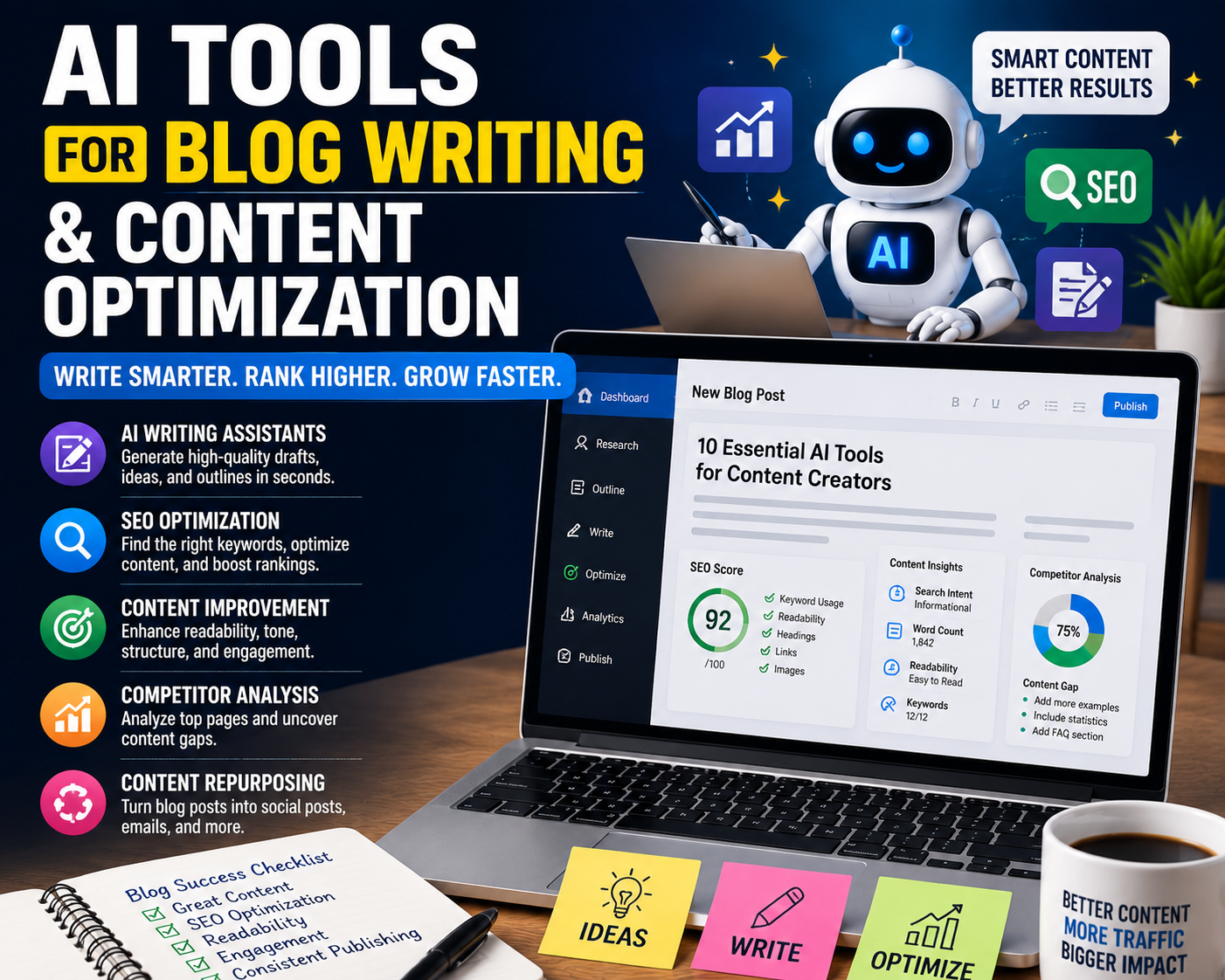

Discover the best AI tools for blog writing and content optimization to create useful, SEO-friendly content, improve rankings, and save valuable time.
Introduction
Creating a successful blog requires much more than putting words on a page. Writers and marketers need to research topics, understand search intent, build useful outlines, write engaging content, optimize headings and keywords, improve readability, and keep articles accurate. That workload can become difficult when one person manages an entire content strategy.
This is where AI tools for blog writing and content optimization can help.
Modern AI platforms can support almost every stage of the blogging process. They can generate topic ideas, create outlines, rewrite unclear sentences, identify content gaps, suggest search-focused improvements, and help turn one article into multiple marketing assets. Some specialized platforms also combine AI writing with traditional SEO data and emerging AI-search optimization features.
However, using AI successfully does not mean publishing whatever an AI system generates. The strongest strategy combines automation with human experience, original information, careful editing, and fact-checking.
In this guide, we’ll explore the best uses of AI tools for blog writing and content optimization, compare different categories of platforms, explain their benefits and limitations, and provide a practical workflow you can use to produce better blog content.
What Are AI Tools for Blog Writing and Content Optimization?
AI tools for blog writing and content optimization are software applications that use artificial intelligence to assist with content research, writing, editing, SEO, and publishing.
Different tools specialize in different stages of the process.
Some are general-purpose AI assistants that can brainstorm and draft content. Others are dedicated SEO platforms that analyze keywords, competitors, readability, topic coverage, and search visibility.
Typical capabilities include:
- Blog topic generation
- Keyword research assistance
- Search-intent analysis
- Content outlines
- First-draft generation
- Headline suggestions
- Meta title and description creation
- Content rewriting
- Grammar improvement
- Readability analysis
- Semantic keyword suggestions
- Internal-link recommendations
- Content-gap analysis
- Content repurposing
- AI-search visibility analysis
The important distinction is that AI should function as a content assistant, not an automatic replacement for editorial judgment.
Google’s guidance says AI-generated content itself is not automatically against its Search policies. The focus is on quality, usefulness, originality, and whether automation is being used primarily to manipulate search rankings. (Google for Developers)
Why Bloggers Are Using AI in 2026
Blogging has become increasingly competitive. Publishing an article is easy; publishing something genuinely useful is much harder.
The best AI tools for blog writing and content optimization help solve specific bottlenecks.
Faster Research and Planning
Before writing an article, you may need to identify:
- What readers are searching for
- Which questions they ask
- What competitors cover
- What information is missing
- Which subtopics deserve their own sections
AI can help organize this research into a usable content brief.
However, research should still be verified against trustworthy sources, especially when an article involves current events, technology specifications, health information, finance, cybersecurity, or other sensitive subjects.
Faster First Drafts
Starting with a blank document is often the hardest part of writing.
An AI assistant can produce a rough outline or first draft that gives the writer something to work with.
That can reduce the time spent on repetitive writing while allowing the human writer to concentrate on:
- Accuracy
- Examples
- Experience
- Storytelling
- Original insights
- Brand voice
Better Content Repurposing
A long blog article can become:
- A newsletter.
- Five social-media posts.
- A short video script.
- A LinkedIn article.
- A list of frequently asked questions.
- A customer email.
- A sales-team summary.
This makes AI tools for blog writing and content optimization especially useful for small marketing teams.
Best AI Tools for Blog Writing and Content Optimization
There is no single best AI platform for everyone. The right choice depends on your content volume, SEO goals, budget, team size, and existing software.
1. ChatGPT
ChatGPT is one of the most flexible options for blog production.
It can help with brainstorming, outlining, drafting, rewriting, summarizing, content repurposing, and strategic planning. OpenAI’s current documentation lists drafting, rewriting, summarization, creative suggestions, research through available tools, and other capabilities. (OpenAI Help Center)
A blogger might use it to create a content brief such as:
“Create an outline for a beginner-friendly article about home cybersecurity. Identify the reader’s likely questions, suggest useful H2 sections, and list areas that require fact-checking.”
The output can then become the starting point for a human-written article.
Best for: General-purpose content creation and brainstorming.
Strength: Flexibility.
Limitation: It is not a substitute for specialized keyword research, editorial review, or independent fact-checking.
2. Semrush Content Tools
Semrush offers a more SEO-focused approach.
Its SEO Writing Assistant evaluates areas such as SEO, readability, originality, and tone of voice. It can also provide AI-assisted writing and rewriting capabilities. (Semrush)
Semrush’s newer Content Optimizer also addresses traditional SEO and AI-search visibility. Its recommendations include keyword coverage, readability, tone, structure, and factors intended to improve visibility in AI-powered search experiences. (Semrush)
This makes Semrush useful for teams that want content creation and optimization connected to search data.
Best for: SEO teams and content marketers.
Strength: Combines content editing with SEO data.
Limitation: Advanced functionality can be more complex than a simple AI writing assistant.
3. Grammarly
Grammarly is primarily an editing and writing-quality platform.
It can be useful after an AI-generated or human-written draft is complete.
Use it to check:
- Grammar
- Sentence clarity
- Tone
- Conciseness
- Word choice
- Professional communication
This is valuable because AI-generated writing can sometimes sound repetitive or overly formal.
Best for: Editing and polishing.
Strength: Easy-to-use writing improvement.
Limitation: It should be combined with a dedicated research and SEO workflow.
4. Jasper
Jasper is designed around marketing content and brand-focused workflows.
It can be useful for teams that create:
- Blog content
- Social campaigns
- Advertising copy
- Email content
- Brand messaging
- Marketing variations
Its greatest value is often not simply generating words but helping teams maintain consistency across multiple marketing assets.
Best for: Marketing departments and content teams.
Strength: Brand-oriented content workflows.
Limitation: May be more than an individual blogger needs.
5. Copy.ai
Copy.ai is particularly useful for marketing workflows and go-to-market content.
Instead of treating AI as a basic text generator, workflow-based platforms can help standardize repeated processes.
For example, a content team could create a workflow that takes a new blog article and produces:
- Social captions
- Email copy
- Sales messaging
- Short summaries
- Content briefs
Best for: Marketing automation and content workflows.
Strength: Repeatable processes.
Limitation: Advanced workflow capabilities may be unnecessary for small personal blogs.
Comparison Table
| Tool Category | Primary Use | Best For | Main Advantage | Potential Limitation |
|---|---|---|---|---|
| General AI Assistant | Writing and research | Bloggers and marketers | Flexible | Requires human fact-checking |
| SEO Platform | Optimization | SEO professionals | Search data | Can be complex |
| Writing Editor | Editing | Writers | Better readability | Limited research functions |
| Marketing AI | Brand content | Marketing teams | Consistent messaging | Higher cost |
| Workflow AI | Automation | Agencies | Repeatable processes | Setup can take time |
How AI Helps With Every Stage of Blog Writing
The real value of AI tools for blog writing and content optimization becomes clearer when you look at the entire content lifecycle.
Stage 1: Topic Research
Start by identifying what your audience actually needs.
AI can help brainstorm:
- Beginner questions
- Comparison topics
- Problem-solving articles
- Frequently asked questions
- Content clusters
- Supporting topics
Do not stop at generic suggestions. Compare ideas against real search data and your audience’s needs.
Stage 2: Search Intent
A keyword does not tell you everything about the reader.
Someone searching for “best running shoes” may want recommendations.
Someone searching for “how to clean running shoes” probably wants instructions.
Someone searching for “running shoe size chart” may want a quick reference.
Your content should match the underlying intent.
Stage 3: Outline Creation
AI can quickly transform research into a logical outline.
A useful outline should answer:
- What does the reader need first?
- What questions naturally follow?
- Which information deserves an H2?
- Which details belong under an H3?
- What can be removed?
Do not create sections simply to increase word count.
Stage 4: Drafting
This is where AI can save substantial time.
However, provide specific instructions.
Instead of:
“Write a blog post about email marketing.”
Use:
“Create a beginner-friendly section explaining how abandoned-cart emails work. Use a practical example, avoid exaggerated claims, and explain when this strategy may not work.”
The second prompt provides context and constraints.
Stage 5: Human Editing
This step should never be skipped.
Read the article as if you were the target customer.
Ask:
- Is the information accurate?
- Does the article answer the searcher’s question?
- Are the examples realistic?
- Does it contain original insights?
- Does it sound like our brand?
- Is anything repetitive?
- Are there unsupported claims?
Stage 6: SEO Optimization
After the article is useful, optimize it for search.
Look at:
- Primary keyword
- Related terms
- Search intent
- Title
- H2 and H3 headings
- Meta description
- Internal links
- Image alt text
- URL structure
- Content gaps
Semrush’s current content tools, for example, provide recommendations involving keyword coverage, readability, structure, and SEO while also addressing AI-search visibility. (Semrush)
Stage 7: Final Quality Review
Before publishing, complete a final review.
Check:
- Facts.
- Links.
- Statistics.
- Spelling.
- Formatting.
- Images.
- Metadata.
- Calls to action.
- Author information.
- Originality.
Benefits of AI Tools for Blog Writing
Save Time
AI can reduce repetitive tasks such as outlining, rewriting, summarizing, and generating variations.
Overcome Writer’s Block
When you know what you want to say but cannot organize it, AI can suggest structures and angles.
Improve Readability
AI-powered editing tools can identify long sentences, awkward wording, repetition, and unclear passages.
Scale Content Production
A small team can support more content channels when AI handles selected repetitive tasks.
Support SEO Work
Specialized tools can identify keyword opportunities, content gaps, readability problems, and structural weaknesses.
Repurpose Existing Content
One article can become several additional marketing assets without starting from scratch.
Improve Content Consistency
Teams can create repeatable prompts, templates, style instructions, and editorial workflows.
Challenges and Limitations
Despite their advantages, AI tools for blog writing and content optimization have important limitations.
AI Can Produce Incorrect Information
AI systems can generate confident-sounding statements that are inaccurate.
Never assume that a polished paragraph is automatically factual.
Generic Writing Is Easy to Produce
If you ask an AI system to write a generic article, you may receive information that looks similar to thousands of other websites.
The solution is to provide original material.
Include:
- Personal experience
- Expert interviews
- Customer examples
- Original research
- First-hand testing
- Data
- Product comparisons
- Unique opinions supported by evidence
Keyword Stuffing Can Hurt Quality
SEO optimization should improve usefulness, not make an article awkward.
Do not force the same keyword into every paragraph.
Use natural language and related terminology.
AI Can Flatten Brand Voice
Without clear editorial guidance, AI content can sound generic.
Give your AI tool examples of your preferred style and then edit the result carefully.
Too Many Tools Create Complexity
It is tempting to subscribe to every new AI platform.
That can create unnecessary expenses and duplicated workflows.
A simple three-tool stack may be more productive than ten disconnected applications.
How to Use AI Without Sacrificing Content Quality
The best approach is to divide responsibilities between AI and humans.
Let AI Handle
- Brainstorming
- First-draft structures
- Rewriting
- Summaries
- Content repurposing
- Basic formatting
- Idea expansion
Let Humans Handle
- Original research
- Expert opinions
- Fact verification
- Final conclusions
- Strategic positioning
- Sensitive topics
- First-hand experience
- Final editorial approval
This division creates a more reliable workflow.
Google’s guidance emphasizes people-first content that provides original information, research, analysis, and genuine value rather than content created primarily to manipulate rankings. (Google for Developers)
A Practical AI Blog Writing Workflow
Here is a simple process for bloggers and marketing teams.
Step 1: Choose the Topic
Start with a real customer problem rather than an arbitrary keyword.
Step 2: Research the Search Intent
Determine what the reader expects to find.
Step 3: Build a Content Brief
Use AI to organize the topic, audience, questions, sections, and information gaps.
Step 4: Add Original Expertise
Provide your own experiences, examples, research, and opinions.
Step 5: Create the Draft
Use AI to accelerate the first version where appropriate.
Step 6: Rewrite for Humans
Remove generic statements and add useful detail.
Step 7: Fact-Check
Verify important claims using reliable sources.
Step 8: Optimize for Search
Improve headings, metadata, internal links, topical coverage, and readability.
Step 9: Add Visuals
Use useful charts, screenshots, original photographs, diagrams, or illustrations when they genuinely help readers.
Step 10: Publish and Measure
Track:
- Organic traffic
- Engagement
- Search visibility
- Click-through rate
- Leads
- Conversions
- Revenue
The purpose of optimization is not simply to achieve a higher tool score. It is to produce a better experience and stronger business results.
How to Write Better AI Prompts for Blog Content
Better prompts usually create better starting points.
A useful blog-writing prompt can include five elements:
Role + audience + task + requirements + constraints
For example:
“Act as an experienced technology writer. Create an outline for beginners researching home Wi-Fi security. Explain each topic simply, include practical examples, avoid unsupported statistics, and identify claims that require current-source verification.”
This is more useful than simply asking an AI to “write an SEO article.”
Give the AI Your Audience
Tell it whether the reader is:
- A beginner
- An expert
- A business owner
- A developer
- A parent
- A student
- A professional buyer
Give It Your Desired Outcome
Specify whether the article should:
- Teach
- Compare
- Explain
- Help readers choose
- Solve a problem
- Encourage a purchase
Give It Real Information
The more useful original information you provide, the less generic the result is likely to be.
Future Trends in AI Content Optimization
The next phase of AI tools for blog writing and content optimization is moving beyond simple text generation.
AI Search Optimization
Traditional SEO focuses heavily on search-engine results.
The growing use of AI-powered answer systems creates another visibility challenge: getting your information discovered, understood, and referenced by AI systems.
Some current SEO platforms are already adding features specifically designed to evaluate content for AI-search visibility alongside traditional search optimization. (Semrush)
AI Content Agents
Future tools are likely to handle longer sequences of tasks.
Instead of simply asking an AI to write an introduction, a marketer may be able to give an agent a content brief and have it:
- Research the subject.
- Organize a content outline.
- Identify information gaps.
- Draft sections.
- Suggest internal links.
- Prepare metadata.
- Create social variations.
- Generate a publishing checklist.
Human approval will still be important.
Greater Emphasis on First-Hand Experience
As generic AI writing becomes easier to produce, unique human information becomes more valuable.
A blog with:
- Original testing
- Expert interviews
- Real customer stories
- Original images
- Proprietary data
- Practical experiments
can offer something that generic AI output cannot easily reproduce.
Content Optimization Will Become Continuous
Instead of optimizing an article once and forgetting about it, publishers may increasingly monitor content performance and update pages based on changes in search behavior, competitors, audience questions, and AI-search visibility.
Read More About:Affordable AI Content Marketing Tools for Startups
Frequently Asked Questions
1. What are the best AI tools for blog writing and content optimization?
The best choice depends on your needs. General AI assistants are useful for brainstorming and drafting, while platforms such as Semrush are more focused on SEO analysis and content optimization. Writing-focused tools can help improve grammar, clarity, and tone.
2. Can AI write a complete blog post?
Yes, AI can generate a complete draft. However, a draft should not automatically be treated as a finished article. Human editing, fact-checking, original insights, and quality control are essential.
3. Is AI-generated blog content good for Google?
AI-generated content can perform well if it is useful, accurate, original, and created for people. Google states that using AI is not inherently against its guidelines, but using automation to generate content primarily to manipulate search rankings can violate spam policies. (Google for Developers)
4. Can AI improve SEO?
Yes. AI can assist with keyword organization, content gaps, readability, structure, metadata, internal-link ideas, and content optimization. Specialized tools can combine AI assistance with search data.
5. Should I use AI for every blog post?
Not necessarily. Use AI where it saves meaningful time or improves the workflow. Some articles may benefit more from original reporting, expert interviews, personal experience, or manual research.
6. How can I make AI-written content sound human?
Add specific experiences, original examples, real customer questions, expert opinions, and your own perspective. Then edit the article for natural rhythm and remove repetitive or generic language.
7. Can AI replace an SEO writer?
AI can automate parts of an SEO writer’s workflow, but strategy, research, editorial judgment, originality, and business understanding remain important.
8. What is AI content optimization?
AI content optimization means using AI to improve content’s usefulness, clarity, structure, search visibility, and performance. Modern platforms increasingly address both traditional search and AI-powered search experiences. (Semrush)
9. How often should AI-generated articles be fact-checked?
Every published article should receive an appropriate level of fact-checking. The more consequential or time-sensitive the information, the more carefully it should be verified.
10. What is the biggest mistake when using AI for blogging?
The biggest mistake is treating AI output as the finished product. AI should accelerate the content process, while humans remain responsible for accuracy, originality, expertise, and usefulness.
Conclusion
The best AI tools for blog writing and content optimization do not simply help publishers create more words. Their real value is helping writers research faster, organize ideas, improve drafts, identify optimization opportunities, and repurpose useful information.
The most effective workflow is therefore not “AI writes everything.”
It is:
Research → Plan → Create → Edit → Verify → Optimize → Publish → Measure
Use AI for repetitive tasks and creative assistance, but keep human expertise at the center of the process.
For SEO, focus on satisfying the reader rather than forcing keywords into every paragraph. For quality, add original research and experience. For trust, verify important claims. And for long-term visibility, create content that remains useful even when search algorithms and AI platforms change.
As AI search continues to evolve, the competitive advantage will increasingly belong to publishers that combine efficient technology with something AI cannot manufacture on its own: genuine expertise, original information, and a deep understanding of their audience.
Key Takeaways
- AI tools for blog writing and content optimization can accelerate research, drafting, editing, and SEO work.
- Use general-purpose AI assistants for brainstorming, outlines, drafting, and repurposing.
- Use specialized SEO platforms when you need keyword, competitor, readability, and search-visibility analysis.
- Always fact-check important AI-generated claims.
- Add original research, first-hand experience, examples, and expert insights.
- Do not use AI simply to mass-produce low-value pages.
- Optimize for people first and search engines second.
- Avoid unnatural keyword repetition and keyword stuffing.
- Treat AI output as a draft rather than automatically publishable content.
- Measure content success through traffic, engagement, leads, conversions, and revenue.
- AI-search visibility is becoming an increasingly important part of content strategy.
- The strongest future content strategies will combine AI efficiency with human expertise.