
Discover the best generative AI solutions for small businesses, their benefits, use cases, challenges, future trends, and practical implementation strategies.
Introduction
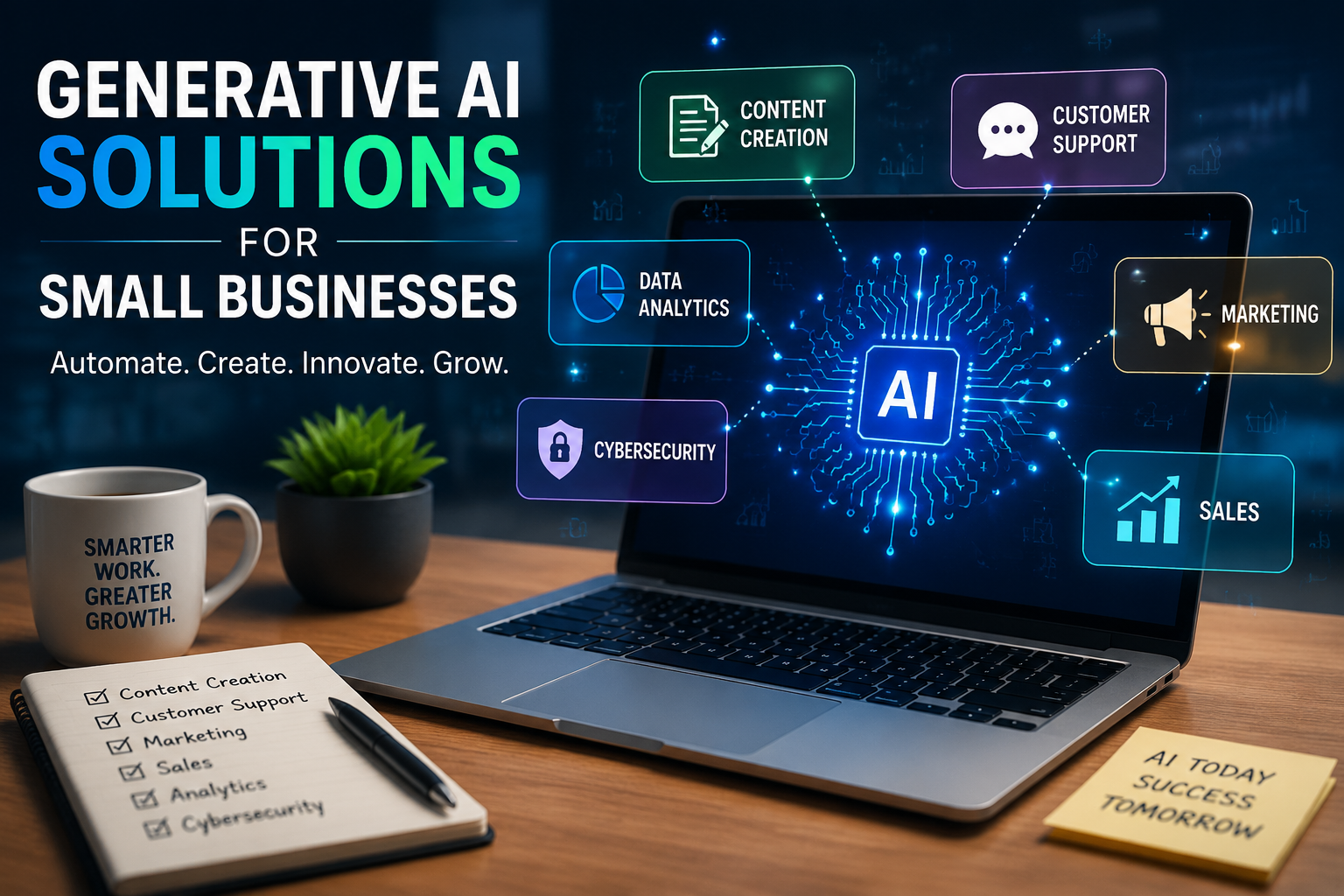
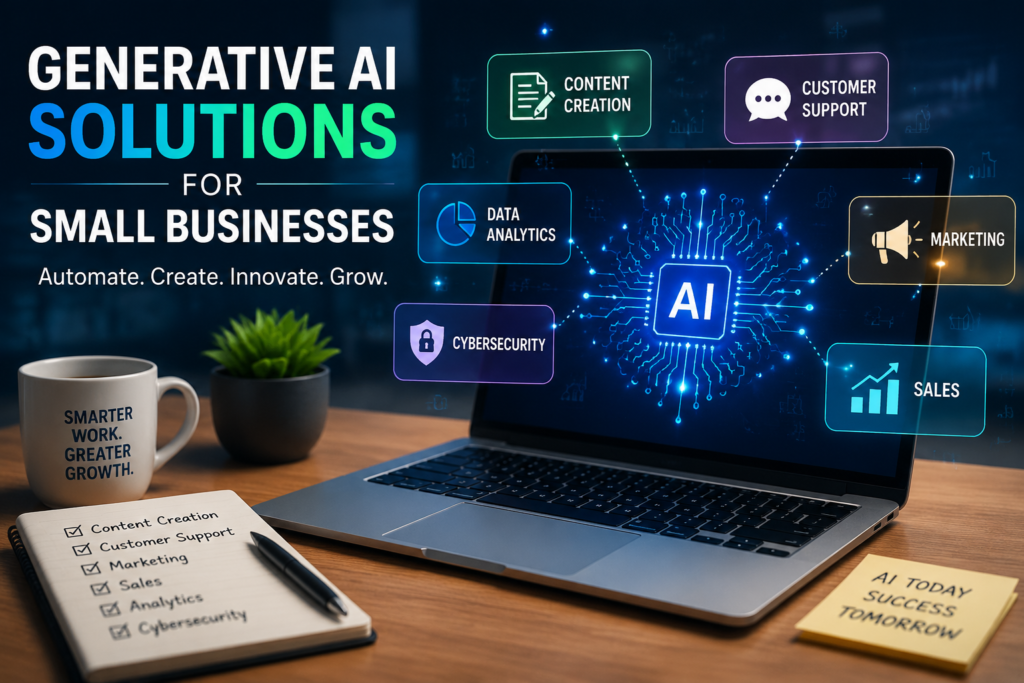
Generative AI solutions for small businesses are transforming how entrepreneurs operate, compete, and grow in today’s digital economy. Once considered technology reserved for large enterprises with extensive budgets, generative AI has become more accessible, affordable, and practical for businesses of every size. From automating customer support and creating marketing content to improving cybersecurity and streamlining daily operations, AI-powered tools enable small businesses to achieve more with fewer resources.
As artificial intelligence continues to evolve, business owners are discovering innovative ways to increase productivity, reduce costs, and deliver better customer experiences. The latest AI news consistently highlights how small companies are successfully leveraging generative AI to compete with larger organisations.
This comprehensive guide explores the most effective generative AI solutions for small businesses, explains their practical applications, discusses implementation strategies, examines industry trends, and provides expert insights to help you make informed decisions.
Why Generative AI Matters for Small Businesses
Small businesses often face challenges such as limited budgets, smaller teams, and increasing customer expectations. Generative AI helps overcome these obstacles by automating repetitive tasks while enhancing creativity and operational efficiency.
Unlike traditional automation, generative AI creates original content, generates insights, answers customer questions, writes code, designs graphics, summarises documents, and assists with decision-making.
Modern AI models can understand natural language, making them accessible even to users with minimal technical expertise.
The Growing Adoption of AI
Recent industry research indicates that AI adoption among small and medium-sized businesses continues to accelerate. Businesses increasingly use AI for:
- Marketing automation
- Customer support
- Content creation
- Sales assistance
- Financial forecasting
- Business analytics
- Software development
- Cybersecurity monitoring
- Human resource management
As AI tools become easier to use, they continue replacing repetitive manual work rather than replacing human creativity.
How Generative AI Works
Generative AI uses advanced machine learning models trained on massive datasets to generate human-like text, images, code, audio, and other digital content.
The process typically involves:
- Receiving user instructions (prompts)
- Analysing context
- Predicting the most appropriate response
- Generating original output
- Learning from user interactions and updates
These capabilities make AI valuable across nearly every business function.
Top Generative AI Solutions for Small Businesses
AI-Powered Content Creation
Content marketing is essential for business growth but often requires significant time and resources.
Generative AI can create:
- Blog posts
- Social media content
- Product descriptions
- Email campaigns
- Website copy
- Advertising headlines
- Video scripts
- SEO content
This enables businesses to maintain consistent online visibility while reducing content production costs.
Example
An online clothing retailer can generate hundreds of unique product descriptions in minutes instead of spending weeks writing them manually.
AI Customer Support
AI chatbots provide instant customer service around the clock.
Modern AI assistants can:
- Answer FAQs
- Process returns
- Track orders
- Schedule appointments
- Recommend products
- Escalate complex issues
This improves customer satisfaction while reducing support costs.
AI Marketing Automation
Generative AI helps marketers personalise campaigns using customer behaviour and preferences.
Applications include:
- Personalised emails
- Ad copy generation
- Audience segmentation
- Campaign optimisation
- Customer journey mapping
AI also analyses campaign performance and recommends improvements.
AI Sales Assistance
Sales teams benefit from AI through:
- Proposal generation
- Lead qualification
- CRM updates
- Sales forecasting
- Meeting summaries
- Personalised outreach
This allows representatives to spend more time building relationships rather than performing administrative tasks.
AI Financial Management
Financial AI tools assist with:
- Expense categorisation
- Invoice generation
- Budget forecasting
- Cash-flow prediction
- Financial reporting
Business owners gain better visibility into financial performance.
AI Software Development
Many small technology businesses now use AI coding assistants to accelerate development.
These tools can:
- Write code
- Detect bugs
- Suggest improvements
- Generate documentation
- Automate testing
Developers become significantly more productive while reducing repetitive coding tasks.
AI Cybersecurity
Cybersecurity has become increasingly important as cyber threats continue evolving.
Generative AI enhances security by:
- Detecting phishing attempts
- Analysing suspicious activity
- Monitoring network behaviour
- Automating threat detection
- Generating incident reports
- Assisting security analysts
AI cybersecurity solutions help smaller organisations improve protection without maintaining large security teams.
Real-World Applications Across Industries
Retail
Retail businesses use AI for:
- Product recommendations
- Inventory forecasting
- Customer support
- Marketing campaigns
- Product descriptions
Healthcare
Healthcare providers use AI for:
- Appointment scheduling
- Medical documentation
- Patient communication
- Administrative automation
Human oversight remains essential for clinical decisions.
Professional Services
Law firms, accountants, and consultants leverage AI to:
- Draft documents
- Summarise contracts
- Research regulations
- Generate reports
Manufacturing
Manufacturers use AI for:
- Process optimisation
- Equipment maintenance predictions
- Inventory planning
- Technical documentation
Education
Educational institutions use AI for:
- Lesson planning
- Personalised tutoring
- Content creation
- Administrative support
Comparison Table: Traditional Software vs Generative AI
| Feature | Traditional Software | Generative AI Solutions |
|---|---|---|
| Automation | Rule-based | Context-aware |
| Content Creation | Limited | Highly capable |
| Learning Ability | Minimal | Continuously improving |
| Customer Support | Scripted | Conversational |
| Decision Support | Static reports | Intelligent recommendations |
| Flexibility | Low | High |
| Productivity | Moderate | Significant improvement |
| Creativity | None | High |
Best Practices for Implementing Generative AI
Start with High-Impact Tasks
Identify repetitive tasks consuming the most employee time.
Good starting points include:
- Email writing
- Customer support
- Content marketing
- Data summarisation
Train Employees
AI works best when employees understand:
- Prompt writing
- Fact-checking
- Privacy practices
- Responsible AI use
Protect Sensitive Data
Avoid uploading confidential information unless using secure enterprise AI platforms with appropriate safeguards.
Monitor Results
Measure success using metrics such as:
- Productivity improvements
- Customer satisfaction
- Cost savings
- Revenue growth
- Employee efficiency
Industry Trends and Expert Insights
Industry analysts expect generative AI adoption to continue growing rapidly as businesses recognise measurable productivity gains. Many experts predict AI will become a standard component of business software rather than a specialised add-on.
Several trends are shaping the market:
- AI assistants integrated into everyday productivity tools.
- Increased investment in AI cybersecurity to counter increasingly sophisticated cyber threats.
- Greater focus on responsible AI governance, transparency, and compliance.
- More industry-specific AI models tailored for sectors such as healthcare, finance, legal services, and manufacturing.
- Wider availability of affordable AI subscriptions designed specifically for small businesses.
These developments suggest that businesses adopting AI strategically today are likely to be better positioned for future competitiveness.
Benefits of Generative AI Solutions for Small Businesses
Generative AI offers numerous advantages that directly impact growth and operational efficiency.
Key benefits include:
- Increased productivity
- Reduced operational costs
- Faster content creation
- Improved customer engagement
- Better decision-making
- Enhanced cybersecurity capabilities
- Personalised marketing campaigns
- Scalable business operations
- Greater employee efficiency
- Competitive advantage
Challenges and Limitations
Despite its benefits, generative AI has limitations that businesses should understand.
Common challenges include:
- AI-generated inaccuracies or “hallucinations”
- Data privacy concerns
- Cybersecurity risks if used improperly
- Copyright and intellectual property considerations
- Employee training requirements
- Integration with existing systems
- Regulatory compliance obligations
- Dependence on high-quality prompts
- Ongoing subscription costs
- Need for human review of critical outputs
Successful implementation requires combining AI efficiency with human judgement and oversight.
Future Trends
Generative AI continues evolving at an impressive pace.
Future developments are expected to include:
AI Agents
Autonomous AI agents capable of completing multi-step business tasks with minimal supervision.
Hyper-Personalisation
AI delivering highly customised customer experiences based on real-time behavioural data.
Voice-Based Business Assistants
Natural conversational assistants will become central to workplace productivity.
Industry-Specific AI
Specialised AI models designed for healthcare, manufacturing, retail, finance, education, and legal services.
Stronger AI Cybersecurity
AI-powered security systems will proactively detect, predict, and respond to sophisticated cyberattacks.
AI and Internet of Things (IoT)
Generative AI will increasingly integrate with smart devices and connected sensors to automate business operations, predictive maintenance, and real-time decision-making.
Read More About:AI-Powered Business Management Tools: The Complete Guide for Smarter Business Growth
Frequently Asked Questions (FAQ)
1. What are generative AI solutions for small businesses?
Generative AI solutions are artificial intelligence tools that create original content, automate repetitive tasks, assist with customer service, improve marketing, enhance cybersecurity, generate code, analyse business data, and support decision-making.
2. Are generative AI tools affordable for small businesses?
Yes. Many AI platforms now offer affordable monthly subscriptions, free tiers, or pay-as-you-go pricing, making them accessible even for start-ups and small enterprises.
3. Can generative AI replace employees?
No. Generative AI is designed to augment human capabilities by automating routine work. Employees remain essential for strategic thinking, creativity, relationship building, and final decision-making.
4. Is generative AI secure?
Generative AI can be secure when organisations use reputable providers, implement strong access controls, protect sensitive information, and follow cybersecurity best practices. Human oversight remains important for safeguarding confidential data.
5. Which departments benefit most from generative AI?
Nearly every department can benefit, including:
- Marketing
- Sales
- Customer support
- Finance
- Human resources
- IT
- Software development
- Operations
- Cybersecurity
6. How should a small business begin adopting AI?
Start with a clear business problem, select one or two high-impact use cases, train employees, establish data governance policies, measure results, and expand gradually as confidence and expertise grow.
Conclusion
Generative AI solutions for small businesses have evolved from emerging technologies into practical tools that deliver measurable value. Whether improving marketing campaigns, strengthening cybersecurity, enhancing customer support, automating administrative work, or accelerating software development, AI enables organisations to operate more efficiently while remaining competitive in an increasingly digital marketplace.
However, successful AI adoption requires more than simply purchasing software. Businesses should define clear objectives, invest in employee training, implement responsible AI governance, and maintain human oversight to ensure quality, accuracy, and compliance.
As AI technology continues advancing, organisations that thoughtfully integrate generative AI into their workflows will be better positioned to innovate, improve customer experiences, reduce operational costs, and achieve sustainable long-term growth.
Key Takeaways
- Generative AI is becoming an essential business tool for organisations of all sizes.
- Small businesses can automate repetitive work while improving productivity.
- AI supports marketing, sales, customer service, finance, software development, and cybersecurity.
- Human oversight remains essential for quality assurance and ethical decision-making.
- Data privacy and cybersecurity should be prioritised during AI implementation.
- Affordable AI solutions have made advanced capabilities accessible to smaller organisations.
- AI adoption should begin with clearly defined business objectives and measurable outcomes.
- Future innovations such as AI agents, hyper-personalisation, and smarter cybersecurity will further transform business operations.
- Following responsible AI practices helps maximise value while minimising risks.
- Businesses that embrace AI strategically today are likely to gain a lasting competitive advantage.