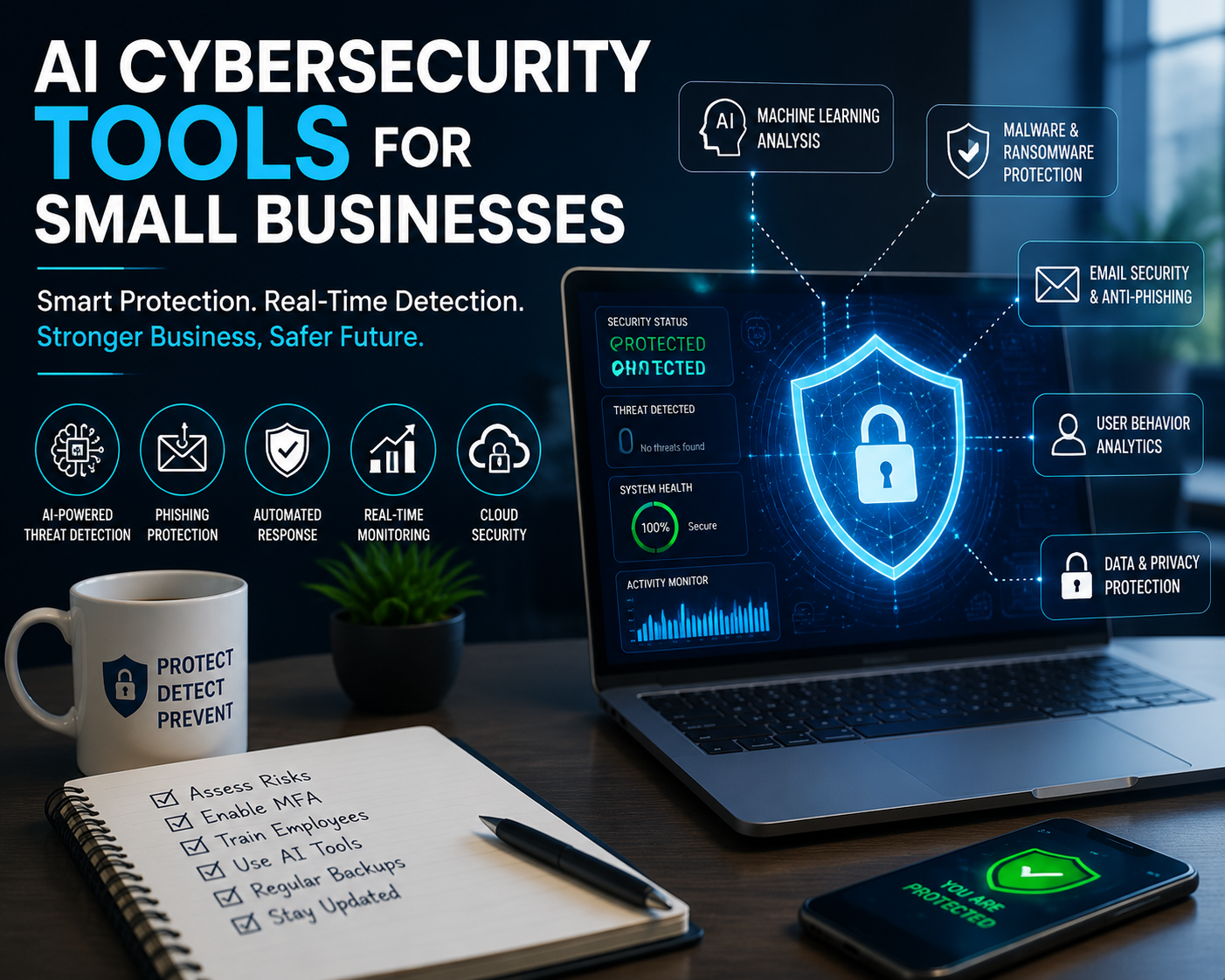

Discover the best AI cybersecurity tools for small businesses, their benefits, use cases, challenges, future trends, and expert tips to strengthen security.
Introduction
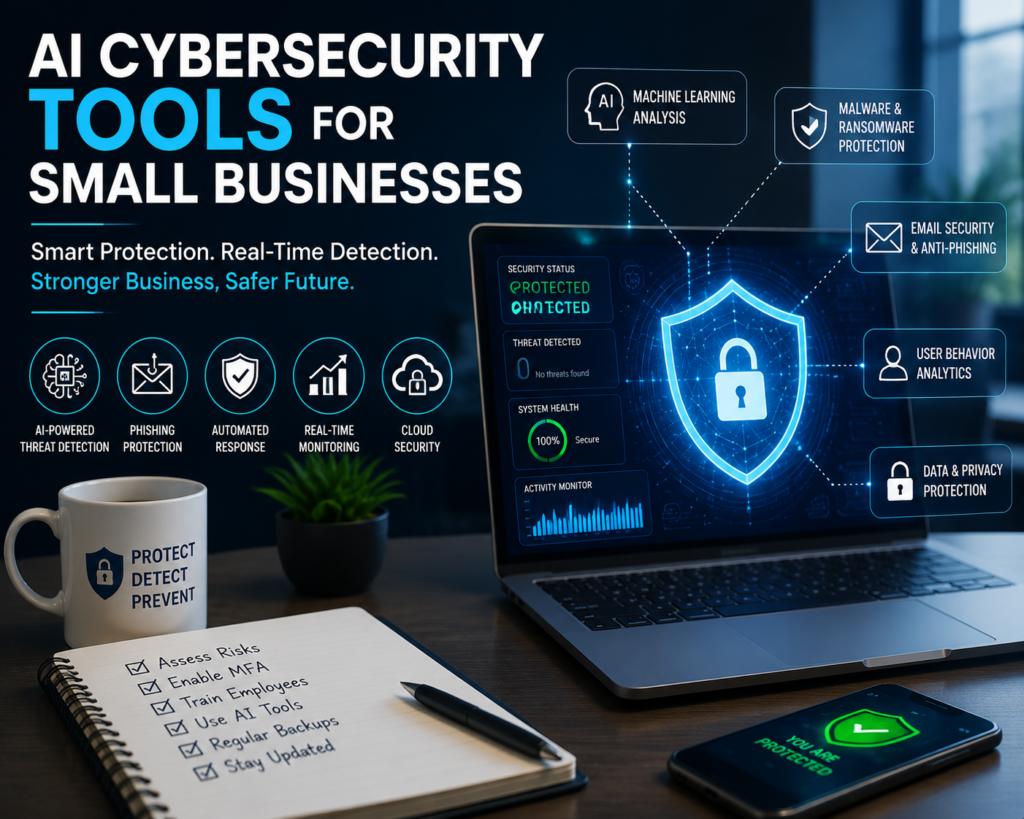
Cyberattacks are no longer a problem exclusive to large corporations. Today, AI cybersecurity tools for small businesses have become essential for protecting sensitive data, preventing cyber threats, and ensuring business continuity. Small and medium-sized businesses (SMBs) are increasingly targeted by cybercriminals because they often lack dedicated security teams and enterprise-level defences.
Fortunately, artificial intelligence is changing the cybersecurity landscape. AI-powered security solutions can detect suspicious behaviour, identify malware, stop phishing attacks, automate incident response, and continuously monitor networks in real time. These capabilities help businesses strengthen their security posture without requiring a large IT department.
Recent AI news shows rapid growth in AI-powered cybersecurity platforms as businesses worldwide invest in intelligent threat detection and automated security operations. As cyber threats become more sophisticated, AI has emerged as one of the most effective tools for defending modern organisations.
This comprehensive guide explores the best AI cybersecurity tools for small businesses, how they work, their advantages, implementation strategies, industry trends, and practical recommendations for choosing the right solution.
Why Small Businesses Need AI Cybersecurity
Many small business owners mistakenly believe cybercriminals only target large enterprises. In reality, attackers frequently focus on smaller organisations because they often have weaker security controls.
Common cyber threats include:
- Phishing emails
- Ransomware
- Malware infections
- Credential theft
- Business email compromise
- Insider threats
- Data breaches
- Distributed Denial-of-Service (DDoS) attacks
Traditional security systems often struggle to detect modern attacks. AI cybersecurity tools continuously analyse data, identify unusual behaviour, and respond to threats much faster than manual monitoring.
The Rising Cost of Cybercrime
Cybercrime continues to cost businesses billions of pounds annually through financial losses, downtime, regulatory penalties, and reputational damage. For small businesses, even a single successful attack can have devastating consequences.
AI-powered security reduces these risks by detecting threats early and automating responses before significant damage occurs.
What Are AI Cybersecurity Tools?
AI cybersecurity tools use machine learning, behavioural analytics, automation, and artificial intelligence to identify, analyse, and respond to cyber threats.
Unlike traditional antivirus software that relies mainly on known signatures, AI security platforms continuously learn from network activity and can identify previously unknown threats.
These tools help businesses:
- Monitor networks
- Detect anomalies
- Identify malicious behaviour
- Prevent phishing
- Analyse security logs
- Automate incident response
- Improve compliance
- Protect cloud environments
How AI Improves Cybersecurity
AI enhances security through several intelligent capabilities.
Behavioural Analysis
AI establishes normal user behaviour patterns and quickly identifies unusual activities.
Examples include:
- Unusual login locations
- Abnormal file downloads
- Unexpected administrator actions
- Suspicious network traffic
Threat Detection
Machine learning identifies malware and cyberattacks that traditional security software may miss.
AI analyses:
- File behaviour
- Network communications
- User activity
- Application behaviour
- Device interactions
Automated Incident Response
Instead of waiting for human intervention, AI can:
- Isolate infected devices
- Block malicious IP addresses
- Disable compromised accounts
- Notify administrators
- Launch investigation workflows
Predictive Security
Modern AI analyses threat intelligence and predicts emerging attack patterns before they become widespread.
Best AI Cybersecurity Tools for Small Businesses
AI Endpoint Protection
Endpoint protection secures laptops, desktops, servers, and mobile devices against malware, ransomware, and other threats.
Key capabilities include:
- Real-time protection
- Behaviour monitoring
- Malware detection
- Device isolation
- Automatic remediation
AI Email Security
Email remains one of the most common attack vectors.
AI email security helps detect:
- Phishing emails
- Business email compromise
- Malicious attachments
- Suspicious links
- Spoofed domains
AI continuously learns from evolving phishing tactics.
AI Network Monitoring
AI monitors network traffic to detect unusual patterns that may indicate cyberattacks.
It identifies:
- Data exfiltration
- Lateral movement
- Botnet activity
- Unauthorised access
- Network anomalies
AI Cloud Security
As businesses migrate to cloud platforms, AI secures cloud workloads by:
- Monitoring configurations
- Detecting vulnerabilities
- Managing access permissions
- Identifying risky behaviour
AI Identity and Access Management
Identity security has become a critical cybersecurity priority.
AI strengthens access management by:
- Detecting compromised accounts
- Monitoring login behaviour
- Enforcing adaptive authentication
- Reducing insider threats
AI Security Information and Event Management (SIEM)
AI-powered SIEM platforms collect security data from multiple sources.
They:
- Correlate events
- Detect threats
- Prioritise alerts
- Reduce false positives
- Automate investigations
Practical Use Cases
Retail Businesses
Retailers use AI to:
- Detect payment fraud
- Secure point-of-sale systems
- Protect customer accounts
- Monitor online transactions
Healthcare Clinics
Healthcare organisations rely on AI to:
- Protect patient records
- Detect unauthorised access
- Monitor medical devices
- Ensure compliance
Financial Services
Financial firms use AI for:
- Fraud detection
- Identity verification
- Transaction monitoring
- Regulatory reporting
Professional Services
Law firms and accounting firms benefit from AI by:
- Protecting confidential documents
- Monitoring employee access
- Detecting suspicious downloads
- Preventing ransomware
E-commerce Businesses
Online retailers use AI to:
- Detect fraudulent orders
- Prevent account takeover
- Monitor payment security
- Block malicious bots
Comparison Table: Traditional Security vs AI Cybersecurity
| Feature | Traditional Security | AI Cybersecurity |
|---|---|---|
| Threat Detection | Signature-based | Behaviour-based |
| Zero-Day Detection | Limited | Strong |
| Response Speed | Manual | Automated |
| Learning Ability | Static | Continuous |
| False Positives | Higher | Lower |
| Scalability | Moderate | Excellent |
| Real-Time Monitoring | Limited | Continuous |
| Threat Prediction | Minimal | Advanced |
Choosing the Right AI Cybersecurity Tool
Selecting the best solution depends on your organisation’s size, industry, and security requirements.
Consider these factors:
Business Size
Choose a solution that scales with future growth.
Ease of Use
Small businesses benefit from intuitive dashboards and minimal maintenance.
Integration
Ensure compatibility with:
- Microsoft 365
- Google Workspace
- Cloud platforms
- Firewalls
- Existing antivirus software
Compliance Support
Businesses handling regulated data should ensure AI tools support frameworks such as:
- GDPR
- ISO 27001
- PCI DSS
- HIPAA (where applicable)
Cost
Compare:
- Subscription pricing
- Included features
- Support services
- Deployment costs
- Scalability
Best Practices for AI Cybersecurity Implementation
Implementing AI security successfully requires more than purchasing software.
Recommended practices include:
- Conduct a cybersecurity risk assessment.
- Train employees to recognise phishing attempts.
- Enable multi-factor authentication.
- Keep operating systems updated.
- Backup critical business data regularly.
- Monitor AI-generated security alerts.
- Review security policies frequently.
- Test incident response plans.
- Perform regular vulnerability assessments.
- Combine AI with human expertise.
Industry Trends and Expert Insights
Cybersecurity experts increasingly view AI as an essential component of modern defence strategies rather than an optional enhancement. As cybercriminals adopt AI to automate attacks and create more convincing phishing campaigns, businesses must respond with equally advanced defensive technologies.
Several notable industry trends include:
- AI-powered Security Operations Centres (SOCs) becoming more accessible to small businesses through managed services.
- Greater use of Extended Detection and Response (XDR) platforms that correlate data across endpoints, networks, cloud environments, and email.
- Increased investment in Zero Trust architectures, where AI continuously verifies user identity and device trustworthiness.
- Rapid growth in generative AI tools that assist security analysts by summarising incidents, generating investigation reports, and recommending remediation steps.
- Stronger regulatory focus on cybersecurity resilience, encouraging organisations to adopt proactive monitoring and risk management practices.
These developments highlight the growing importance of integrating AI into cybersecurity strategies to stay ahead of evolving threats.
Benefits
AI cybersecurity tools provide numerous advantages for small businesses.
Major benefits include:
- Continuous threat monitoring
- Faster threat detection
- Reduced false positives
- Automated incident response
- Improved ransomware protection
- Enhanced phishing detection
- Lower operational costs
- Better compliance management
- Increased employee productivity
- Stronger customer trust
- Scalable protection
- Improved visibility into security events
Challenges and Limitations
Although AI significantly improves cybersecurity, businesses should understand its limitations.
Common challenges include:
- Initial implementation costs
- Dependence on quality data
- Potential AI model bias
- False positives during early deployment
- Employee training requirements
- Integration complexity
- Privacy concerns
- Need for ongoing monitoring
- Evolving cyber threats
- Human oversight remains essential
AI should complement experienced security professionals rather than replace them.
Future Trends
The future of AI cybersecurity is expected to include several exciting advancements.
Autonomous Security Operations
AI systems will independently detect, investigate, and respond to cyber threats with minimal human intervention.
AI-Powered Threat Hunting
Machine learning will proactively search for hidden threats before they become active attacks.
Generative AI Security Assistants
Security teams will increasingly use conversational AI assistants to analyse incidents, explain vulnerabilities, and automate documentation.
Adaptive Authentication
Authentication systems will continuously evaluate user behaviour instead of relying solely on passwords.
Smarter IoT Security
AI will protect connected smart devices by identifying abnormal behaviour and preventing attacks on Internet of Things (IoT) ecosystems.
Explainable AI
Future AI security platforms will provide clearer explanations for why alerts are generated, helping security teams make faster and more informed decisions.
Read More About:Generative AI Solutions for Small Businesses: A Complete Guide to Smarter Growth
Frequently Asked Questions (FAQ)
1. What are AI cybersecurity tools for small businesses?
AI cybersecurity tools use artificial intelligence and machine learning to detect, analyse, and respond to cyber threats automatically. They help protect networks, devices, cloud environments, and sensitive business data.
2. Are AI cybersecurity tools better than traditional antivirus software?
AI tools complement traditional antivirus software by detecting unknown and behaviour-based threats that signature-based solutions may miss. Using both together provides stronger protection.
3. Can small businesses afford AI cybersecurity?
Yes. Many vendors now offer cloud-based subscription models that provide enterprise-grade AI security features at affordable monthly prices, making them accessible to small and medium-sized businesses.
4. Does AI eliminate the need for cybersecurity professionals?
No. AI automates repetitive tasks and accelerates threat detection, but human expertise remains essential for strategic planning, complex investigations, compliance, and decision-making.
5. Which cyber threats can AI detect?
AI can identify a wide range of threats, including phishing, ransomware, malware, insider threats, account compromise, unusual network activity, data exfiltration, and certain zero-day attacks.
6. How can a small business begin implementing AI cybersecurity?
Start by assessing your current security posture, identifying critical assets, choosing AI tools that integrate with your existing infrastructure, training employees, enabling multi-factor authentication, and continuously reviewing security alerts and performance.
Conclusion
AI cybersecurity tools for small businesses have become indispensable in an era of increasingly sophisticated cyber threats. By combining machine learning, behavioural analytics, and automation, these solutions enable organisations to detect attacks earlier, respond faster, and reduce the impact of security incidents.
However, technology alone is not enough. Businesses should adopt a layered security strategy that includes employee awareness training, regular software updates, robust access controls, secure backups, and ongoing risk assessments. AI works best when paired with sound cybersecurity governance and informed human oversight.
As AI capabilities continue to evolve, small businesses that invest in intelligent cybersecurity today will be better equipped to protect their operations, maintain customer trust, meet regulatory requirements, and thrive in an increasingly digital economy.
Key Takeaways
- AI cybersecurity tools provide intelligent, real-time protection against modern cyber threats.
- Behaviour-based detection enables AI to identify previously unknown attacks more effectively than traditional signature-based methods.
- Small businesses can strengthen security without maintaining large in-house security teams.
- AI enhances email security, endpoint protection, network monitoring, cloud security, and identity management.
- Combining AI with human expertise delivers the most effective cybersecurity strategy.
- Employee awareness and multi-factor authentication remain critical components of cyber defence.
- Cloud-based AI security solutions make advanced protection more affordable and scalable for small businesses.
- Emerging trends such as autonomous security operations, explainable AI, and adaptive authentication will continue to reshape the cybersecurity landscape.
- Proactive investment in AI cybersecurity can reduce financial losses, improve compliance, and build long-term customer confidence.