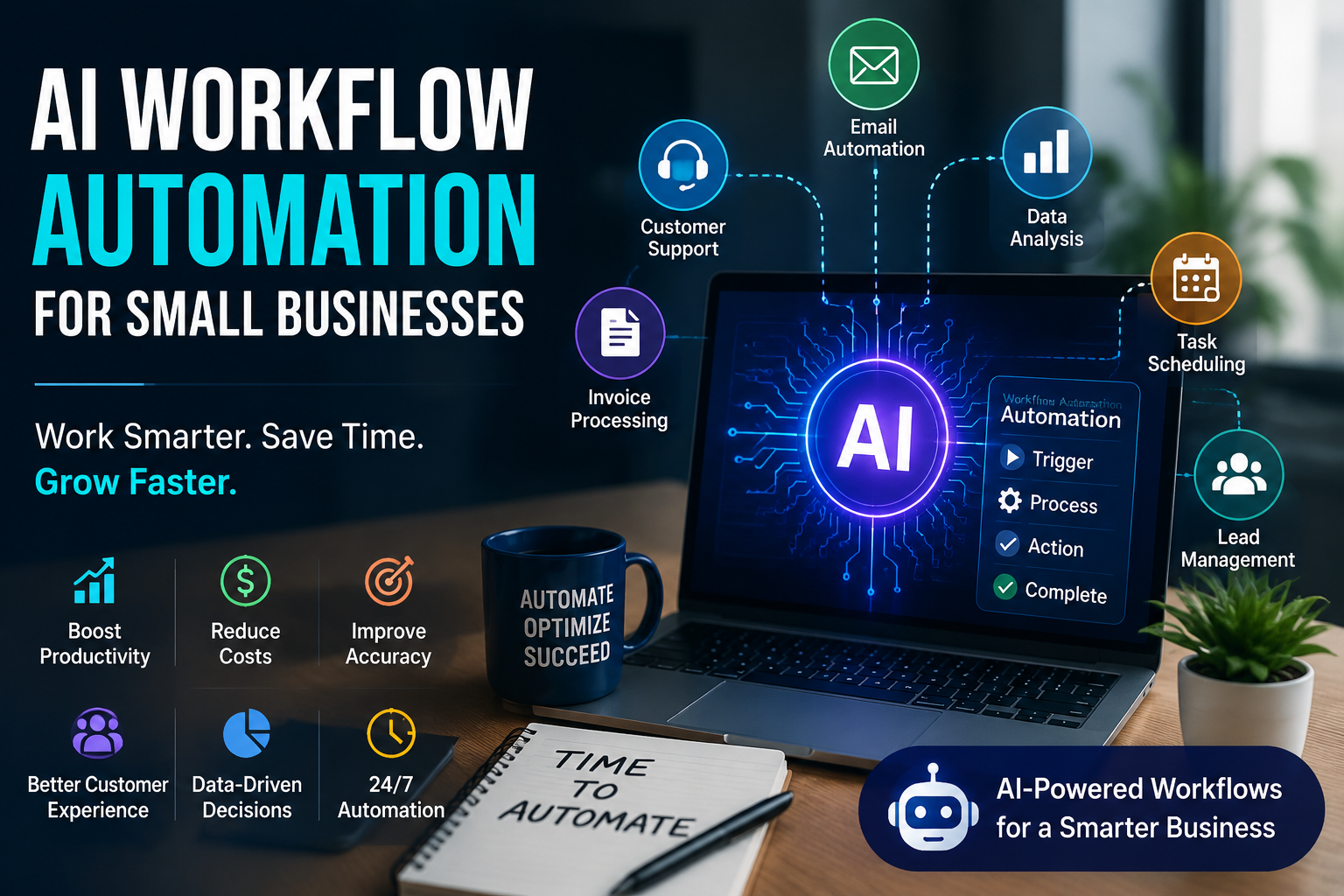

Discover how AI workflow automation for small businesses boosts productivity, reduces costs, and streamlines operations with practical examples, tools, benefits, and future trends.
AI Workflow Automation for Small Businesses: The Complete 2026 Guide
Introduction
AI workflow automation for small businesses has rapidly evolved from a luxury reserved for large enterprises into an essential competitive advantage for companies of every size. Thanks to affordable cloud-based AI platforms, no-code automation tools, and intelligent assistants, even businesses with limited budgets can automate repetitive tasks, improve customer service, reduce operational costs, and make better decisions through data-driven insights.
As artificial intelligence continues to dominate AI news, organizations are increasingly adopting automation technologies to simplify everyday operations without hiring additional staff. From automating invoices and email responses to managing customer support, inventory, marketing campaigns, and cybersecurity monitoring, AI is transforming how small businesses operate.
This comprehensive guide explores everything you need to know about AI workflow automation for small businesses, including its benefits, real-world applications, implementation strategies, challenges, future trends, and frequently asked questions.
What Is AI Workflow Automation?
AI workflow automation refers to using artificial intelligence technologies to automate business processes that traditionally require human intervention.
Unlike traditional automation, which follows predefined rules, AI-powered automation can:
- Learn from historical data
- Understand natural language
- Recognize images and documents
- Predict future outcomes
- Make intelligent recommendations
- Continuously improve performance
This makes AI significantly more flexible than conventional workflow software.
How AI Differs from Traditional Automation
| Traditional Automation | AI Workflow Automation |
|---|---|
| Rule-based | Learns from data |
| Fixed workflows | Adaptive workflows |
| Requires manual updates | Continuously improves |
| Limited decision-making | Intelligent decision-making |
| Handles repetitive tasks | Handles repetitive and cognitive tasks |
Why Small Businesses Need AI Workflow Automation
Small businesses often face several operational challenges:
- Limited staff
- Tight budgets
- Growing customer expectations
- Increasing administrative work
- Competition from larger companies
AI automation helps overcome these challenges by allowing employees to focus on strategic work instead of repetitive administrative tasks.
For example:
A small accounting firm can automatically classify receipts, generate invoices, schedule appointments, and answer common customer queries without expanding its workforce.
How AI Workflow Automation Works
AI workflow automation typically follows several stages.
1. Data Collection
AI gathers information from:
- Emails
- Customer forms
- CRM systems
- Accounting software
- Websites
- Cloud storage
- Documents
2. Data Analysis
Machine learning algorithms analyse the collected information to identify patterns and predict outcomes.
3. Decision Making
The AI decides what action should happen next based on business rules and learned behaviour.
Examples include:
- Sending approval requests
- Routing support tickets
- Detecting fraudulent transactions
- Scheduling follow-up emails
4. Continuous Learning
Unlike traditional automation, AI improves over time as it processes additional data.
Common AI Workflow Automation Use Cases
Customer Support Automation
AI chatbots provide:
- 24/7 customer service
- Instant responses
- Ticket creation
- Order tracking
- FAQ assistance
- Appointment booking
This significantly reduces support costs while improving customer satisfaction.
Email Management
AI automatically:
- Sorts emails
- Prioritises urgent messages
- Generates responses
- Summarises conversations
- Schedules follow-ups
Employees spend less time managing inboxes.
Marketing Automation
AI can automate:
- Email campaigns
- Customer segmentation
- Lead scoring
- Social media scheduling
- Ad optimisation
- Content recommendations
Marketing teams achieve higher conversion rates with less manual effort.
Sales Automation
Sales teams use AI to:
- Identify qualified leads
- Predict buying behaviour
- Generate proposals
- Schedule meetings
- Track customer interactions
HR Automation
Human resources departments automate:
- Resume screening
- Interview scheduling
- Employee onboarding
- Payroll workflows
- Performance reviews
Finance and Accounting
AI simplifies financial operations by:
- Processing invoices
- Detecting duplicate payments
- Expense categorisation
- Tax preparation
- Cash flow forecasting
Inventory Management
Retail businesses automate:
- Stock monitoring
- Purchase orders
- Demand forecasting
- Supplier communication
- Warehouse optimisation
Real-World Examples of AI Workflow Automation
Local Retail Store
A small retailer integrates AI with its inventory system.
The AI predicts demand based on:
- Seasonal trends
- Sales history
- Weather forecasts
- Local events
The result:
- Reduced stock shortages
- Lower storage costs
- Higher sales
Digital Marketing Agency
The agency automates:
- Client reporting
- Keyword tracking
- Social media publishing
- Content scheduling
- Lead management
Employees spend more time developing creative strategies.
Healthcare Clinic
A clinic uses AI to automate:
- Appointment reminders
- Insurance verification
- Patient record updates
- Follow-up communications
Administrative workload decreases dramatically.
Popular AI Workflow Automation Tools
Several AI platforms are suitable for small businesses.
| Tool | Best For | Key Features |
|---|---|---|
| ChatGPT | Content, customer support, productivity | Natural language assistance |
| Microsoft Copilot | Microsoft 365 users | AI within Office applications |
| Zapier AI | Workflow automation | Connects thousands of apps |
| Make | Advanced workflows | Visual automation builder |
| Notion AI | Knowledge management | Writing and organisation |
| HubSpot AI | Sales and marketing | CRM automation |
| Salesforce Einstein | Customer relationship management | Predictive analytics |
| Google Workspace AI | Productivity | AI-powered collaboration |
Industries Benefiting Most
AI workflow automation is creating value across numerous industries.
Healthcare
- Patient scheduling
- Medical documentation
- Billing automation
Retail
- Inventory forecasting
- Customer recommendations
- Order processing
Manufacturing
- Predictive maintenance
- Supply chain optimisation
- Quality control
Legal Services
- Document review
- Contract analysis
- Client intake
Financial Services
- Fraud detection
- Risk assessment
- Compliance monitoring
Education
- Student support
- Assignment evaluation
- Administrative automation
AI Workflow Automation and Cybersecurity
One major topic appearing in recent AI news is cybersecurity automation.
Modern AI systems help businesses:
- Detect phishing attacks
- Monitor unusual activity
- Identify malware
- Analyse security logs
- Respond to cyber threats faster
Small businesses are increasingly targeted by cybercriminals, making AI-powered security automation a valuable investment.
How to Implement AI Workflow Automation
Successful implementation requires planning.
Step 1: Identify Repetitive Tasks
Look for activities that:
- Consume significant time
- Follow predictable rules
- Require minimal creativity
Step 2: Prioritise High-Impact Processes
Focus on workflows that provide measurable returns.
Examples include:
- Customer support
- Data entry
- Marketing
- Accounting
Step 3: Choose the Right AI Platform
Consider:
- Budget
- Ease of use
- Security
- Integrations
- Scalability
Step 4: Start Small
Automate one process before expanding.
Step 5: Measure Results
Track metrics such as:
- Hours saved
- Cost reductions
- Customer satisfaction
- Revenue growth
- Error rates
Comparison Table: Manual vs AI Workflow Automation
| Feature | Manual Workflow | AI Workflow Automation |
|---|---|---|
| Speed | Slow | Very fast |
| Accuracy | Moderate | High |
| Human Errors | Common | Minimal |
| Scalability | Limited | Excellent |
| Cost Over Time | High | Lower |
| Availability | Working hours | 24/7 |
| Productivity | Moderate | High |
| Decision Support | Manual | AI-powered |
Benefits of AI Workflow Automation
Businesses adopting AI workflow automation gain several advantages.
Increased Productivity
Employees spend more time on strategic work rather than repetitive tasks.
Lower Operating Costs
Automation reduces labour expenses and operational inefficiencies.
Better Customer Experience
Customers receive faster responses and more personalised interactions.
Improved Accuracy
AI significantly reduces human errors in repetitive processes.
Enhanced Decision-Making
AI provides insights using real-time business data.
Business Scalability
Growing businesses can manage increasing workloads without proportionally increasing staffing.
Stronger Cybersecurity
AI continuously monitors systems and identifies suspicious behaviour before major incidents occur.
Challenges and Limitations
Despite its advantages, AI workflow automation presents several challenges.
Initial Investment
Some businesses require upfront spending on software and implementation.
Data Quality
Poor-quality data leads to inaccurate AI predictions.
Employee Resistance
Staff may worry about job security or struggle to adapt to new technologies.
Integration Complexity
Older software systems may not integrate easily with modern AI platforms.
Privacy and Compliance
Businesses must ensure compliance with data protection regulations when handling customer information.
AI Bias
Poorly trained AI models can produce biased or inaccurate recommendations.
Future Trends
AI workflow automation continues to evolve rapidly.
Hyperautomation
Businesses will automate entire operational ecosystems rather than individual tasks.
Autonomous AI Agents
AI assistants will independently complete multi-step workflows with minimal human supervision.
Smarter Predictive Analytics
Future systems will forecast customer behaviour, financial risks, and operational bottlenecks with greater accuracy.
Voice-Driven Automation
Natural language commands will increasingly replace traditional software interfaces.
AI and Robotics Integration
Physical automation will combine with intelligent software in warehouses, manufacturing, and logistics.
Industry-Specific AI Platforms
More vendors are developing specialised AI solutions tailored to healthcare, retail, finance, legal services, and manufacturing.
Expert Insights and Industry Trends
Industry analysts continue to observe rapid growth in AI adoption among small and medium-sized businesses. Advances in generative AI, intelligent document processing, and low-code automation platforms have significantly lowered the barriers to entry. Organisations that strategically automate repetitive processes often see improvements in productivity, customer satisfaction, and operational efficiency.
Experts also recommend adopting AI gradually. Rather than attempting to automate every workflow simultaneously, businesses typically achieve better outcomes by starting with one or two high-impact processes, measuring results, and expanding automation based on proven success.
As highlighted across ongoing AI news, responsible AI governance, employee training, and strong cybersecurity practices are becoming just as important as the technology itself.
Read More About:AI Cybersecurity Tools for Small Businesses: Complete Guide
Frequently Asked Questions
1. What is AI workflow automation for small businesses?
AI workflow automation uses artificial intelligence to automate repetitive business processes such as customer support, accounting, marketing, scheduling, document management, and data analysis, enabling businesses to improve efficiency and reduce manual work.
2. Is AI workflow automation expensive?
Not necessarily. Many modern AI platforms offer affordable subscription plans and scalable pricing, making automation accessible even for startups and small businesses with limited budgets.
3. Which departments benefit most from AI automation?
Customer service, marketing, finance, human resources, sales, operations, inventory management, and cybersecurity are among the departments that can benefit most from AI-powered automation.
4. Can AI replace employees?
AI is designed primarily to automate repetitive and time-consuming tasks rather than replace employees entirely. In most cases, it enables staff to focus on higher-value activities such as strategy, creativity, and customer relationships.
5. How secure is AI workflow automation?
When implemented correctly with appropriate encryption, access controls, regular updates, and compliance measures, AI workflow automation can improve organisational security by identifying threats and reducing human error.
6. What is the biggest challenge when adopting AI automation?
One of the biggest challenges is ensuring high-quality data and selecting workflows that provide measurable business value. Employee training and change management are also essential for successful adoption.
7. How long does implementation take?
Simple workflows can often be automated within days or weeks using no-code platforms, while more complex enterprise-level implementations may take several months depending on integrations and business requirements.
Conclusion
AI workflow automation for small businesses is no longer a futuristic concept—it is a practical solution that helps organisations operate more efficiently, serve customers better, and remain competitive in an increasingly digital economy. From automating customer service and financial processes to improving cybersecurity and marketing performance, AI delivers measurable benefits across virtually every business function.
The key to success is a strategic approach: begin with repetitive, high-impact tasks, choose tools that align with your business goals, ensure strong data governance, and continuously evaluate performance. Businesses that embrace AI responsibly today will be better positioned to adapt to tomorrow’s technological advances and changing customer expectations.
As developments continue to shape AI news, workflow automation will remain one of the most valuable investments for small businesses seeking sustainable growth, operational resilience, and long-term success.
Key Takeaways
- AI workflow automation helps small businesses reduce repetitive manual work.
- Intelligent automation improves productivity, efficiency, and operational accuracy.
- AI supports customer service, finance, marketing, HR, sales, inventory management, and cybersecurity.
- Modern no-code AI platforms make automation affordable for businesses of all sizes.
- Starting with one high-value workflow reduces implementation risks.
- High-quality data and employee training are critical for successful AI adoption.
- AI enhances decision-making through predictive analytics and real-time insights.
- Strong cybersecurity practices should accompany every AI implementation.
- Future innovations such as autonomous AI agents and hyperautomation will further transform business operations.
- Businesses that invest in AI workflow automation today are better prepared for long-term digital growth and competitiveness.