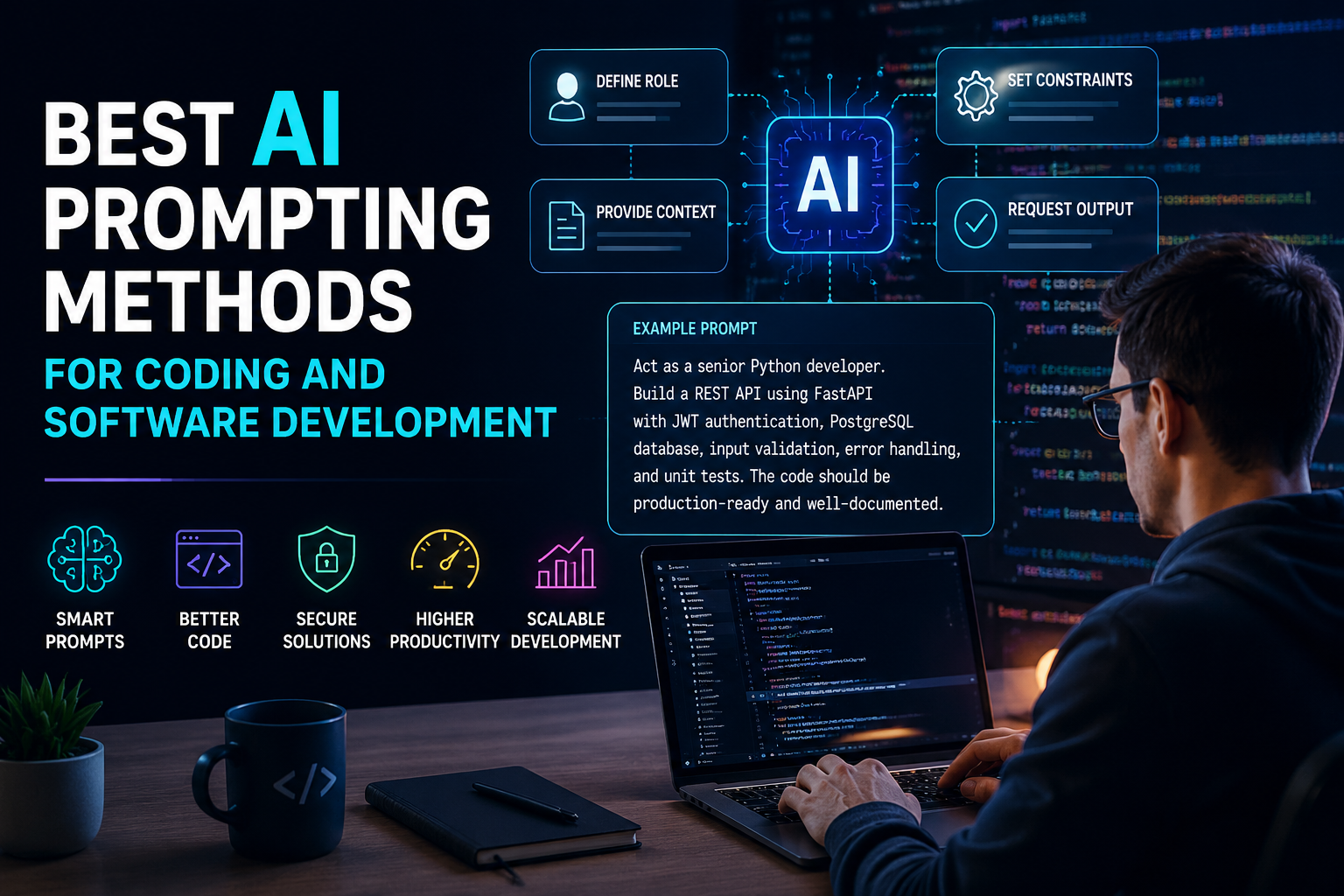

Discover the best AI prompting methods for coding and software development. Learn expert techniques, practical examples, and AI trends to improve coding accuracy and productivity.
Introduction
Artificial intelligence has transformed software development by enabling developers to generate code, debug applications, write documentation, automate testing, and even design software architectures in seconds. However, the quality of AI-generated results depends heavily on one crucial factor: the prompt.
Understanding the Best AI prompting methods for coding and software development has become an essential skill for developers, DevOps engineers, cybersecurity professionals, software architects, and technology enthusiasts. A well-crafted prompt can produce clean, secure, and maintainable code, while a vague prompt often leads to inaccurate or incomplete results.
As modern AI coding assistants continue evolving, developers who master effective prompting techniques gain a significant competitive advantage. Whether you’re using AI to create APIs, optimise algorithms, generate documentation, review pull requests, or identify security vulnerabilities, structured prompting dramatically improves the quality of outputs.
This comprehensive guide explores the most effective AI prompting methods, practical examples, industry best practices, future trends, and expert recommendations to help you maximise AI’s potential in software development.
Why AI Prompting Matters in Software Development
AI coding assistants are trained on massive datasets containing programming languages, documentation, open-source repositories, and software engineering knowledge. They generate responses based on the context provided by the user.
Instead of thinking of AI as a search engine, think of it as a collaborative software engineer. The better your instructions, the better the collaboration.
Effective prompting helps developers:
- Generate higher-quality code
- Reduce debugging time
- Improve software security
- Produce better documentation
- Increase development speed
- Learn unfamiliar technologies faster
- Maintain coding standards
- Reduce repetitive tasks
Poor prompting often results in:
- Incorrect code
- Missing edge cases
- Security vulnerabilities
- Inefficient algorithms
- Generic solutions
- Incomplete implementations
Understanding How AI Interprets Coding Prompts
Before exploring prompting methods, it is important to understand how AI processes instructions.
AI models analyse:
- Context
- Programming language
- Framework
- Project requirements
- Previous conversation
- Constraints
- Desired output format
The more context provided, the better the generated solution.
Example
Poor prompt:
Write a login function.
Improved prompt:
Write a secure login function in Python using Flask that validates email and password, hashes passwords using bcrypt, protects against SQL injection, includes JWT authentication, and returns appropriate HTTP status codes.
The second prompt provides clear expectations, allowing AI to generate far more useful code.
Best AI Prompting Methods for Coding and Software Development
1. Be Extremely Specific
Specific prompts dramatically improve AI accuracy.
Include details such as:
- Programming language
- Framework
- Libraries
- Database
- Security requirements
- Coding standards
- Performance goals
Example
Instead of:
Build an API.
Use:
Build a REST API in Node.js using Express and MongoDB with JWT authentication, rate limiting, input validation, Swagger documentation, and unit tests.
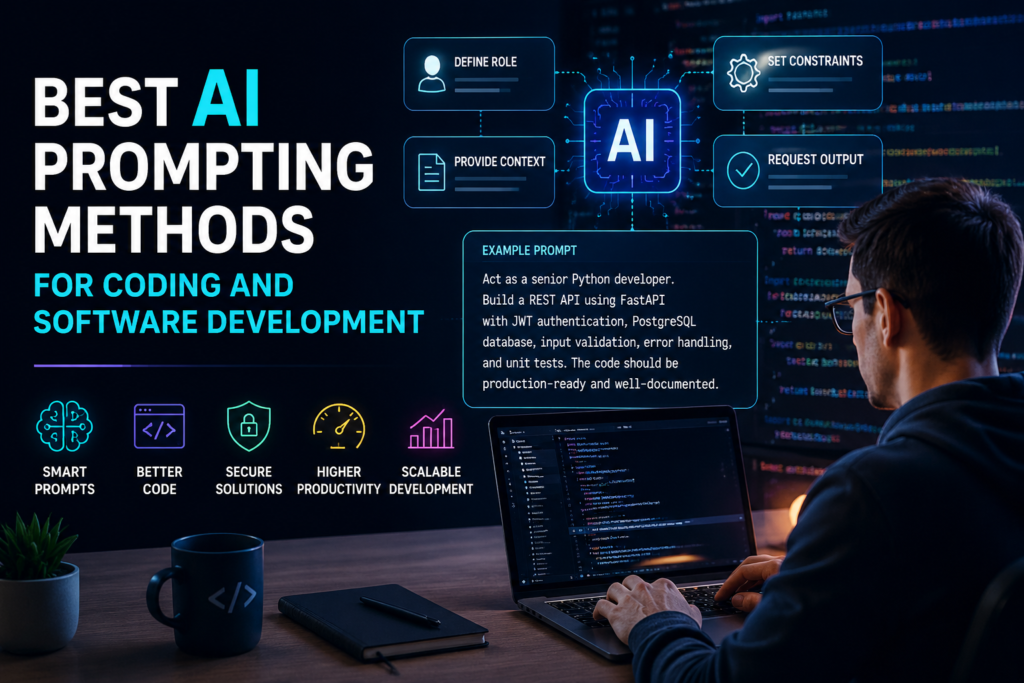
2. Define the AI’s Role
Assigning a role helps AI tailor its response.
Examples include:
- Senior Software Engineer
- DevOps Engineer
- Security Analyst
- Backend Architect
- Frontend Developer
- Database Administrator
Example
Act as a senior Java developer with experience building enterprise banking applications.
This immediately changes the tone and depth of the generated solution.
3. Provide Context
Context helps AI understand the larger objective.
Useful context includes:
- Existing architecture
- Project goals
- Team coding standards
- Performance requirements
- User expectations
- Target platform
Example:
This project is a SaaS inventory platform serving over 500,000 users. Optimise for scalability and maintainability.
4. Break Large Tasks into Smaller Prompts
Complex software projects should not be generated in a single prompt.
Instead, divide work into stages:
- Design architecture
- Create database schema
- Generate backend
- Build frontend
- Write API tests
- Review security
- Optimise performance
This iterative approach improves quality significantly.
5. Request Step-by-Step Reasoning
Rather than asking for immediate code, ask AI to explain its design process first.
Example:
Explain the architecture before writing the implementation.
Benefits include:
- Better understanding
- Easier debugging
- More maintainable code
- Improved learning
6. Use Constraints
Constraints help narrow AI responses.
Examples:
- Maximum memory usage
- O(n log n) complexity
- Avoid recursion
- Use only standard libraries
- Compatible with Python 3.12
- Follow SOLID principles
Example prompt:
Write an algorithm with O(n) time complexity without using external packages.
7. Request Multiple Solutions
Instead of asking for one answer, request alternatives.
Example:
Show three different implementations with performance comparisons.
This allows developers to choose the best design.
8. Ask AI to Review Its Own Code
Self-review improves quality considerably.
Prompt example:
Review the generated code for security issues, performance bottlenecks, edge cases, and maintainability.
This often identifies problems before deployment.
9. Use Prompt Chaining
Prompt chaining means using AI outputs as inputs for later prompts.
Example workflow:
- Generate requirements
- Design architecture
- Generate API
- Generate frontend
- Create tests
- Optimise performance
- Generate documentation
Professional AI users commonly rely on this workflow.
10. Request Production-Ready Code
Always specify production expectations.
Example:
Generate production-ready code with comments, error handling, logging, validation, unit tests, and documentation.
This avoids simplistic examples unsuitable for real-world applications.
Practical AI Prompt Examples
Backend Development
Prompt:
Build a scalable FastAPI microservice with PostgreSQL, JWT authentication, Docker support, OpenAPI documentation, Redis caching, and comprehensive unit tests.
Frontend Development
Prompt:
Create a responsive React dashboard using TypeScript, Tailwind CSS, Redux Toolkit, and reusable components.
Cybersecurity
Prompt:
Review this authentication code for OWASP Top 10 vulnerabilities and recommend secure improvements.
Code Optimisation
Prompt:
Optimise this Python algorithm for lower memory usage while maintaining readability.
Documentation
Prompt:
Generate developer documentation with installation steps, API endpoints, architecture overview, and deployment instructions.
Comparison Table: Common AI Prompting Methods
| Prompting Method | Best Use Case | Advantages | Potential Drawbacks |
|---|---|---|---|
| Direct Prompting | Simple coding tasks | Fast and straightforward | May lack detail |
| Role-Based Prompting | Professional software design | Better expertise simulation | Requires detailed instructions |
| Chain Prompting | Large projects | Higher accuracy | More time-consuming |
| Constraint-Based Prompting | Performance optimisation | Produces focused results | Needs clear requirements |
| Self-Review Prompting | Code quality assurance | Finds hidden issues | May not catch every edge case |
| Multi-Solution Prompting | Architecture decisions | Encourages comparison | Generates more output to evaluate |
Real-World Applications
Modern organisations increasingly use AI prompting across software development workflows.
Common applications include:
Enterprise Software Development
AI assists with:
- API development
- Database design
- Cloud deployment
- Infrastructure automation
- Code reviews
Cybersecurity
Security teams use AI for:
- Vulnerability detection
- Secure coding recommendations
- Threat modelling
- Malware analysis
- Compliance documentation
DevOps
AI helps automate:
- CI/CD pipelines
- Infrastructure as Code
- Docker configurations
- Kubernetes manifests
- Monitoring scripts
Mobile Development
Developers generate:
- Flutter applications
- Swift interfaces
- Android components
- Cross-platform UI
- Mobile testing scripts
Industry Insights and AI News
The AI software development landscape continues to evolve rapidly. Modern AI coding assistants can now generate multi-file applications, explain legacy code, perform automated debugging, and assist with architecture design. Industry research consistently shows that developers using AI responsibly can complete routine programming tasks faster while maintaining or improving code quality when human review remains part of the workflow.
At the same time, organisations are strengthening governance around AI-generated code by introducing security reviews, licensing checks, and internal prompting guidelines. As AI capabilities expand, prompt engineering is becoming a recognised technical skill for development teams, reflecting a broader trend in AI news and enterprise technology adoption.
Benefits
Mastering AI prompting methods offers numerous advantages:
- Faster software development
- Improved code quality
- Reduced debugging time
- Better software architecture
- Increased developer productivity
- Enhanced collaboration
- Stronger cybersecurity practices
- More comprehensive documentation
- Easier onboarding for junior developers
- Faster learning of new frameworks and languages
Challenges or Limitations
Despite its advantages, AI-assisted coding has limitations.
Common challenges include:
- Hallucinated code or APIs
- Outdated framework knowledge depending on the model
- Potential security vulnerabilities
- Limited understanding of proprietary systems without sufficient context
- Licensing considerations for generated code
- Over-reliance on AI reducing critical thinking
- Need for continuous human review
- Difficulty handling highly specialised business logic
Developers should treat AI as a collaborative assistant rather than a replacement for engineering judgement.
Future Trends
The future of AI prompting in software development is exceptionally promising.
Emerging trends include:
Multi-Agent Development
Multiple AI agents will collaborate on planning, coding, testing, debugging, documentation, and deployment.
Personalised AI Coding Assistants
Future assistants will understand individual coding styles, project history, and team standards.
Autonomous Testing
AI will automatically generate:
- Unit tests
- Integration tests
- Security tests
- Performance benchmarks
Context-Aware Development
AI systems will increasingly understand entire repositories rather than isolated files, enabling more consistent recommendations.
Secure-by-Default Coding
AI assistants will increasingly incorporate secure coding practices, compliance requirements, and vulnerability prevention directly into generated code.
Read More About:AI Cybersecurity Tools for Small Businesses: Complete Guide
Frequently Asked Questions
1. What is the best AI prompting method for coding?
The most effective approach combines role-based prompting, detailed context, explicit constraints, and iterative refinement. Clear, structured prompts consistently produce higher-quality results than short, generic requests.
2. Can AI replace software developers?
No. AI accelerates development by automating repetitive tasks and assisting with problem-solving, but experienced developers remain essential for architecture, business logic, security, quality assurance, and strategic decision-making.
3. Which programming languages work best with AI?
Most leading AI coding tools perform well with popular languages such as Python, JavaScript, TypeScript, Java, C#, Go, Rust, PHP, Kotlin, Swift, and SQL.
4. How can I improve AI-generated code?
Provide detailed requirements, define the programming language and framework, include performance and security constraints, request production-ready output, and always review and test the generated code before deployment.
5. Is AI-generated code secure?
Not always. AI can introduce insecure patterns or overlook edge cases. Every AI-generated solution should undergo manual review, automated testing, dependency checks, and security analysis before production use.
6. Why is prompt engineering important for developers?
Prompt engineering helps developers communicate requirements more effectively to AI systems, leading to more accurate code, fewer revisions, improved productivity, and better learning outcomes.
Conclusion
The Best AI prompting methods for coding and software development go far beyond asking an AI tool to “write some code.” Successful prompting requires clear objectives, detailed context, appropriate constraints, iterative refinement, and critical human oversight.
Developers who adopt structured prompting techniques can significantly improve productivity, reduce repetitive work, strengthen software security, and produce higher-quality applications. As AI continues to reshape software engineering, prompt engineering is becoming a valuable professional skill alongside programming, testing, and system design.
By combining AI’s speed with human expertise, organisations and individual developers can build smarter, safer, and more scalable software while staying ahead in an increasingly AI-driven technology landscape.
Key Takeaways
- Mastering AI prompting significantly improves coding quality and productivity.
- Specific, context-rich prompts consistently outperform vague instructions.
- Role-based prompting helps AI generate more professional and relevant solutions.
- Breaking complex projects into smaller prompt chains produces better results.
- Production-ready prompts should include security, testing, documentation, and error handling requirements.
- AI-generated code should always be reviewed by experienced developers.
- Effective prompting supports better software architecture, faster debugging, and improved collaboration.
- Prompt engineering is rapidly becoming a core skill in modern software development.
- AI continues to influence coding practices, cybersecurity, and enterprise software engineering.
- Combining human expertise with AI assistance delivers the best long-term development outcomes.