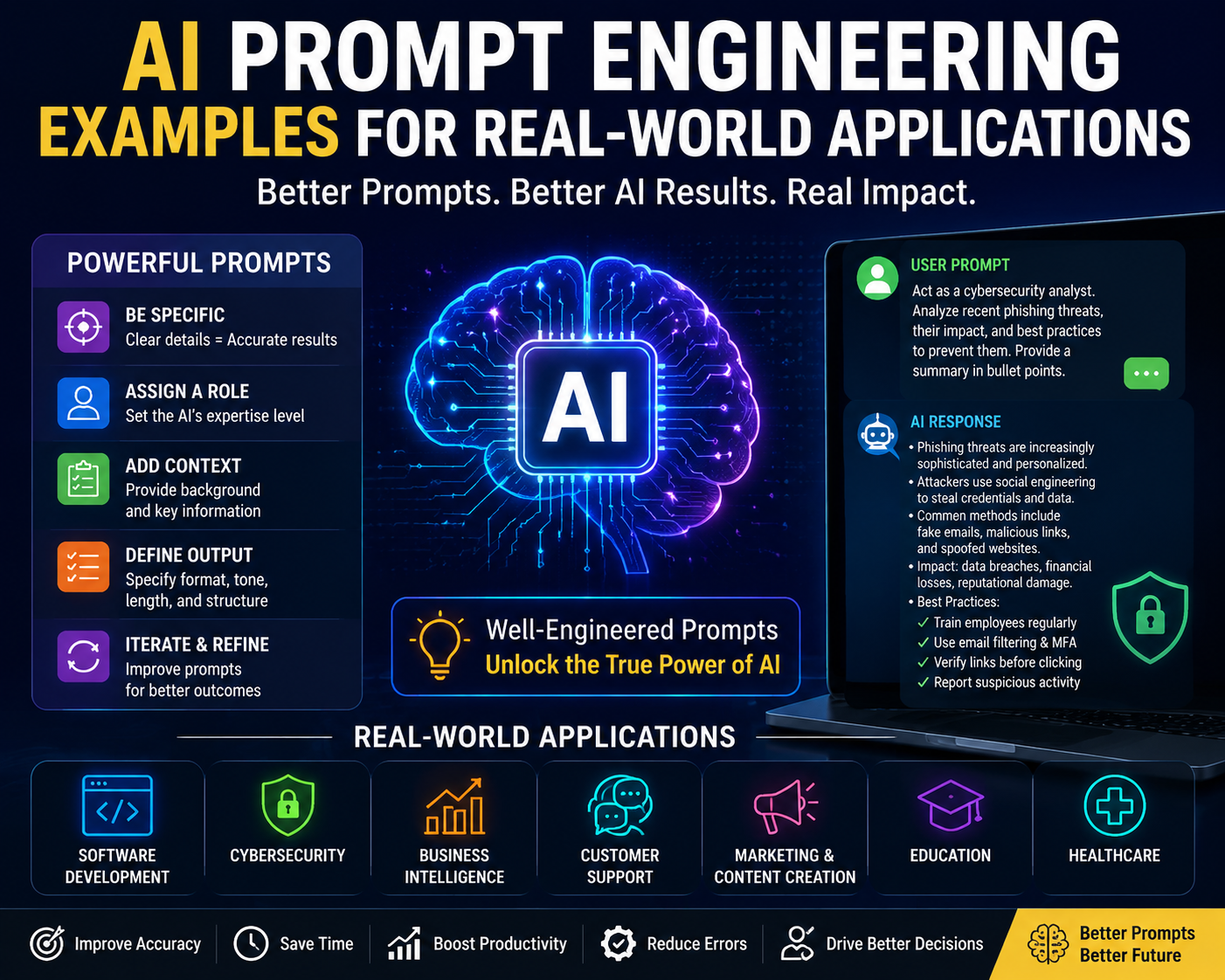

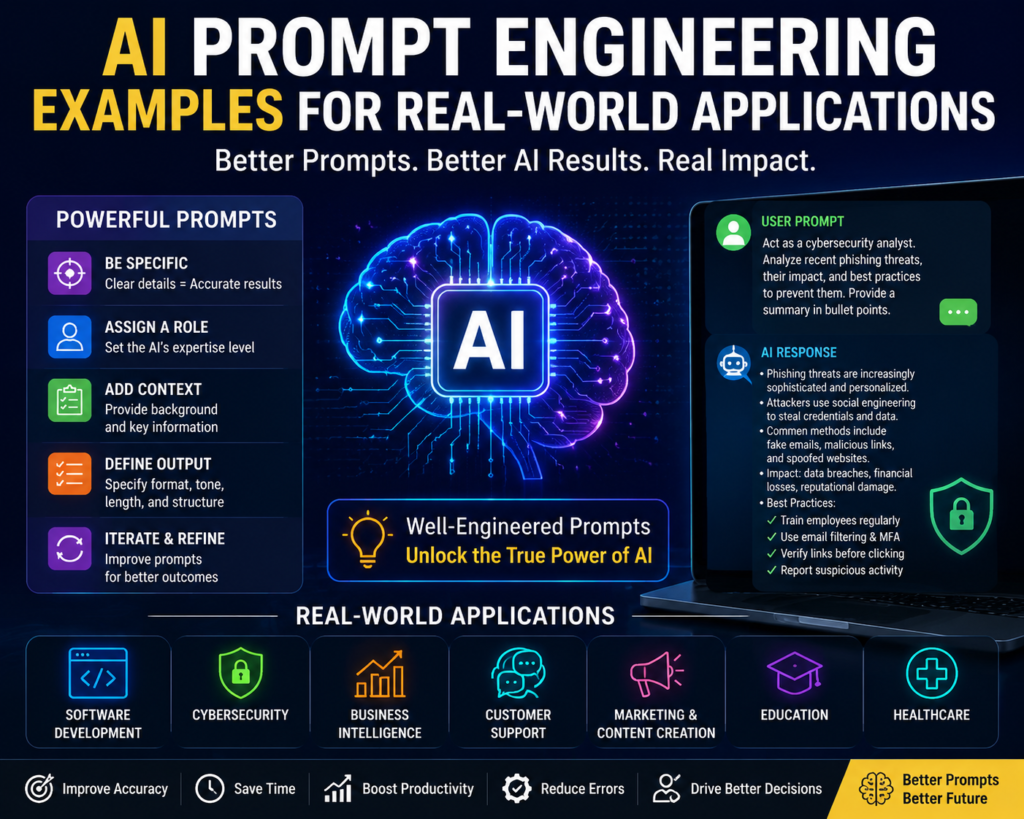
Discover AI prompt engineering examples for real-world applications with practical use cases, expert tips, cybersecurity insights, and industry best practices.
Introduction
Artificial intelligence has rapidly evolved from a futuristic concept into an everyday productivity tool used across nearly every industry. Whether you’re writing code, creating marketing content, analysing cybersecurity threats, automating customer support, or generating business reports, the quality of AI-generated responses depends largely on one critical skill—prompt engineering.
Understanding AI prompt engineering examples for real-world applications has become essential for developers, business owners, cybersecurity professionals, marketers, educators, and technology enthusiasts. Instead of simply asking an AI chatbot a question, effective prompt engineering involves providing clear instructions, context, constraints, and desired outcomes to achieve accurate, relevant, and high-quality results.
As generative AI continues transforming workplaces, professionals who master prompt engineering gain a significant competitive advantage. Better prompts reduce errors, improve efficiency, increase productivity, and unlock advanced AI capabilities that many casual users never experience.
In this guide, you’ll explore practical AI prompt engineering examples for real-world applications, discover proven prompting techniques, compare different methods, and learn how industries are using AI to solve real business challenges.
What Is AI Prompt Engineering?
AI prompt engineering is the process of designing effective instructions that guide artificial intelligence models toward producing accurate, useful, and context-aware responses.
A prompt can be:
- A question
- A detailed instruction
- A role assignment
- A coding request
- A business scenario
- A multi-step workflow
- A document summarisation request
Rather than relying on vague questions, prompt engineering provides AI with the context needed to produce high-quality results.
For example:
Weak Prompt
Write an email.
Strong Prompt
Write a professional follow-up email to a client after a product demonstration. Keep the tone friendly, mention the key product benefits, answer common objections, and include a clear call-to-action for scheduling another meeting.
The second prompt delivers a far more targeted and useful response.
Why Prompt Engineering Matters
Modern AI models can generate impressive results, but they cannot accurately infer every user’s intent without guidance.
Effective prompt engineering helps users:
- Improve response accuracy
- Save valuable time
- Reduce repetitive revisions
- Generate structured outputs
- Improve AI reliability
- Increase workplace productivity
- Produce higher-quality business content
- Strengthen decision-making
Poor prompts often produce:
- Generic answers
- Incorrect information
- Missing context
- Weak formatting
- Incomplete solutions
Core Principles of Effective Prompt Engineering
Be Specific
The more detailed the prompt, the better the response.
Instead of:
Explain cybersecurity.
Try:
Explain ransomware attacks for small business owners using simple language and include prevention strategies.
Provide Context
Context helps AI understand your goals.
Include:
- Industry
- Audience
- Experience level
- Desired tone
- Output format
- Constraints
Assign a Role
Role prompting dramatically improves specialised outputs.
Examples include:
- Cybersecurity analyst
- Software engineer
- Financial advisor
- Technical writer
- Marketing strategist
- HR consultant
Example:
Act as a senior cybersecurity consultant performing a vulnerability assessment for a healthcare organisation.
Define the Desired Output
Instead of asking for “an article,” specify:
- Bullet points
- Table
- Executive summary
- JSON
- Markdown
- Report
- Checklist
This reduces unnecessary editing later.
AI Prompt Engineering Examples for Real-World Applications
Software Development
Developers use prompt engineering to accelerate coding while maintaining quality.
Example Prompt
Act as a senior Python developer. Build a REST API using FastAPI with JWT authentication, PostgreSQL integration, Docker support, logging, unit tests, and detailed comments.
Applications include:
- API development
- Code debugging
- Documentation
- Unit testing
- Refactoring
- Code optimisation
AI Cybersecurity
Security teams increasingly rely on AI for faster threat detection and incident response.
Example Prompt
Act as a cybersecurity analyst. Review this firewall configuration, identify potential vulnerabilities based on OWASP recommendations, explain each risk, and suggest secure improvements.
Common cybersecurity use cases:
- Threat intelligence
- Malware analysis
- Log analysis
- Phishing detection
- Security documentation
- Compliance reporting
Business Intelligence
Executives use AI to analyse reports faster.
Example:
Summarise this quarterly sales report into five executive insights with recommended business actions.
AI assists with:
- KPI reporting
- Financial summaries
- Forecast analysis
- Market research
- Competitive analysis
Customer Support
Prompt engineering enables faster customer service.
Example:
Respond as a friendly support representative. Resolve the customer’s issue, apologise professionally, and recommend the next steps.
Applications include:
- Email responses
- Live chat
- Ticket summaries
- FAQ generation
- Knowledge bases
Marketing
Marketing professionals use AI every day.
Prompt:
Create a LinkedIn post promoting a cybersecurity webinar for IT managers. Keep it under 200 words and include a compelling call-to-action.
AI generates:
- Blog articles
- Email campaigns
- Social media posts
- SEO content
- Product descriptions
Education
Teachers increasingly use AI.
Prompt example:
Explain machine learning to a 12-year-old using simple examples and a short quiz at the end.
Educational uses include:
- Lesson plans
- Practice questions
- Study guides
- Course outlines
- Feedback generation
Healthcare Administration
Healthcare organisations use AI primarily for administrative tasks.
Prompt:
Summarise these clinical notes into a concise handover report while preserving key medical information.
AI can help with documentation, scheduling, coding support, and patient communication, while qualified professionals remain responsible for clinical decisions.
Comparison Table: Common Prompt Engineering Techniques
| Technique | Best Use Case | Advantages | Limitations |
|---|---|---|---|
| Zero-Shot Prompting | Simple tasks | Fast | Less context |
| Few-Shot Prompting | Consistent formatting | Higher accuracy | Longer prompts |
| Role Prompting | Expert responses | Professional output | Requires clear roles |
| Chain Prompting | Complex workflows | Better reasoning | More time |
| Constraint Prompting | Technical work | Precise responses | Needs detailed requirements |
| Iterative Prompting | Refinement | Highest quality | Multiple interactions |
Industry Insights
Prompt engineering has evolved into a valuable professional skill as organisations adopt generative AI across software development, customer service, research, marketing, and cybersecurity. Businesses are creating internal prompt libraries, governance policies, and review processes to improve consistency and reduce risks associated with AI-generated content.
In software engineering, structured prompts help teams automate repetitive coding tasks while maintaining documentation and testing standards. In cybersecurity, AI assists analysts with log analysis, vulnerability reviews, and incident reporting, but expert validation remains essential before making operational decisions.
Recent trends in AI news also highlight the rise of AI agents capable of handling multi-step workflows, making prompt quality even more important for achieving reliable outcomes.
Benefits of AI Prompt Engineering
Mastering AI prompt engineering examples for real-world applications offers far more than better chatbot conversations. It enables individuals and organisations to unlock the full potential of generative AI while improving efficiency, accuracy, and decision-making.
Some of the most significant benefits include:
- Higher-quality AI responses through clear, detailed instructions.
- Increased productivity by automating repetitive tasks.
- Faster software development with AI-assisted coding and debugging.
- Better cybersecurity workflows through automated threat analysis and documentation.
- Improved content creation for blogs, emails, reports, and marketing campaigns.
- Enhanced customer support with consistent, personalised responses.
- Reduced operational costs by streamlining routine processes.
- Better decision-making through faster data analysis and summarisation.
- Greater accessibility by helping non-technical users perform complex tasks.
- Continuous learning as professionals experiment with different prompting strategies.
Ultimately, effective prompt engineering transforms AI from a simple assistant into a reliable productivity partner.
Challenges or Limitations
Although prompt engineering delivers impressive results, it also has limitations that users should understand.
AI Can Produce Incorrect Information
Even well-crafted prompts cannot guarantee factual accuracy. AI systems may occasionally generate incorrect or outdated information, making human verification essential.
Prompt Quality Determines Output
Poorly written prompts often produce vague, incomplete, or irrelevant responses. Learning how to structure prompts takes practice.
Security and Privacy Concerns
Users should avoid including confidential business information, passwords, customer data, or sensitive intellectual property in prompts unless using approved enterprise AI platforms with appropriate safeguards.
Limited Business Context
AI only understands the information provided within the prompt and conversation. Without sufficient context, recommendations may not align with organisational goals or policies.
Human Oversight Remains Essential
AI-generated content should always be reviewed by qualified professionals, especially in industries such as healthcare, finance, cybersecurity, and law, where accuracy and compliance are critical.
Future Trends in AI Prompt Engineering
Prompt engineering continues to evolve alongside advances in generative AI. Several emerging trends are expected to shape its future.
AI Agents and Autonomous Workflows
Rather than completing a single task, AI systems are increasingly capable of managing multi-step workflows such as planning projects, generating code, testing software, and preparing reports with minimal human intervention.
Multimodal Prompt Engineering
Modern AI models can process text, images, audio, and video together. Future prompts will increasingly combine multiple content types, enabling richer interactions and more powerful applications.
Personalised AI Assistants
AI assistants are becoming more context-aware, adapting to individual users, organisations, coding styles, writing preferences, and business processes.
Enterprise Prompt Libraries
Many organisations are building centralised prompt libraries containing approved templates for customer service, software development, cybersecurity, legal documentation, and marketing to improve consistency and governance.
Secure and Responsible AI
Future prompt engineering will place greater emphasis on privacy, transparency, ethical AI use, and compliance with emerging regulations. Organisations will continue investing in governance frameworks to reduce risks associated with AI-generated content.
Read More About:Best AI Prompting Methods for Coding and Software Development
Frequently Asked Questions
1. What is AI prompt engineering?
AI prompt engineering is the process of designing clear and structured instructions that help AI models generate more accurate, relevant, and useful responses.
2. Why is prompt engineering important?
Prompt engineering improves the quality of AI-generated outputs by providing context, constraints, and specific objectives. Better prompts typically produce better results.
3. Who should learn prompt engineering?
Anyone using generative AI can benefit, including software developers, cybersecurity professionals, marketers, educators, business leaders, researchers, students, and content creators.
4. What industries use prompt engineering?
Prompt engineering is widely used in software development, healthcare administration, finance, marketing, education, cybersecurity, customer service, manufacturing, legal services, and scientific research.
5. Can prompt engineering replace technical skills?
No. Prompt engineering complements professional expertise rather than replacing it. Human knowledge remains essential for validating AI outputs and making informed decisions.
6. What makes a good AI prompt?
A strong prompt typically includes:
- Clear objectives
- Relevant context
- Specific constraints
- Desired output format
- Target audience
- Examples when appropriate
7. How can I improve my prompts?
Practice writing detailed instructions, provide background information, define the AI’s role, specify the desired output format, and refine prompts based on previous results.
8. Is prompt engineering only for ChatGPT?
No. Prompt engineering principles apply to many generative AI platforms, coding assistants, image generators, document summarisation tools, and enterprise AI systems.
Conclusion
Understanding AI prompt engineering examples for real-world applications is becoming an increasingly valuable skill in today’s AI-driven workplace. From software development and cybersecurity to marketing, education, customer service, and business intelligence, well-designed prompts enable AI systems to deliver more accurate, efficient, and meaningful results.
The most successful AI users recognise that prompt engineering is an iterative process. Clear objectives, sufficient context, appropriate constraints, and continuous refinement consistently produce better outcomes than vague or generic instructions.
As generative AI continues to evolve, prompt engineering will remain a core competency for professionals seeking to improve productivity, automate workflows, and solve increasingly complex problems. Organisations that invest in prompt engineering skills, governance, and responsible AI practices will be well positioned to maximise the benefits of artificial intelligence while maintaining quality, security, and trust.
Key Takeaways
- AI prompt engineering improves the accuracy and usefulness of AI-generated responses.
- Clear, context-rich prompts consistently outperform vague instructions.
- Role-based, constraint-based, and iterative prompting techniques enhance output quality.
- Prompt engineering has practical applications across software development, cybersecurity, marketing, education, business intelligence, and customer support.
- Human review remains essential for validating AI-generated content, particularly in high-stakes industries.
- Enterprise organisations are adopting prompt libraries and governance frameworks to standardise AI usage.
- Multimodal AI, autonomous agents, and personalised assistants are shaping the future of prompt engineering.
- Developing prompt engineering skills can significantly improve productivity and decision-making.
- Responsible AI practices—including privacy, transparency, and human oversight—are critical for long-term success.
- Mastering prompt engineering today prepares individuals and organisations for the next generation of AI-powered innovation.