
Explore the future of multimodal AI systems, their benefits, real-world applications, challenges, emerging trends, and how they will transform industries.
Introduction
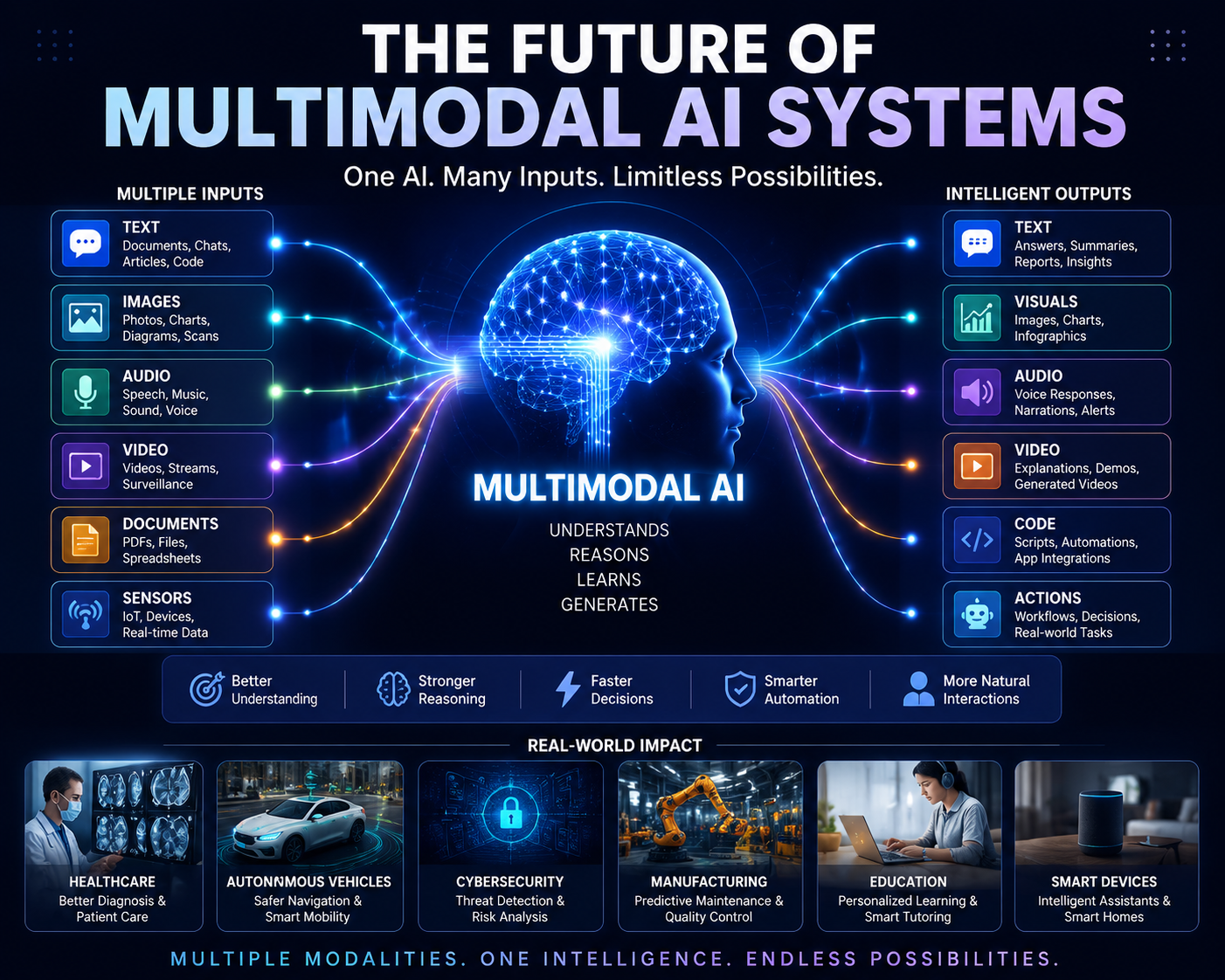
Artificial intelligence has evolved far beyond simple text generation. Today’s most advanced AI models can understand and process multiple types of data simultaneously, including text, images, audio, video, documents, and even sensor inputs. This revolutionary approach, known as multimodal AI, is redefining how humans interact with intelligent systems and paving the way for a new generation of AI-powered applications.
Understanding the Future of Multimodal AI Systems is becoming essential for businesses, developers, cybersecurity professionals, and technology enthusiasts. Unlike traditional AI models that specialize in a single data type, multimodal AI integrates information from various sources to produce richer insights, more accurate responses, and more human-like interactions.
From autonomous vehicles and AI-powered healthcare to cybersecurity, robotics, education, and smart devices, multimodal AI is rapidly becoming the foundation of next-generation intelligent systems. Major technology companies are investing billions of dollars into multimodal research because it promises AI that can see, hear, read, understand, and reason much like humans.
In this comprehensive guide, we’ll explore how multimodal AI works, why it matters, its real-world applications, benefits, challenges, future trends, and what businesses and professionals should expect over the coming years.
What Is Multimodal AI?
Multimodal AI refers to artificial intelligence systems capable of processing and understanding multiple forms of data simultaneously.
Instead of relying on only one input type—such as text—multimodal AI combines several data sources to generate a more comprehensive understanding.
Common data modalities include:
- Text
- Images
- Audio
- Video
- Documents
- Speech
- Sensor data
- Location data
- Medical imaging
For example, a multimodal AI assistant could analyze a photograph, listen to spoken instructions, read accompanying documents, and generate an accurate response based on all available information.
This mirrors how humans naturally combine sight, hearing, language, and context to make decisions.
How Multimodal AI Systems Work
Multimodal AI systems combine specialized models into a unified architecture.
Step 1: Data Collection
The system receives one or more input types such as:
- Text prompts
- Voice commands
- Images
- Videos
- PDFs
- Sensor readings
Step 2: Data Encoding
Each modality is converted into numerical representations known as embeddings.
These embeddings allow AI to compare relationships between different forms of information.
Step 3: Cross-Modal Understanding
The AI aligns different modalities together.
For example:
- An image of a broken machine
- A spoken description of the issue
- A maintenance manual
The AI understands all three as part of the same problem.
Step 4: Reasoning
Large AI models analyze the combined information to determine the most accurate response.
Step 5: Output Generation
The AI produces outputs that may include:
- Text
- Images
- Audio
- Code
- Reports
- Recommendations
- Interactive responses
Why Multimodal AI Represents the Future
Traditional AI models are powerful but limited.
Text-only systems cannot interpret images.
Image recognition systems cannot understand conversations.
Speech assistants often lack visual understanding.
Multimodal AI removes these limitations by integrating multiple data sources into a unified intelligence layer.
This results in:
- Better decision-making
- Improved contextual awareness
- More natural interactions
- Greater accuracy
- Enhanced automation
As computing power and AI models continue to improve, multimodal systems are expected to become the standard across industries.
Key Technologies Behind Multimodal AI
Several technologies enable multimodal intelligence.
Large Language Models (LLMs)
LLMs provide reasoning and language understanding.
Computer Vision
Computer vision enables AI to analyze images and videos.
Applications include:
- Object detection
- Facial recognition
- Medical imaging
- Industrial inspection
Speech Recognition
AI converts spoken language into text for further analysis.
Natural Language Processing (NLP)
NLP enables AI to understand context, intent, and meaning in written or spoken language.
Vector Databases
These databases store embeddings for efficient retrieval and semantic search across multiple data types.
Retrieval-Augmented Generation (RAG)
RAG enhances multimodal AI by retrieving relevant external knowledge before generating responses, improving accuracy and reducing hallucinations.
Real-World Applications of Multimodal AI
Healthcare
Doctors can upload:
- Medical images
- Patient histories
- Laboratory reports
- Voice notes
The AI combines all inputs to assist with diagnosis, treatment planning, and clinical documentation.
Autonomous Vehicles
Self-driving vehicles process:
- Camera feeds
- Radar
- LiDAR
- GPS
- Traffic data
Combining these inputs enables safer navigation and faster decision-making.
AI Cybersecurity
Multimodal AI strengthens cybersecurity by analyzing:
- Network traffic
- Security logs
- User behavior
- Threat intelligence
- Incident reports
This improves threat detection and response.
Smart Devices
Future smart devices will combine:
- Voice commands
- Gesture recognition
- Camera inputs
- Environmental sensors
This enables more intuitive and personalized user experiences.
Education
AI tutors can understand:
- Student questions
- Uploaded homework
- Handwritten notes
- Spoken responses
They provide personalized explanations based on multiple forms of input.
Manufacturing
Factories use multimodal AI to monitor:
- Equipment images
- Sensor data
- Maintenance logs
- Operational reports
This enables predictive maintenance and minimizes downtime.
Retail and E-commerce
Retailers leverage multimodal AI for:
- Visual product search
- Customer support
- Personalized recommendations
- Inventory management
- Virtual shopping assistants
Multimodal AI vs Traditional AI
| Feature | Traditional AI | Multimodal AI |
|---|---|---|
| Input Types | Single | Multiple |
| Context Awareness | Limited | High |
| Image Understanding | Sometimes | Advanced |
| Audio Processing | Separate systems | Integrated |
| Decision Accuracy | Moderate | Higher |
| Human-Like Interaction | Limited | Excellent |
| Enterprise Applications | Moderate | Extensive |
| Future Scalability | Good | Excellent |
Business Impact of Multimodal AI
Organizations are adopting multimodal AI because it offers measurable business benefits.
Key advantages include:
- Improved customer experiences
- Faster decision-making
- Better operational efficiency
- Reduced manual work
- Enhanced data utilization
- Increased automation
- Better predictive analytics
Industries such as healthcare, finance, logistics, manufacturing, and cybersecurity are expected to be among the biggest beneficiaries.
Expert Insights and Industry Trends
The AI industry is shifting from single-purpose models to unified systems capable of understanding diverse information sources. Technology companies are rapidly developing multimodal foundation models that integrate text, images, audio, video, and structured data into a single interface, reducing the need for separate specialized tools.
Enterprises are also investing in multimodal AI for internal knowledge management, customer service, and decision support. By combining documents, visual assets, conversations, and operational data, organizations can create assistants that deliver more context-aware and reliable responses.
Another emerging trend is the integration of multimodal AI with edge computing, enabling intelligent processing directly on smart devices such as smartphones, wearables, industrial sensors, and autonomous robots. This reduces latency, improves privacy, and supports real-time decision-making.
Benefits
Multimodal AI provides numerous advantages over traditional AI systems.
More Accurate Results
Combining multiple data sources enables richer understanding and fewer errors.
Better Human-AI Interaction
Users can communicate naturally using voice, images, text, and gestures.
Improved Decision-Making
Organizations gain more comprehensive insights by analyzing diverse information simultaneously.
Increased Automation
Complex workflows involving different data formats can be automated more effectively.
Enhanced Accessibility
Multimodal interfaces improve accessibility for users with different communication preferences and abilities.
Stronger Business Intelligence
Organizations can extract deeper insights from structured and unstructured data across multiple channels.
Challenges and Limitations
Despite its promise, multimodal AI faces several challenges.
High Computational Requirements
Training and deploying multimodal models requires significant computing resources and infrastructure.
Data Integration Complexity
Combining diverse data types while maintaining accuracy is technically demanding.
Privacy and Security
Processing images, audio, and personal data raises concerns about privacy, consent, and regulatory compliance.
Bias and Fairness
Biases present in one modality can influence the entire system if not carefully managed.
Model Explainability
Understanding how multimodal systems reach conclusions remains difficult in many scenarios.
Infrastructure Costs
Organizations may need investments in storage, networking, GPUs, and specialized software to support multimodal AI.
Future Trends
The future of multimodal AI systems will be shaped by several transformative developments.
Agentic AI
Future AI agents will independently gather information from multiple modalities, reason through complex tasks, and execute multi-step workflows with minimal human intervention.
Real-Time Multimodal Processing
Advances in hardware will enable AI to analyze text, video, audio, and sensor data simultaneously with near-instantaneous responses.
Personalized AI Assistants
AI assistants will adapt to individual users by understanding their voice, preferences, documents, schedules, and visual environment.
Multimodal Robotics
Robots equipped with cameras, microphones, tactile sensors, and advanced reasoning capabilities will perform increasingly complex tasks in healthcare, logistics, manufacturing, and home environments.
Smarter Cybersecurity
Future cybersecurity platforms will combine behavioral analytics, network telemetry, visual dashboards, and threat intelligence to detect sophisticated attacks more effectively.
Industry-Specific Foundation Models
Organizations will develop specialized multimodal AI models tailored for sectors such as healthcare, legal services, finance, education, and scientific research.
Read More About:AI Business Ideas with Low Investment: 15 Profitable Opportunities for 2026
Frequently Asked Questions (FAQ)
1. What is multimodal AI?
Multimodal AI is artificial intelligence that can process and understand multiple types of data—such as text, images, audio, video, and documents—within a single system.
2. Why is multimodal AI important?
It enables more accurate, context-aware, and human-like interactions by combining information from different sources instead of relying on a single input type.
3. Which industries benefit the most from multimodal AI?
Healthcare, cybersecurity, finance, manufacturing, education, retail, logistics, automotive, and smart device industries are among the leading adopters.
4. How does multimodal AI improve cybersecurity?
It analyzes network logs, user behavior, threat intelligence, emails, images, and system alerts together, enabling faster detection of complex cyber threats and reducing false positives.
5. Is multimodal AI better than traditional AI?
For many real-world applications, yes. Multimodal AI offers greater contextual understanding, improved accuracy, and more flexible interactions by integrating multiple data sources.
6. What technologies power multimodal AI?
Key technologies include large language models, computer vision, natural language processing, speech recognition, vector databases, Retrieval-Augmented Generation (RAG), and advanced machine learning architectures.
7. What are the biggest challenges facing multimodal AI?
The primary challenges include computational costs, data integration complexity, privacy concerns, explainability, infrastructure requirements, and ensuring fairness across diverse datasets.
Conclusion
The Future of Multimodal AI Systems represents one of the most significant advancements in artificial intelligence. By enabling AI to understand and reason across text, images, audio, video, documents, and sensor data simultaneously, multimodal systems move much closer to the way humans naturally perceive and interpret the world.
This capability is already transforming industries ranging from healthcare and cybersecurity to manufacturing, education, retail, and autonomous transportation. Businesses adopting multimodal AI can improve decision-making, enhance customer experiences, automate complex workflows, and unlock deeper insights from diverse data sources.
While challenges such as infrastructure costs, privacy, explainability, and responsible AI governance remain, continued innovation in computing power, foundation models, and data management is expected to make multimodal AI increasingly accessible and practical. Organizations that invest in building expertise, adopting secure AI practices, and integrating multimodal capabilities into their digital strategies will be well positioned to thrive in the next era of intelligent computing.
Key Takeaways
- Future of Multimodal AI Systems centers on integrating multiple data types into a unified AI architecture.
- Multimodal AI combines text, images, audio, video, documents, and sensor data for richer contextual understanding.
- Industries such as healthcare, cybersecurity, manufacturing, education, retail, and transportation are rapidly adopting these systems.
- Compared with traditional AI, multimodal models deliver higher accuracy, stronger reasoning, and more natural human-computer interactions.
- Emerging technologies such as Retrieval-Augmented Generation (RAG), vector databases, and agentic AI are accelerating multimodal innovation.
- Challenges include computational demands, privacy, explainability, and data integration complexity.
- Future developments will emphasize personalized AI assistants, autonomous agents, multimodal robotics, and edge AI processing.
- Businesses that embrace multimodal AI responsibly can gain significant competitive advantages through better automation, smarter decision-making, and enhanced user experiences.