
Discover how AI video generation for marketing boosts engagement, reduces costs, and transforms content creation with tools, trends, benefits, and best practices.
Introduction
Video has become the most powerful form of digital marketing, capturing audiences across social media, websites, email campaigns, and online advertising. However, producing high-quality marketing videos has traditionally required significant investments in equipment, editing software, creative teams, and production time. Artificial intelligence is changing that reality.
AI Video Generation for Marketing enables businesses to create professional-quality videos in minutes rather than weeks. By leveraging advanced AI models, marketers can generate scripts, voiceovers, animations, avatars, subtitles, visual effects, and complete promotional videos with minimal manual effort. This technology allows organizations of all sizes—from startups to global enterprises—to scale their video marketing strategies while reducing costs and improving efficiency.
As AI continues to evolve, video generation tools are becoming increasingly sophisticated, offering personalized content, multilingual support, automated editing, and real-time optimization. These innovations are transforming how brands communicate with customers, making video production faster, smarter, and more accessible than ever before.
In this comprehensive guide, you’ll learn how AI video generation works, its benefits, practical applications, industry trends, challenges, future developments, and how businesses can successfully integrate AI-powered video creation into their marketing strategies.
What Is AI Video Generation for Marketing?
AI video generation refers to the use of artificial intelligence to automate or assist in creating marketing videos.
Instead of relying entirely on manual production, AI tools can generate:
- Marketing videos
- Product demonstrations
- Social media reels
- Explainer videos
- Training content
- Advertisements
- Promotional campaigns
- Personalized customer videos
Modern AI platforms combine machine learning, natural language processing (NLP), computer vision, and generative AI to streamline every stage of video creation.
How AI Video Generation Works
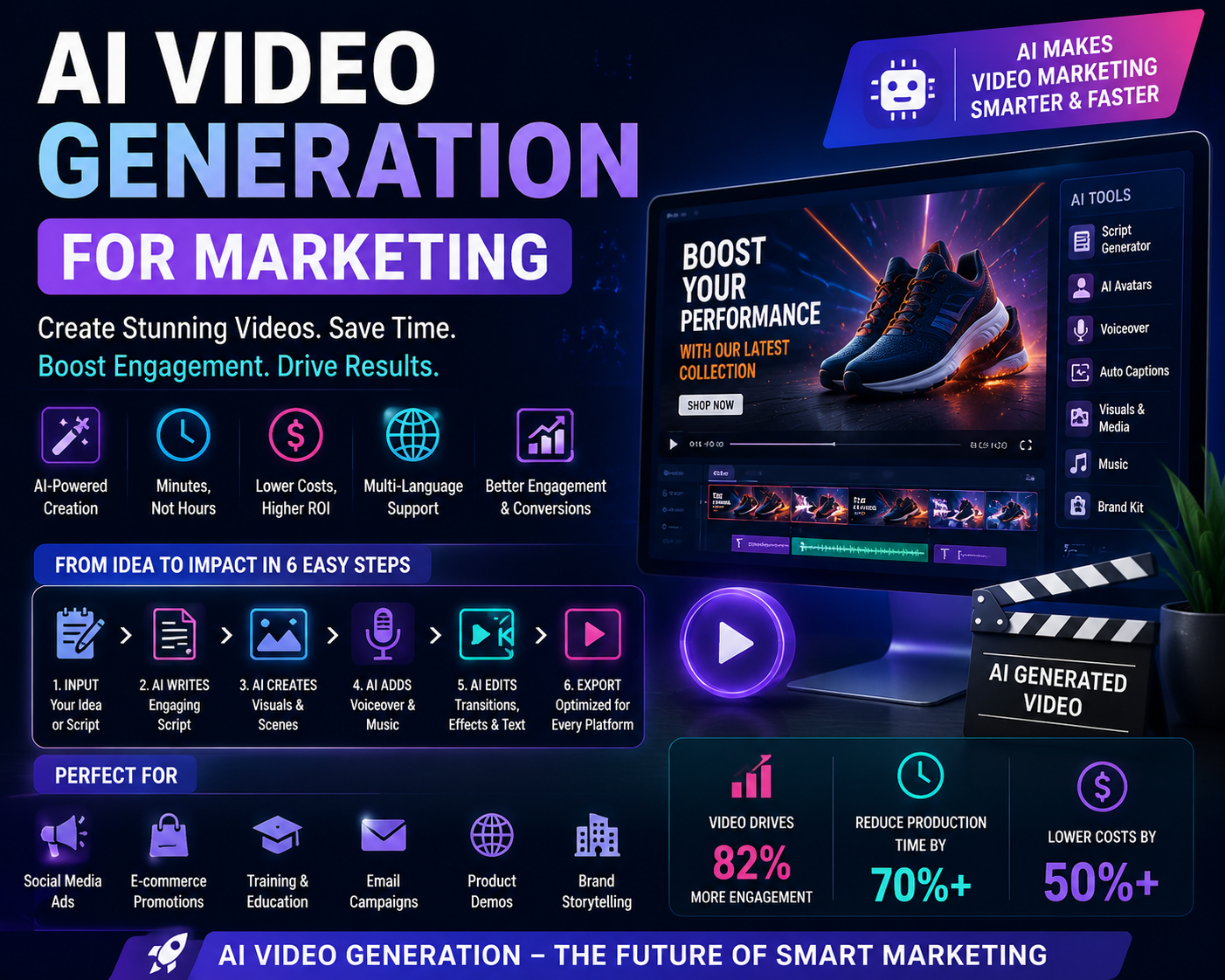
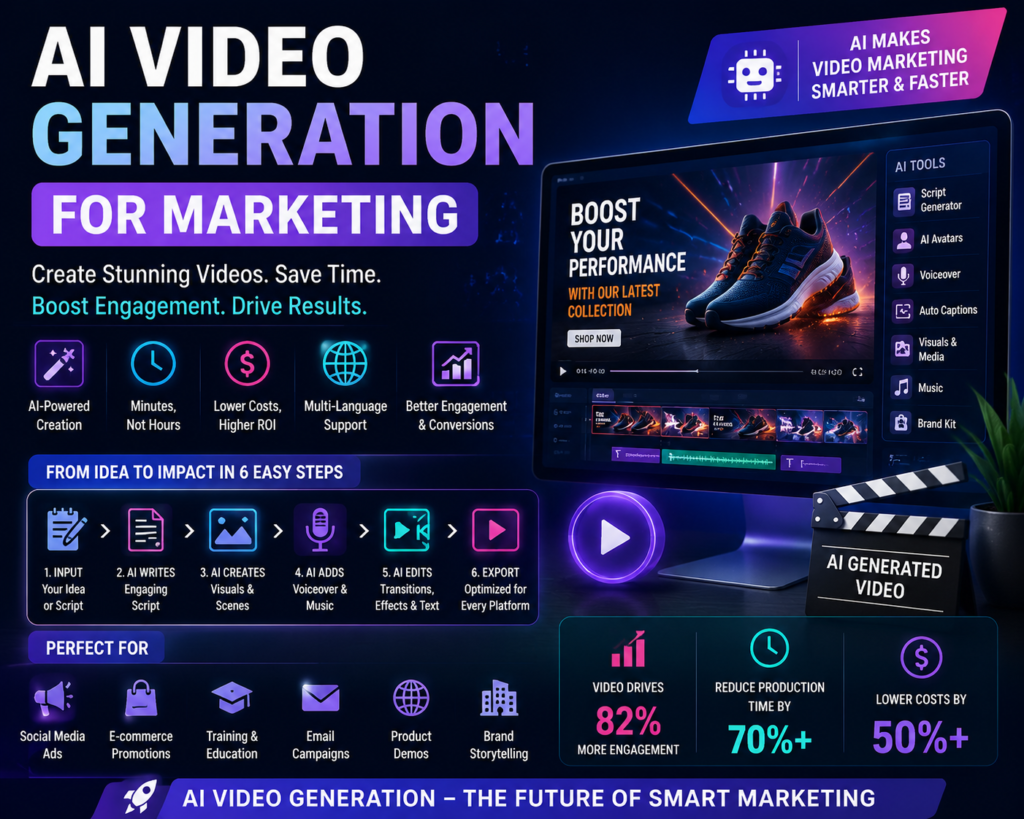
AI video generation involves several automated steps that simplify traditional production workflows.
Step 1: Content Input
Users provide:
- A text prompt
- A blog article
- A product description
- A marketing script
- A presentation
- Existing images or video clips
Step 2: Script Generation
AI can create or enhance scripts optimized for marketing objectives, audience engagement, and platform requirements.
Step 3: Visual Creation
The AI generates:
- Backgrounds
- Animations
- Graphics
- AI avatars
- Product visuals
- Motion effects
Step 4: Voice Generation
Text-to-speech models produce natural-sounding voiceovers in multiple languages and accents.
Step 5: Video Editing
AI automatically handles:
- Scene transitions
- Captions
- Background music
- Timing adjustments
- Visual effects
- Brand elements
Step 6: Final Export
Videos are optimized for platforms such as:
- YouTube
- TikTok
- Websites
- Email marketing campaigns
Why AI Video Marketing Is Growing Rapidly
Video consistently delivers strong engagement, but traditional production often limits how much content businesses can create.
AI addresses this challenge by making video creation:
- Faster
- More affordable
- Easier to scale
- More personalized
- Accessible to smaller businesses
Organizations are increasingly using AI to meet the growing demand for video content across digital channels.
Key Technologies Behind AI Video Generation
Several AI technologies work together to produce modern marketing videos.
Generative AI
Generative AI creates original video content from text prompts, scripts, or other inputs.
Natural Language Processing (NLP)
NLP helps AI understand marketing goals, generate scripts, and optimize messaging for different audiences.
Computer Vision
Computer vision enables AI to recognize objects, edit scenes, enhance visuals, and analyze video content.
Text-to-Speech (TTS)
Modern TTS engines generate realistic voiceovers in multiple languages, making global campaigns easier to produce.
AI Avatars
Digital presenters can deliver scripts naturally without requiring live actors or recording sessions.
Machine Learning
Machine learning continuously improves editing quality, personalization, and audience targeting based on performance data.
Real-World Applications of AI Video Generation
Social Media Marketing
Brands create:
- Instagram Reels
- TikTok videos
- Facebook advertisements
- YouTube Shorts
- LinkedIn promotional content
AI helps marketers publish consistently while adapting content for each platform.
Product Demonstrations
Businesses generate engaging product videos that highlight features, benefits, and use cases without extensive production resources.
Personalized Customer Campaigns
AI can customize videos using customer-specific details such as names, preferences, purchase history, or regional languages to improve engagement.
Email Marketing
Embedding personalized AI-generated videos into email campaigns can increase click-through rates and customer interaction.
E-commerce
Online retailers use AI-generated videos to:
- Showcase products
- Explain features
- Compare models
- Increase conversions
Employee Training
Organizations produce onboarding and training videos quickly while maintaining consistent messaging across teams.
Educational Marketing
Educational institutions and online learning platforms use AI to create course previews, promotional videos, and interactive learning materials.
Industries Using AI Video Generation
AI-powered video creation is being adopted across multiple sectors.
Retail
Retailers create promotional campaigns, seasonal advertisements, and product showcases.
Healthcare
Healthcare organizations produce patient education materials, awareness campaigns, and training videos.
Finance
Financial institutions create educational videos explaining services, investment products, and security best practices.
Real Estate
Agents generate virtual property tours and neighborhood overviews to attract buyers.
Technology
Software companies produce tutorials, feature updates, product launches, and customer onboarding videos.
Education
Universities, schools, and training providers use AI-generated content for marketing and instructional purposes.
AI Video Generation vs Traditional Video Production
| Feature | Traditional Production | AI Video Generation |
|---|---|---|
| Production Time | Days to weeks | Minutes to hours |
| Cost | High | Low to moderate |
| Equipment Needed | Extensive | Minimal |
| Editing Speed | Manual | Automated |
| Personalization | Limited | Highly scalable |
| Multilingual Support | Expensive | Built-in |
| Scalability | Moderate | Excellent |
| Content Updates | Time-consuming | Fast and easy |
Best Practices for AI Video Marketing
To maximize results, businesses should follow proven strategies.
Define Clear Objectives
Identify whether the video is intended for:
- Brand awareness
- Lead generation
- Customer education
- Product promotion
- Customer retention
Keep Videos Short and Engaging
Short-form videos often perform best on social media, while longer formats work well for tutorials and webinars.
Maintain Brand Consistency
Ensure AI-generated content aligns with your:
- Logo
- Color palette
- Typography
- Tone of voice
- Messaging
Review AI Outputs
Although AI automates production, human review is essential to verify accuracy, quality, and brand alignment.
Optimize for Each Platform
Adjust video dimensions, length, captions, and calls to action based on the intended platform.
Business Benefits of AI Video Generation
Organizations adopting AI-powered video creation often experience measurable improvements.
These include:
- Faster content production
- Reduced marketing costs
- Increased engagement
- Higher conversion rates
- Improved scalability
- Better campaign consistency
- Faster localization for global audiences
Expert Insights and Industry Trends
AI video generation has evolved from a niche capability into a core component of modern digital marketing. Businesses are increasingly integrating AI into their content workflows to meet the growing demand for high-quality videos across multiple channels.
One major trend is the rise of AI-powered personalization. Rather than creating a single video for all viewers, marketers can now generate customized content tailored to different customer segments, geographic regions, languages, or purchasing behaviors.
Another significant development is the growing use of multimodal AI. Modern systems combine text, images, audio, branding assets, and analytics to create richer and more engaging videos. Integration with customer relationship management (CRM) platforms and marketing automation software is also enabling brands to produce data-driven campaigns at scale.
Benefits
AI video generation offers numerous advantages for marketers and businesses.
Lower Production Costs
Organizations reduce expenses related to filming, editing, voice talent, and production equipment.
Faster Content Creation
Videos that once required weeks can now be produced in hours or even minutes.
Improved Scalability
Businesses can create hundreds of personalized videos without proportionally increasing production resources.
Multilingual Capabilities
AI-generated voiceovers and subtitles simplify international marketing campaigns.
Consistent Branding
Templates and automation help maintain consistent messaging and visual identity across campaigns.
Better Accessibility
Automatic captions, translations, and voice generation make videos more inclusive for diverse audiences.
Challenges and Limitations
Despite its advantages, AI video generation has several limitations.
Creative Constraints
AI may struggle to replicate highly original storytelling or emotionally nuanced performances.
Quality Variations
Output quality depends on the AI platform, input data, and prompt quality.
Ethical Concerns
The use of AI-generated avatars and synthetic voices raises questions about transparency, authenticity, and responsible use.
Copyright Issues
Businesses must ensure they have appropriate rights for any assets, music, or training materials used in AI-generated videos.
Brand Oversight
Human review remains necessary to ensure messaging, compliance, and factual accuracy.
Future Trends
AI video generation is expected to evolve rapidly over the next several years.
Hyper-Personalized Videos
Future systems will automatically generate individualized videos based on customer behavior, preferences, and purchase history.
Interactive AI Videos
Viewers will engage with AI-generated videos that adapt content in real time based on user interactions.
Real-Time Video Creation
Live AI systems will produce customized marketing content during customer interactions and events.
Advanced AI Avatars
Future avatars will deliver increasingly natural facial expressions, gestures, and emotional communication.
Multimodal AI Integration
AI will combine text, images, audio, video, and customer data into unified marketing workflows for richer and more context-aware campaigns.
Smarter Analytics
AI platforms will provide predictive insights, automatically suggesting improvements to maximize engagement, conversions, and return on investment.
Read More About:Future of Multimodal AI Systems: Trends, Benefits & Real-World Impact
Frequently Asked Questions (FAQ)
1. What is AI video generation for marketing?
AI video generation uses artificial intelligence to automate the creation of marketing videos, including scripts, visuals, voiceovers, editing, subtitles, and animations.
2. Can AI replace traditional video production?
AI can significantly streamline many production tasks, but human creativity, strategy, storytelling, and quality control remain essential for high-impact marketing campaigns.
3. Which businesses benefit the most from AI video generation?
E-commerce, retail, education, healthcare, real estate, finance, technology, travel, and digital marketing agencies are among the industries seeing strong benefits.
4. Is AI-generated video suitable for social media?
Yes. AI tools can quickly produce optimized videos for platforms such as YouTube, Instagram, TikTok, Facebook, and LinkedIn, making them ideal for high-volume social media marketing.
5. Does AI video generation support multiple languages?
Most modern AI platforms offer multilingual voiceovers, subtitles, and translations, helping businesses reach international audiences more efficiently.
6. What are the biggest risks of AI-generated marketing videos?
Potential risks include inaccurate information, inconsistent branding, copyright concerns, ethical issues related to synthetic media, and overreliance on automation without human review.
7. How can businesses get the best results from AI video generation?
Define clear marketing objectives, provide high-quality input, review AI-generated content carefully, maintain brand consistency, optimize videos for each platform, and continuously analyze campaign performance.
Conclusion
AI Video Generation for Marketing is transforming how businesses create, distribute, and optimize video content. By automating scripting, editing, voice generation, visual production, and personalization, AI enables organizations to produce high-quality marketing videos faster, more efficiently, and at a fraction of traditional production costs.
From social media campaigns and product demonstrations to employee training and personalized customer experiences, AI-generated video is becoming an essential tool for organizations seeking to scale their digital marketing efforts. While human creativity and strategic oversight remain vital, AI empowers marketing teams to focus on storytelling, audience engagement, and campaign innovation rather than repetitive production tasks.
As multimodal AI, advanced avatars, interactive video experiences, and predictive analytics continue to evolve, businesses that responsibly adopt AI-powered video generation will be better positioned to engage audiences, improve marketing performance, and remain competitive in an increasingly video-driven digital landscape.
Key Takeaways
- AI Video Generation for Marketing enables businesses to create professional-quality videos quickly and cost-effectively.
- AI automates scripting, editing, voiceovers, subtitles, animations, and personalization.
- Industries including retail, healthcare, finance, education, technology, and real estate are rapidly adopting AI-powered video creation.
- Compared with traditional production, AI offers faster workflows, lower costs, and greater scalability.
- Human review remains essential for creativity, factual accuracy, ethical compliance, and brand consistency.
- Emerging trends include hyper-personalized videos, interactive AI experiences, multimodal workflows, and advanced AI avatars.
- Businesses that combine AI automation with strong marketing strategies can improve engagement, increase conversions, and maximize return on investment.
- Responsible AI governance, transparency, and continuous optimization will be key factors in the long-term success of AI-driven video marketing initiatives.