
Discover the best AI-powered lead generation techniques to attract, qualify, and convert more prospects using automation, predictive analytics, and intelligent marketing.
Introduction
Generating high-quality leads has always been one of the biggest challenges for businesses. Traditional lead generation methods often require significant manual effort, time, and marketing budgets while producing inconsistent results. Today, artificial intelligence is fundamentally changing this process by helping organizations identify, attract, nurture, and convert prospects more efficiently than ever before.
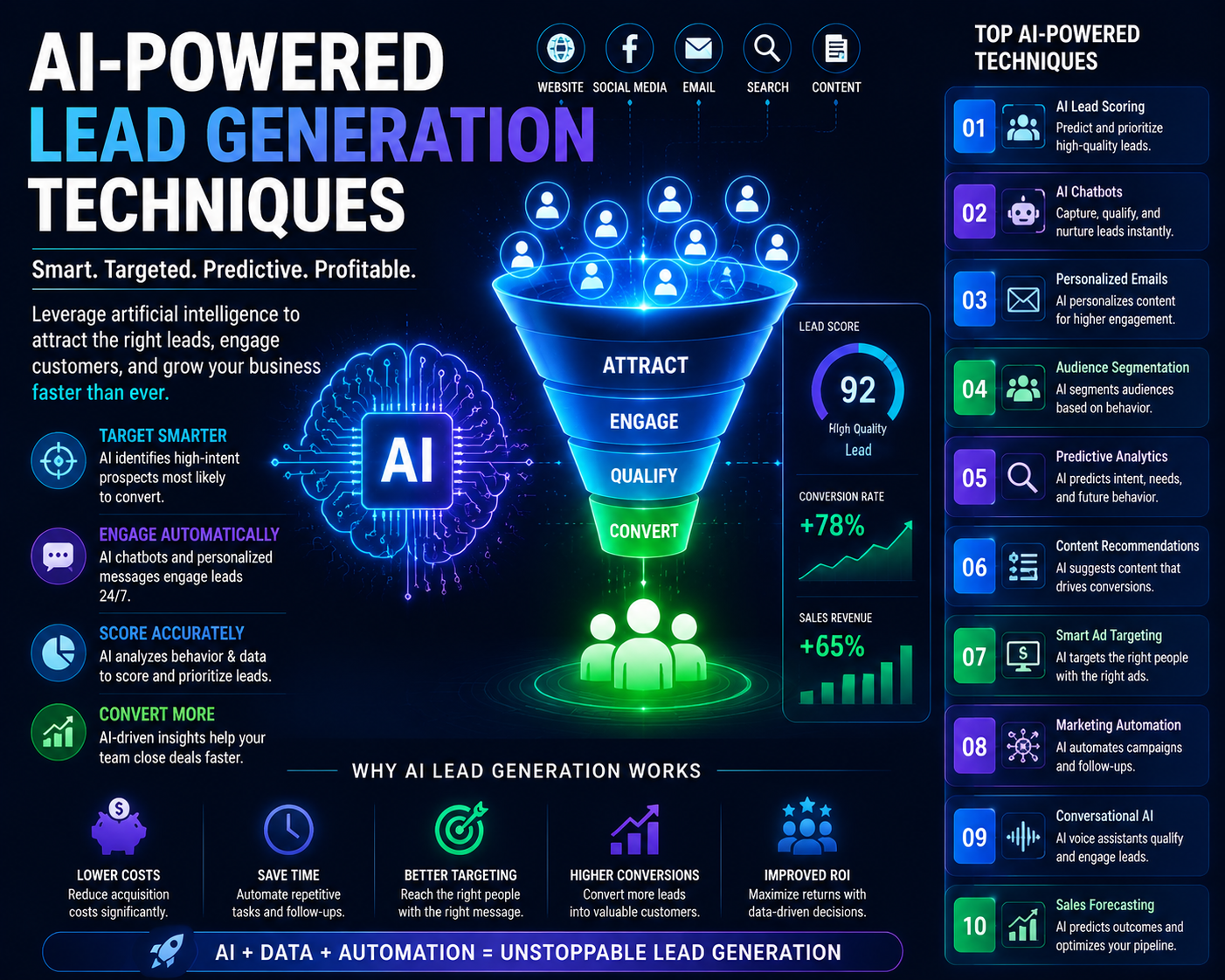
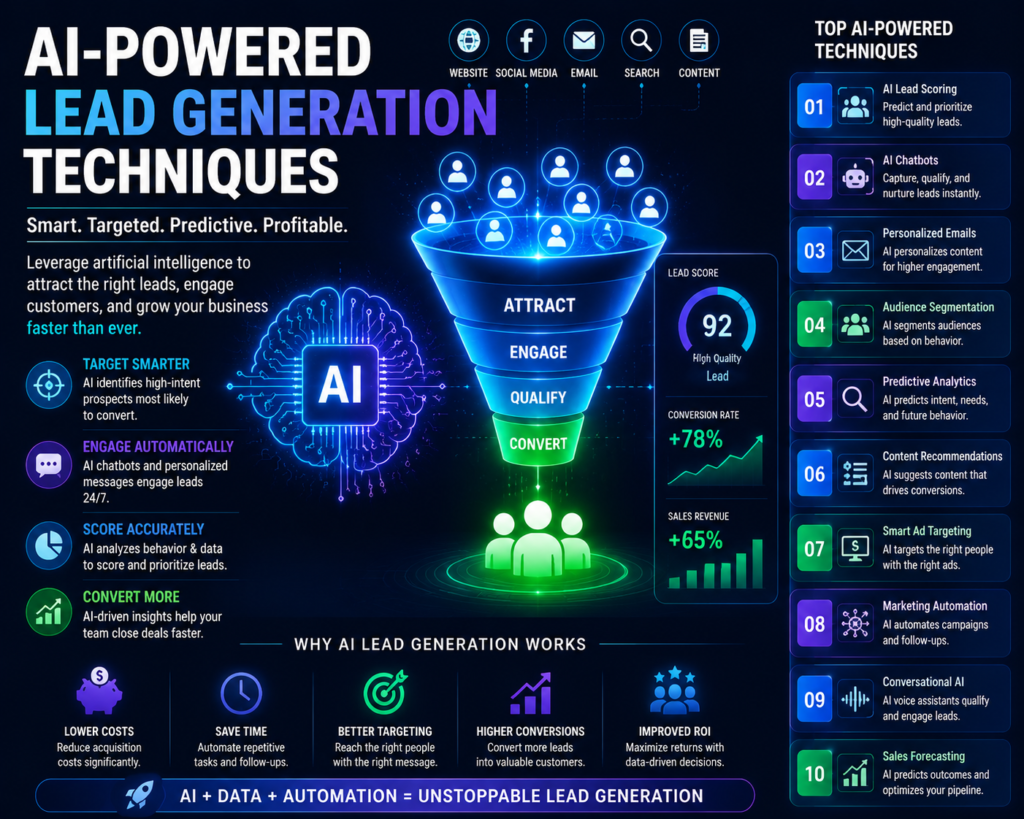
AI-Powered Lead Generation Techniques combine machine learning, predictive analytics, automation, natural language processing (NLP), and customer data analysis to improve every stage of the sales funnel. Instead of relying on guesswork, businesses can use AI to identify ideal customers, personalize marketing campaigns, score leads based on buying intent, and automate follow-ups that increase conversion rates.
From startups and e-commerce businesses to enterprise sales teams and B2B organizations, AI-powered lead generation has become an essential competitive advantage. Modern AI tools analyze massive volumes of customer data in real time, uncover hidden opportunities, and help marketing and sales professionals focus on the prospects most likely to become paying customers.
In this comprehensive guide, you’ll learn how AI-powered lead generation works, the most effective techniques, practical use cases, benefits, challenges, future trends, and best practices for building a scalable, data-driven lead generation strategy.
What Is AI-Powered Lead Generation?
AI-powered lead generation is the use of artificial intelligence to automate and optimize the process of finding, qualifying, nurturing, and converting potential customers.
Rather than relying solely on manual outreach or broad marketing campaigns, AI analyzes customer behavior, demographics, online interactions, and purchasing patterns to identify high-value prospects.
AI supports multiple stages of lead generation, including:
- Prospect identification
- Audience segmentation
- Lead scoring
- Personalized marketing
- Chatbot interactions
- Email automation
- Sales forecasting
- Customer journey optimization
The result is a faster, more efficient, and highly targeted approach to acquiring new customers.
Why AI Is Transforming Lead Generation
Modern businesses generate enormous amounts of customer data from websites, social media, email campaigns, CRM systems, and digital advertising. Processing this information manually is impractical.
AI enables organizations to:
- Analyze millions of data points instantly
- Predict buying intent
- Personalize customer interactions
- Automate repetitive tasks
- Improve marketing ROI
- Shorten sales cycles
- Increase conversion rates
These capabilities allow sales and marketing teams to focus their efforts where they have the greatest impact.
How AI-Powered Lead Generation Works
Step 1: Data Collection
AI gathers information from multiple sources, including:
- Websites
- CRM platforms
- Email campaigns
- Social media
- Search behavior
- Customer interactions
- Advertising platforms
Step 2: Data Analysis
Machine learning algorithms analyze:
- Customer demographics
- Browsing patterns
- Purchase history
- Engagement metrics
- Behavioral signals
Step 3: Lead Scoring
AI assigns scores based on the likelihood that a prospect will convert into a customer.
Factors may include:
- Website visits
- Content downloads
- Email engagement
- Purchase intent
- Company size
- Budget
- Decision-making authority
Step 4: Personalized Engagement
AI delivers personalized:
- Emails
- Product recommendations
- Website experiences
- Chatbot conversations
- Marketing messages
Step 5: Sales Optimization
AI continuously learns from campaign performance to improve targeting and increase future conversion rates.
Top AI-Powered Lead Generation Techniques
1. Predictive Lead Scoring
Predictive lead scoring uses historical customer data and machine learning to prioritize prospects.
Instead of treating every lead equally, AI identifies those most likely to convert.
Benefits include:
- Better sales productivity
- Higher conversion rates
- Faster follow-up
- Improved resource allocation
2. AI Chatbots for Lead Capture
Modern AI chatbots engage website visitors in real time.
They can:
- Answer questions
- Collect contact information
- Qualify leads
- Book appointments
- Recommend products
- Route prospects to sales teams
Chatbots provide 24/7 customer engagement without requiring human agents.
3. Personalized Email Marketing
AI analyzes customer preferences and behavior to create personalized email campaigns.
It can optimize:
- Subject lines
- Send times
- Content recommendations
- Product offers
- Follow-up sequences
This improves open rates and customer engagement.
4. Intelligent Audience Segmentation
Rather than relying on broad demographic categories, AI groups prospects based on behavioral patterns and purchasing intent.
Examples include:
- Frequent website visitors
- High-value customers
- Returning prospects
- Cart abandoners
- Product researchers
Segmentation enables more relevant marketing campaigns.
5. AI Content Recommendations
AI suggests personalized content such as:
- Blog articles
- Whitepapers
- Product guides
- Videos
- Case studies
Relevant content helps move prospects through the buying journey.
6. Predictive Analytics
Predictive analytics forecasts future customer behavior using historical data.
Businesses can anticipate:
- Purchase probability
- Customer lifetime value
- Churn risk
- Seasonal demand
- Upselling opportunities
7. Social Media Intelligence
AI monitors social media activity to identify prospects discussing relevant products, services, or industry challenges.
Sales teams can engage these potential customers with timely and personalized outreach.
8. AI Sales Assistants
Virtual sales assistants help representatives by:
- Scheduling meetings
- Suggesting responses
- Summarizing conversations
- Tracking customer interactions
- Recommending next actions
This reduces administrative work and improves productivity.
9. Website Personalization
AI dynamically adjusts website content based on visitor behavior.
Examples include:
- Personalized headlines
- Product recommendations
- Custom landing pages
- Targeted promotions
Personalized experiences often improve engagement and conversions.
10. Conversational AI
Conversational AI goes beyond simple chatbots by understanding context and maintaining natural conversations.
It supports:
- Customer support
- Product discovery
- Lead qualification
- Appointment scheduling
- Sales assistance
Real-World Applications
B2B Sales
AI identifies high-value decision-makers, prioritizes outreach, and improves account-based marketing strategies.
E-commerce
Retailers use AI to recommend products, recover abandoned carts, and personalize shopping experiences.
SaaS Companies
Software providers leverage AI for free trial conversions, onboarding automation, and customer retention.
Financial Services
Banks and insurance companies use predictive analytics to identify qualified prospects for loans, investments, and financial products.
Healthcare
Healthcare organizations personalize patient communication, appointment scheduling, and educational outreach while maintaining regulatory compliance.
Education
Educational institutions automate student recruitment, course recommendations, and admissions communication.
AI Lead Generation vs Traditional Lead Generation
| Feature | Traditional Lead Generation | AI-Powered Lead Generation |
|---|---|---|
| Lead Qualification | Manual | Automated |
| Personalization | Limited | Highly Personalized |
| Speed | Moderate | Very Fast |
| Data Analysis | Basic | Advanced |
| Lead Scoring | Manual | Predictive |
| Campaign Optimization | Periodic | Continuous |
| Customer Insights | Limited | Deep Behavioral Analysis |
| Scalability | Moderate | Excellent |
Best Practices for AI-Powered Lead Generation
Build High-Quality Data
AI performs best when trained on accurate, complete, and up-to-date customer information.
Align Sales and Marketing
Ensure both teams use shared goals, consistent lead definitions, and integrated CRM systems.
Focus on Personalization
Customize messaging based on customer interests, industry, purchase history, and behavior.
Monitor AI Performance
Regularly evaluate lead quality, campaign effectiveness, and model accuracy to improve outcomes.
Maintain Human Oversight
AI enhances decision-making, but sales professionals should review critical opportunities and build meaningful customer relationships.
Expert Insights and Industry Trends
AI is rapidly becoming a central component of modern sales and marketing strategies. Businesses increasingly rely on predictive analytics and automation to improve efficiency while delivering more personalized customer experiences.
A major trend is the integration of AI with customer relationship management (CRM) platforms. By combining CRM data with machine learning, organizations can gain a comprehensive view of each prospect, enabling more accurate lead scoring and targeted engagement.
Another important development is the use of generative AI to create personalized sales emails, proposals, and marketing content at scale. Combined with conversational AI and predictive analytics, these tools help businesses accelerate customer acquisition while maintaining relevance and consistency.
Benefits
AI-powered lead generation offers numerous advantages for businesses of all sizes.
Higher Lead Quality
AI identifies prospects with the highest likelihood of converting, improving sales efficiency.
Increased Productivity
Automation reduces repetitive administrative tasks, allowing sales teams to focus on relationship building and closing deals.
Better Personalization
AI delivers customized content and recommendations based on individual customer behavior and preferences.
Faster Sales Cycles
Predictive insights and timely engagement help move prospects through the sales funnel more quickly.
Improved Marketing ROI
More accurate targeting reduces wasted advertising spend and increases campaign effectiveness.
Scalable Growth
AI systems can process large volumes of leads without requiring proportional increases in staffing.
Challenges and Limitations
Despite its advantages, AI-powered lead generation also presents challenges.
Data Privacy Concerns
Organizations must comply with privacy regulations and ensure responsible handling of customer information.
Data Quality Issues
Incomplete or inaccurate data can reduce AI effectiveness and lead to poor recommendations.
Implementation Costs
Advanced AI platforms may require investments in software, integration, and employee training.
Model Bias
Poorly designed AI models may unintentionally favor or overlook certain customer segments.
Human Relationship Building
While AI automates many tasks, successful sales still depend on trust, empathy, and meaningful human interactions.
Future Trends
Several emerging developments will shape the future of AI-powered lead generation.
Hyper-Personalization
AI will create highly individualized customer journeys based on real-time behavior, preferences, and intent.
Autonomous AI Sales Agents
Future AI systems will independently qualify leads, schedule meetings, follow up with prospects, and manage portions of the sales process.
Multimodal AI
Lead generation platforms will combine text, voice, images, video, and customer data to create richer and more engaging interactions.
Predictive Customer Journeys
AI will anticipate customer needs before they are explicitly expressed, enabling proactive engagement.
Enhanced CRM Integration
Deeper integration between AI and CRM systems will provide unified customer intelligence, improving forecasting and sales strategy.
Ethical AI and Compliance
Organizations will place greater emphasis on transparent AI practices, privacy protection, and compliance with evolving regulations.
Frequently Asked Questions (FAQ)
1. What is AI-powered lead generation?
AI-powered lead generation uses artificial intelligence to identify, qualify, nurture, and convert potential customers through automation, predictive analytics, and personalized marketing.
2. How does AI improve lead quality?
AI analyzes customer behavior, engagement, demographics, and purchasing intent to prioritize prospects who are most likely to convert.
3. Can small businesses benefit from AI lead generation?
Yes. Many affordable AI tools enable small businesses to automate marketing, improve customer engagement, and compete more effectively with larger organizations.
4. Is AI replacing sales professionals?
No. AI enhances sales teams by automating repetitive tasks and providing data-driven insights, while human representatives remain essential for relationship building, negotiation, and closing complex deals.
5. What industries use AI-powered lead generation?
AI is widely used across technology, healthcare, finance, education, real estate, manufacturing, retail, SaaS, and professional services.
6. What data is required for AI lead generation?
AI typically uses CRM records, website analytics, email engagement, social media activity, purchase history, advertising data, and customer interactions to generate insights.
7. What are the biggest challenges of AI lead generation?
Common challenges include maintaining data quality, protecting customer privacy, integrating AI with existing systems, minimizing bias, and ensuring ongoing human oversight.
Conclusion
AI-Powered Lead Generation Techniques are transforming how businesses attract, qualify, and convert customers. By combining machine learning, predictive analytics, automation, conversational AI, and personalized marketing, organizations can build more efficient sales funnels and deliver highly relevant customer experiences.
Whether through predictive lead scoring, intelligent chatbots, personalized email campaigns, or AI-driven CRM insights, these technologies enable businesses to focus on high-value opportunities while reducing manual effort and improving marketing performance. Although challenges such as data privacy, implementation complexity, and ethical AI remain important considerations, the long-term advantages far outweigh the obstacles when AI is deployed responsibly.
As AI continues to evolve, businesses that invest in high-quality data, maintain strong human oversight, and embrace responsible AI practices will be well positioned to generate better leads, strengthen customer relationships, and achieve sustainable growth in an increasingly competitive digital marketplace.
Key Takeaways
- AI-Powered Lead Generation Techniques automate prospect identification, qualification, and customer engagement.
- AI improves lead quality through predictive analytics, behavioral analysis, and intelligent lead scoring.
- Chatbots, personalized email marketing, website personalization, and conversational AI enhance customer interactions.
- Compared with traditional methods, AI offers faster processing, deeper insights, and greater scalability.
- High-quality customer data and CRM integration are essential for maximizing AI performance.
- Human expertise remains critical for relationship building, strategic decision-making, and closing complex sales.
- Future innovations include autonomous AI sales agents, hyper-personalization, multimodal customer experiences, and predictive customer journeys.
- Businesses that combine AI automation with ethical practices and customer-centric strategies can significantly improve lead generation performance and long-term revenue growth.