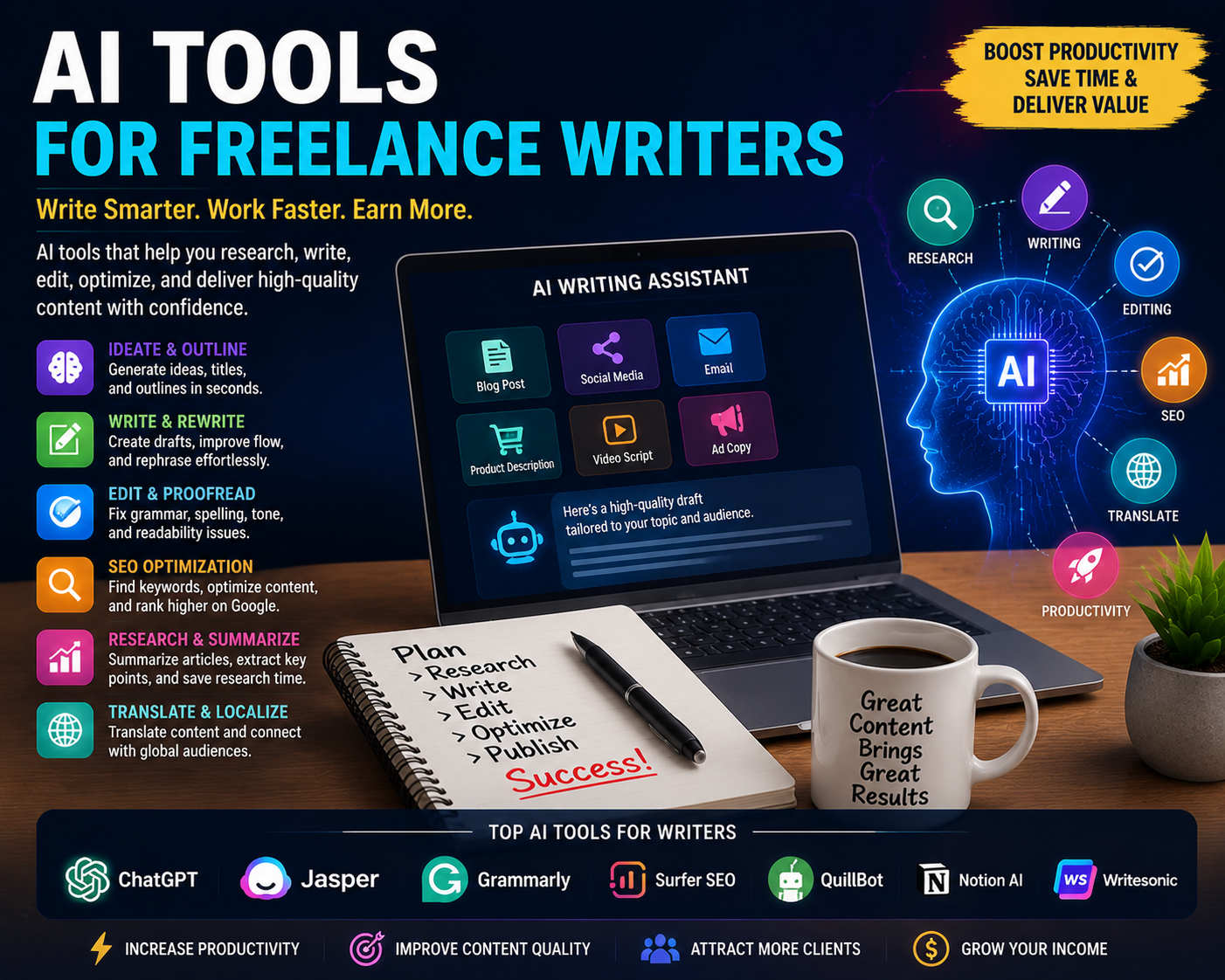

Discover the best AI tools for freelance writers in 2026. Learn how AI improves writing, editing, SEO, research, and productivity while boosting freelance income.
Introduction
Freelance writing has become one of the fastest-growing careers in the digital economy. Businesses, startups, marketing agencies, and online publishers constantly need high-quality content to attract customers, improve search engine rankings, and establish authority. However, producing engaging, accurate, and SEO-friendly content consistently can be challenging, especially when managing multiple clients and tight deadlines.
This is where AI Tools for Freelance Writers are transforming the industry. Artificial intelligence is no longer just a writing assistant—it has evolved into a comprehensive productivity partner that supports research, content planning, grammar checking, SEO optimization, idea generation, editing, summarization, and even client communication.
Rather than replacing professional writers, AI helps them work faster, improve content quality, reduce repetitive tasks, and focus on creativity and strategic thinking. Freelancers who effectively combine AI capabilities with human expertise can deliver better results, manage more projects, and increase their earning potential.
In this comprehensive guide, we’ll explore the best AI tools for freelance writers, how they work, their practical applications, benefits, challenges, future trends, and best practices for using AI responsibly while maintaining originality and credibility.
What Are AI Tools for Freelance Writers?
AI tools for freelance writers are software applications that use artificial intelligence, natural language processing (NLP), and machine learning to assist with different stages of content creation.
These tools can help writers:
- Generate ideas
- Create outlines
- Draft articles
- Improve grammar
- Rewrite sentences
- Optimize SEO
- Conduct research
- Summarize information
- Translate content
- Improve readability
Rather than replacing human creativity, these tools enhance productivity and streamline writing workflows.
Why Freelance Writers Are Adopting AI
Today’s freelance writers face increasing pressure to deliver high-quality content quickly while maintaining accuracy and originality.
AI helps address these challenges by:
- Reducing research time
- Automating repetitive editing
- Improving writing consistency
- Enhancing SEO performance
- Increasing productivity
- Supporting multilingual content creation
- Accelerating brainstorming
As a result, freelancers can handle larger workloads without sacrificing quality.
How AI Writing Tools Work
Step 1: User Input
Writers provide:
- Keywords
- Prompts
- Topics
- Existing drafts
- Research notes
- Client requirements
Step 2: Language Analysis
AI analyzes context, intent, grammar, structure, and semantic relationships using advanced language models.
Step 3: Content Generation
Depending on the task, AI can produce:
- Headlines
- Outlines
- Paragraphs
- Blog posts
- Product descriptions
- Social media captions
- Emails
Step 4: Editing and Optimization
AI improves:
- Grammar
- Tone
- Readability
- Sentence flow
- SEO optimization
- Style consistency
Step 5: Human Review
Professional writers verify:
- Accuracy
- Originality
- Brand voice
- Factual correctness
- Audience relevance
Human editing remains essential for producing trustworthy, high-quality content.
Best AI Tools for Freelance Writers
1. AI Writing Assistants
AI writing assistants help generate first drafts, outlines, introductions, conclusions, and creative ideas.
They are useful for:
- Blog posts
- Website copy
- Marketing content
- Email campaigns
- Social media posts
2. Grammar and Style Checkers
These tools identify:
- Grammar mistakes
- Spelling errors
- Punctuation issues
- Sentence clarity
- Tone inconsistencies
They improve professionalism while saving editing time.
3. AI SEO Optimization Tools
SEO-focused AI platforms help writers optimize content for search engines by analyzing:
- Primary keywords
- Semantic keywords
- Content structure
- Internal linking opportunities
- Readability
- Search intent
These insights improve the chances of ranking higher in search results.
4. AI Research Assistants
Research tools summarize lengthy articles, identify key points, and organize information from multiple sources, allowing writers to spend less time gathering data and more time creating valuable content.
5. AI Summarization Tools
These tools condense long documents into concise summaries, making it easier to review reports, research papers, or interviews efficiently.
6. AI Paraphrasing Tools
Paraphrasing applications help rewrite sentences for clarity, improve readability, or adapt content to different audiences while preserving the original meaning.
7. AI Translation Tools
Freelancers serving international clients can translate content into multiple languages while maintaining context and readability.
8. AI Voice-to-Text Software
Speech recognition tools convert spoken ideas into written text, speeding up brainstorming and first-draft creation.
9. AI Image Generation Tools
Writers can create custom visuals, blog illustrations, and social media graphics to complement written content and improve audience engagement.
10. AI Productivity Tools
Project management and workflow automation platforms help freelancers organize deadlines, client communication, invoices, and writing schedules.
Practical Use Cases
Blog Writing
AI assists with:
- Topic research
- Outlines
- SEO optimization
- Editing
- Content updates
Copywriting
Writers create:
- Sales pages
- Product descriptions
- Landing pages
- Email campaigns
- Advertisements
Technical Writing
AI simplifies complex topics by suggesting clear explanations and organizing information logically.
Social Media Content
Freelancers quickly generate captions, hashtags, campaign ideas, and content calendars for multiple platforms.
Client Communication
AI helps draft professional proposals, project updates, contracts, and follow-up emails.
Content Repurposing
Existing articles can be transformed into:
- Social media posts
- Email newsletters
- Infographics
- Video scripts
- Presentation content
AI Tools vs Traditional Writing Methods
| Feature | Traditional Writing | AI-Assisted Writing |
|---|---|---|
| Research Speed | Moderate | Very Fast |
| Draft Creation | Manual | AI-Assisted |
| Editing | Manual | Automated + Human Review |
| SEO Optimization | Separate Process | Integrated |
| Productivity | Moderate | High |
| Idea Generation | Manual | Instant Suggestions |
| Scalability | Limited | Excellent |
| Content Updates | Time-Consuming | Fast |
Best Practices for Freelance Writers Using AI
Use AI as an Assistant
Treat AI as a productivity tool rather than a replacement for your expertise and creativity.
Verify Facts
Always confirm statistics, references, and technical details before publishing content.
Maintain Your Voice
Edit AI-generated text to reflect your unique writing style and your client’s brand identity.
Focus on Originality
Use AI for brainstorming and drafting, but ensure the final work is unique, insightful, and valuable to readers.
Understand SEO
Optimize content for user intent, semantic keywords, internal linking, and readability instead of relying solely on AI suggestions.
Expert Insights and Industry Trends
The freelance writing industry is rapidly evolving as AI becomes an integral part of content creation workflows. Rather than reducing demand for skilled writers, AI is increasing expectations for productivity, strategic thinking, and subject-matter expertise.
One notable trend is the growing emphasis on human-edited AI content. Clients increasingly seek writers who can combine AI efficiency with fact-checking, storytelling, brand consistency, and original insights that automated systems alone cannot provide.
Another important development is the integration of AI into end-to-end content marketing platforms. Writers can now manage research, drafting, SEO optimization, editing, publishing, and performance analytics within unified ecosystems, streamlining the entire content creation process.
Benefits
AI tools offer significant advantages for freelance writers.
Increased Productivity
AI automates repetitive tasks, enabling writers to complete more projects in less time.
Faster Research
Summarization and research assistants reduce the time required to gather and organize information.
Better SEO Performance
Integrated keyword analysis and optimization improve the visibility of online content.
Improved Writing Quality
Grammar checking, readability analysis, and style suggestions help produce polished, professional work.
Greater Creativity
AI-generated ideas and outlines help overcome writer’s block and inspire fresh perspectives.
Business Growth
Freelancers can scale their services, serve more clients, and diversify income streams by leveraging AI responsibly.
Challenges and Limitations
Despite its advantages, AI-assisted writing also presents challenges.
Accuracy Issues
AI may generate incorrect or outdated information, requiring careful fact-checking.
Lack of Human Perspective
AI cannot fully replicate personal experience, emotional intelligence, or nuanced storytelling.
Risk of Overreliance
Depending too heavily on AI may reduce originality and weaken critical thinking.
Ethical Considerations
Writers should disclose AI usage when appropriate and avoid plagiarism or misleading content.
Client Expectations
Some clients may require fully human-written content or have specific AI usage policies.
Future Trends
Several developments will shape the future of AI tools for freelance writers.
Personalized Writing Assistants
AI systems will adapt to individual writing styles, vocabulary, and client preferences for more tailored suggestions.
Multimodal Content Creation
Writers will increasingly use AI to create integrated text, images, videos, audio, and interactive content from a single workflow.
Smarter Research Tools
Future AI will provide more reliable source verification, citation assistance, and contextual analysis.
Real-Time Collaboration
AI-powered collaboration platforms will enable writers, editors, and clients to work together seamlessly with intelligent suggestions and automated revisions.
Enhanced SEO Intelligence
AI will offer predictive insights into search trends, content performance, and ranking opportunities before articles are published.
Ethical AI Governance
Greater emphasis will be placed on transparency, responsible AI use, copyright compliance, and maintaining authentic human contributions.
Read More About:AI-Powered Lead Generation Techniques: Complete Guide for 2026
Frequently Asked Questions (FAQ)
1. What are AI tools for freelance writers?
AI tools for freelance writers are software applications that assist with research, drafting, editing, SEO optimization, grammar correction, idea generation, and workflow automation using artificial intelligence.
2. Can AI replace freelance writers?
No. AI enhances productivity and supports content creation, but human writers remain essential for creativity, storytelling, strategic thinking, subject expertise, and editorial judgment.
3. Are AI writing tools suitable for SEO content?
Yes. Many AI tools provide keyword suggestions, readability analysis, semantic optimization, and content structure recommendations that support SEO best practices.
4. How can freelance writers use AI responsibly?
Writers should verify facts, maintain originality, edit AI-generated drafts, preserve their unique voice, comply with client requirements, and avoid publishing inaccurate or plagiarized content.
5. What types of content can AI help create?
AI can assist with blog posts, website copy, product descriptions, email campaigns, social media content, technical documentation, scripts, newsletters, proposals, and marketing materials.
6. Does using AI improve freelance productivity?
Yes. By automating repetitive tasks such as research, editing, outlining, and optimization, AI allows freelancers to complete projects more efficiently and manage larger workloads.
7. What are the biggest challenges of AI writing tools?
The main challenges include factual inaccuracies, limited contextual understanding, overreliance on automation, ethical concerns, and the need for ongoing human review and quality assurance.
Conclusion
AI Tools for Freelance Writers are reshaping the content creation industry by making writing faster, more efficient, and more data-driven. From idea generation and research to editing, SEO optimization, and workflow automation, these technologies enable freelancers to deliver high-quality content while managing growing client demands.
However, AI should be viewed as a collaborative assistant rather than a replacement for human expertise. The most successful freelance writers combine AI-powered productivity with critical thinking, creativity, fact-checking, and a distinctive writing voice. This balanced approach ensures content remains accurate, engaging, trustworthy, and aligned with client expectations.
As AI continues to advance with personalized writing assistants, multimodal content creation, and intelligent research capabilities, freelance writers who embrace these tools responsibly will be better equipped to grow their businesses, improve efficiency, and remain competitive in an increasingly digital content landscape.
Key Takeaways
- AI Tools for Freelance Writers streamline research, drafting, editing, SEO optimization, and productivity.
- AI enhances efficiency but does not replace human creativity, expertise, or editorial judgment.
- Writers should always fact-check AI-generated content and maintain originality.
- AI-assisted workflows enable freelancers to manage more projects while improving content quality.
- Integrated SEO features help create search-friendly articles that align with user intent.
- Emerging trends include personalized writing assistants, multimodal content creation, smarter research, and predictive SEO insights.
- Responsible AI use requires transparency, ethical practices, and ongoing human oversight.
- Freelancers who combine AI capabilities with strong writing skills can improve client satisfaction, increase productivity, and build long-term success in the evolving content industry.