
Discover the top AI chatbot use cases for e-commerce, including customer support, sales automation, personalization, and future trends to boost conversions
Introduction
The e-commerce industry has become more competitive than ever, with businesses striving to deliver faster customer service, personalized shopping experiences, and seamless purchasing journeys. Consumers now expect instant responses, accurate product recommendations, and 24/7 support across websites, mobile apps, and social media platforms. Meeting these expectations manually can be expensive and difficult to scale.
This is where AI Chatbot Use Cases for E-Commerce are transforming online retail. Powered by artificial intelligence, natural language processing (NLP), and machine learning, modern chatbots can understand customer intent, answer questions, recommend products, process orders, and provide real-time support without human intervention.
Unlike traditional rule-based chatbots that relied on predefined responses, today’s AI chatbots can hold natural conversations, learn from customer interactions, and continuously improve their performance. They help businesses reduce operational costs, improve customer satisfaction, increase sales conversions, and provide personalized shopping experiences at scale.
From product discovery and order tracking to multilingual support and post-purchase engagement, AI chatbots are becoming an essential component of successful e-commerce strategies. In this comprehensive guide, we’ll explore how AI chatbots work, their most valuable use cases, business benefits, implementation challenges, future trends, and best practices for maximizing their impact.
What Are AI Chatbots for E-Commerce?
AI chatbots are intelligent virtual assistants that interact with customers through natural conversations.
Unlike simple scripted bots, AI-powered chatbots use advanced technologies such as:
- Natural Language Processing (NLP)
- Machine Learning
- Generative AI
- Context Awareness
- Predictive Analytics
These capabilities enable chatbots to understand customer questions, provide relevant answers, recommend products, and complete transactions efficiently.
Why AI Chatbots Matter in E-Commerce
Online shoppers increasingly expect:
- Instant responses
- Personalized recommendations
- 24/7 availability
- Fast problem resolution
- Seamless purchasing experiences
AI chatbots help businesses meet these expectations while reducing customer service costs and improving operational efficiency.
Key advantages include:
- Continuous customer support
- Faster response times
- Higher customer satisfaction
- Increased sales opportunities
- Better shopping experiences
How AI Chatbots Work
Step 1: Customer Interaction
Customers communicate through:
- Website chat
- Mobile applications
- Social media
- Messaging platforms
- Voice assistants
Step 2: Language Understanding
Natural Language Processing identifies:
- Customer intent
- Keywords
- Context
- Sentiment
Step 3: Knowledge Retrieval
The chatbot accesses:
- Product catalogs
- Inventory systems
- Order databases
- Customer profiles
- FAQs
Step 4: Intelligent Response
The chatbot generates personalized responses based on customer needs and business rules.
Step 5: Continuous Learning
Machine learning improves chatbot accuracy through customer interactions and feedback.
Top AI Chatbot Use Cases for E-Commerce
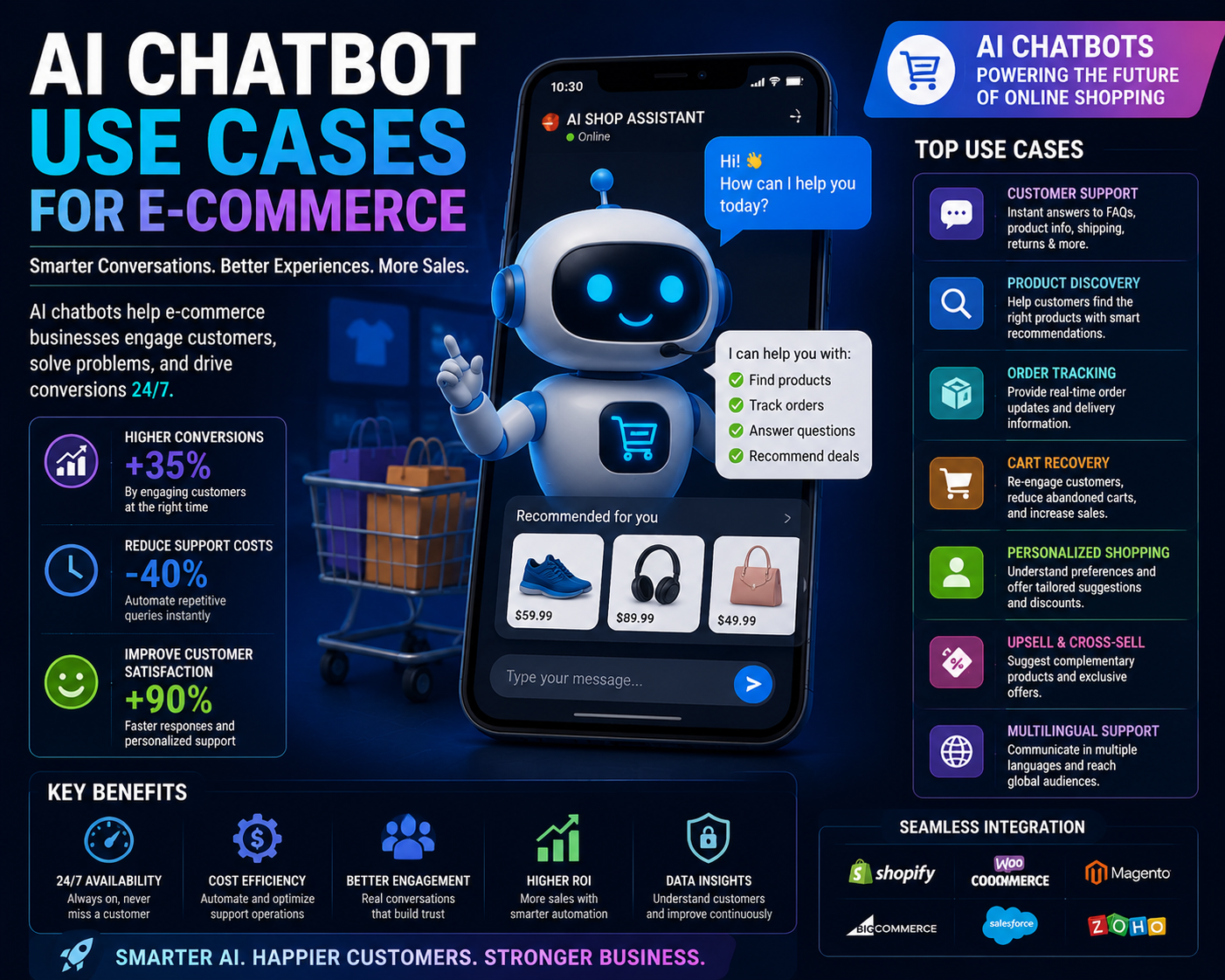
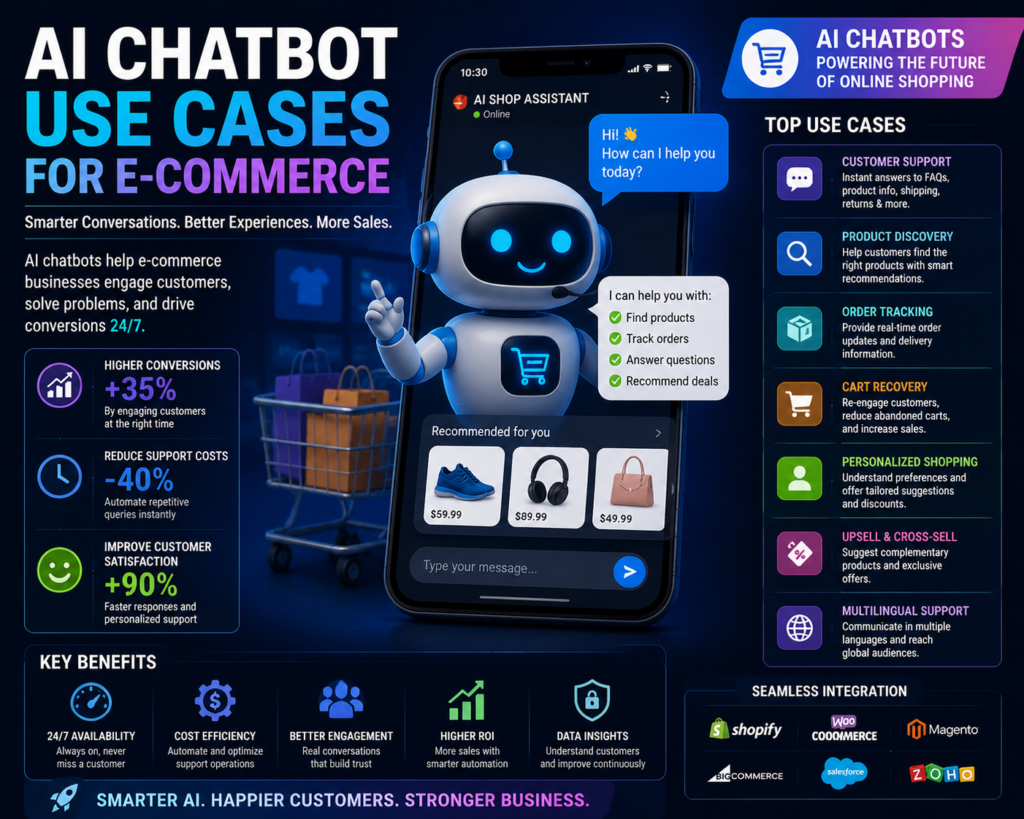
1. Customer Support Automation
One of the most common applications is answering frequently asked questions.
Examples include:
- Shipping information
- Return policies
- Payment methods
- Product availability
- Warranty details
This reduces support workload while providing instant assistance.
2. Product Recommendations
AI chatbots analyze customer preferences, browsing history, and purchasing behavior to recommend relevant products.
Benefits include:
- Higher average order value
- Increased conversions
- Improved customer satisfaction
3. Personalized Shopping Assistance
Virtual shopping assistants help customers:
- Find products
- Compare options
- Select sizes
- Understand specifications
- Choose compatible accessories
This creates a more engaging shopping experience.
4. Order Tracking
Customers can instantly check:
- Order status
- Shipping updates
- Estimated delivery dates
- Tracking numbers
Without contacting customer support.
5. Cart Recovery
AI chatbots identify abandoned shopping carts and engage customers through:
- Personalized reminders
- Discount offers
- Product recommendations
- Checkout assistance
These interactions help recover lost sales.
6. Lead Generation
Chatbots collect valuable customer information such as:
- Names
- Email addresses
- Product interests
- Budget preferences
This data supports future marketing campaigns.
7. Multilingual Customer Service
AI chatbots communicate with international customers in multiple languages, helping businesses expand globally without hiring multilingual support teams.
8. Returns and Refund Management
Customers receive step-by-step assistance for:
- Return requests
- Refund status
- Exchange procedures
- Return shipping instructions
Automation improves efficiency and customer satisfaction.
9. Upselling and Cross-Selling
Based on shopping behavior, AI recommends:
- Premium versions
- Complementary products
- Accessories
- Bundled offers
This increases revenue per transaction.
10. Post-Purchase Engagement
After a purchase, chatbots can:
- Request product reviews
- Recommend additional products
- Provide usage tips
- Share loyalty rewards
- Answer follow-up questions
These interactions strengthen long-term customer relationships.
Real-World Applications
Fashion Retail
Chatbots recommend clothing based on style preferences, size, and previous purchases.
Electronics Stores
Customers receive product comparisons, compatibility advice, and technical support.
Grocery Delivery
AI assists with recurring orders, personalized shopping lists, and delivery updates.
Beauty and Cosmetics
Virtual assistants recommend skincare and cosmetic products based on customer needs.
Furniture Retail
Customers receive room planning suggestions, product dimensions, assembly guidance, and delivery information.
Online Marketplaces
Large marketplaces use AI chatbots to manage millions of customer interactions efficiently across multiple sellers.
AI Chatbots vs Traditional Customer Support
| Feature | Traditional Support | AI Chatbots |
|---|---|---|
| Availability | Business Hours | 24/7 |
| Response Speed | Minutes to Hours | Instant |
| Scalability | Limited | Excellent |
| Personalization | Moderate | High |
| Operating Costs | High | Lower |
| Multilingual Support | Limited | Built-In |
| Simultaneous Conversations | Limited | Unlimited |
| Learning Capability | None | Continuous |
Best Practices for Implementing AI Chatbots
Understand Customer Needs
Analyze frequently asked questions and customer pain points before designing chatbot workflows.
Integrate Business Systems
Connect the chatbot with:
- CRM platforms
- Inventory systems
- Payment gateways
- Order management software
- Customer support tools
Maintain Human Escalation
Allow customers to connect with human agents for complex issues that require empathy or specialized expertise.
Continuously Train the AI
Regularly update knowledge bases and review chatbot conversations to improve accuracy and relevance.
Measure Performance
Track key metrics such as:
- Response time
- Resolution rate
- Customer satisfaction
- Conversion rate
- Cart recovery rate
Expert Insights and Industry Trends
AI chatbots have evolved from simple rule-based assistants into sophisticated conversational AI platforms capable of understanding context, generating natural responses, and supporting complex customer journeys.
A major trend is the adoption of generative AI, enabling chatbots to provide more dynamic and personalized conversations. Rather than relying solely on predefined responses, these systems generate context-aware answers that improve customer engagement.
Another emerging trend is multimodal AI, where chatbots process not only text but also images, voice commands, and videos. Customers can upload product photos, ask spoken questions, or share screenshots, allowing AI to deliver more accurate recommendations and support.
Benefits
AI chatbots provide numerous advantages for e-commerce businesses.
24/7 Customer Support
Customers receive assistance at any time, improving satisfaction and reducing wait times.
Lower Operating Costs
Automation reduces the need for large customer support teams while maintaining high service quality.
Increased Sales
Personalized recommendations and proactive engagement encourage higher conversions and larger purchases.
Improved Customer Experience
Fast responses, personalized assistance, and seamless communication enhance the shopping journey.
Better Data Collection
Chatbots gather valuable customer insights that support marketing, product development, and business decision-making.
Scalable Operations
AI chatbots can handle thousands of conversations simultaneously without compromising performance.
Challenges and Limitations
Despite their advantages, AI chatbots have several limitations.
Complex Customer Issues
Some situations require human judgment, empathy, or specialized expertise beyond current AI capabilities.
Data Privacy
Businesses must protect customer information and comply with data protection regulations.
Integration Complexity
Connecting chatbots with existing business systems may require technical expertise and ongoing maintenance.
AI Hallucinations
Generative AI may occasionally provide inaccurate or misleading information if not properly monitored.
Customer Acceptance
Some customers still prefer interacting with human support representatives, especially for sensitive issues.
Future Trends
Several innovations will shape the future of AI chatbots in e-commerce.
Hyper-Personalization
AI will deliver increasingly individualized shopping experiences based on customer behavior, preferences, and purchase history.
Voice Commerce
Customers will use voice-enabled AI assistants to search products, place orders, and receive support naturally.
Multimodal AI
Future chatbots will combine text, images, audio, and video to provide richer and more intuitive customer interactions.
Autonomous Shopping Assistants
AI agents will independently compare products, manage subscriptions, recommend purchases, and optimize shopping decisions on behalf of users.
Predictive Customer Service
AI will identify potential customer issues before they occur and proactively offer assistance or solutions.
Advanced Analytics
Businesses will use AI-generated insights to improve customer retention, optimize marketing campaigns, and forecast purchasing behavior.
Read More About:AI Tools for Freelance Writers: Best Solutions for Productivity in 2026
Frequently Asked Questions (FAQ)
1. What are AI chatbots for e-commerce?
AI chatbots are intelligent virtual assistants that use artificial intelligence to help customers with product discovery, customer support, order management, and personalized shopping experiences.
2. How do AI chatbots improve online shopping?
They provide instant responses, personalized recommendations, 24/7 support, faster issue resolution, and automated assistance throughout the customer journey.
3. Can AI chatbots increase e-commerce sales?
Yes. By recommending relevant products, recovering abandoned carts, answering customer questions, and simplifying purchasing decisions, AI chatbots can improve conversion rates and average order values.
4. Are AI chatbots suitable for small businesses?
Absolutely. Many affordable chatbot platforms enable small and medium-sized businesses to automate customer support and compete more effectively with larger retailers.
5. Can AI chatbots handle multiple languages?
Yes. Modern AI chatbots support multilingual conversations, making it easier for businesses to serve international customers.
6. What are the biggest challenges of AI chatbots?
Common challenges include handling complex inquiries, maintaining data privacy, integrating with existing systems, preventing inaccurate responses, and balancing automation with human support.
7. Will AI chatbots replace human customer service?
AI chatbots will automate many routine interactions, but human agents will remain essential for resolving complex issues, providing empathy, and handling specialized customer needs.
Conclusion
AI Chatbot Use Cases for E-Commerce demonstrate how artificial intelligence is reshaping online retail by delivering faster support, personalized shopping experiences, and scalable customer engagement. From product recommendations and order tracking to multilingual assistance and post-purchase support, AI chatbots help businesses improve efficiency while enhancing customer satisfaction.
As conversational AI, multimodal technologies, and predictive analytics continue to evolve, chatbots will become even more intelligent, proactive, and integrated into every stage of the customer journey. However, successful implementation requires more than technology alone. Businesses must combine AI automation with strong data management, human oversight, ethical practices, and continuous optimization to ensure reliable and trustworthy customer experiences.
Organizations that invest in AI-powered chatbot solutions today will be better positioned to increase sales, reduce operational costs, strengthen customer loyalty, and remain competitive in the rapidly evolving world of e-commerce.
Key Takeaways
- AI Chatbot Use Cases for E-Commerce include customer support, product recommendations, order tracking, lead generation, cart recovery, and post-purchase engagement.
- AI chatbots use natural language processing, machine learning, and generative AI to deliver personalized customer experiences.
- Compared with traditional support, AI chatbots provide faster responses, lower costs, greater scalability, and 24/7 availability.
- Industries such as fashion, electronics, beauty, grocery, furniture, and online marketplaces are rapidly adopting AI chatbot technology.
- Human agents remain essential for handling complex issues, sensitive situations, and relationship building.
- Future developments include hyper-personalization, voice commerce, multimodal AI, autonomous shopping assistants, and predictive customer service.
- Businesses should integrate chatbots with CRM, inventory, and order management systems while continuously monitoring performance and improving AI models.
- Responsible AI implementation, strong data privacy practices, and ongoing human oversight are key to maximizing the long-term value of AI-powered e-commerce chatbots.