
Learn the best Prompt Engineering Best Practices 2026 to improve AI outputs, boost productivity, reduce hallucinations, and build reliable AI workflows.
Introduction
Artificial intelligence has evolved from a niche technology into a mainstream business tool, powering everything from content creation and software development to customer support, cybersecurity, healthcare, and scientific research. As large language models (LLMs) become more capable, the quality of their outputs increasingly depends on one critical skill: prompt engineering.
Prompt Engineering Best Practices 2026 focus on designing clear, structured, and context-rich instructions that help AI systems produce accurate, relevant, and consistent responses. Whether you’re using AI to write articles, generate code, analyze data, create marketing campaigns, or automate customer service, effective prompts can significantly improve results while reducing errors and hallucinations.
Prompt engineering has also become a valuable professional skill. Developers, marketers, business leaders, researchers, and cybersecurity professionals now rely on carefully crafted prompts to maximize AI performance and streamline complex workflows. As multimodal AI systems continue to evolve, prompt engineering extends beyond text to include images, audio, video, and structured data.
This comprehensive guide explores the latest prompt engineering best practices for 2026, practical techniques, real-world applications, common mistakes, emerging trends, and expert recommendations to help you unlock the full potential of modern AI systems.
What Is Prompt Engineering?
Prompt engineering is the process of designing and refining instructions that guide AI models toward producing accurate, useful, and contextually appropriate outputs.
A prompt can include:
- Questions
- Instructions
- Examples
- Constraints
- Desired formats
- Contextual information
- Reference materials
Well-designed prompts reduce ambiguity and improve consistency across AI-generated responses.
Why Prompt Engineering Matters in 2026
Modern AI models are more capable than ever, but they still rely on user instructions to understand intent.
Effective prompt engineering helps:
- Improve response accuracy
- Reduce hallucinations
- Increase productivity
- Save time
- Generate consistent outputs
- Improve automation
- Support enterprise AI adoption
As organizations integrate AI into mission-critical workflows, prompt quality directly impacts business outcomes.
How Prompt Engineering Works
Step 1: Define the Objective
Clearly identify what you want the AI to accomplish.
Examples include:
- Writing an article
- Generating code
- Summarizing research
- Creating marketing copy
- Analyzing data
Step 2: Provide Context
Give the AI enough background information to understand the task.
Context may include:
- Audience
- Industry
- Business goals
- Existing content
- Technical requirements
Step 3: Specify Constraints
Clearly define:
- Word count
- Tone
- Formatting
- Output structure
- Language
- Style
Step 4: Include Examples
Providing sample inputs and outputs often improves consistency and accuracy.
Step 5: Review and Refine
Prompt engineering is an iterative process.
Analyze AI responses and refine prompts based on results.
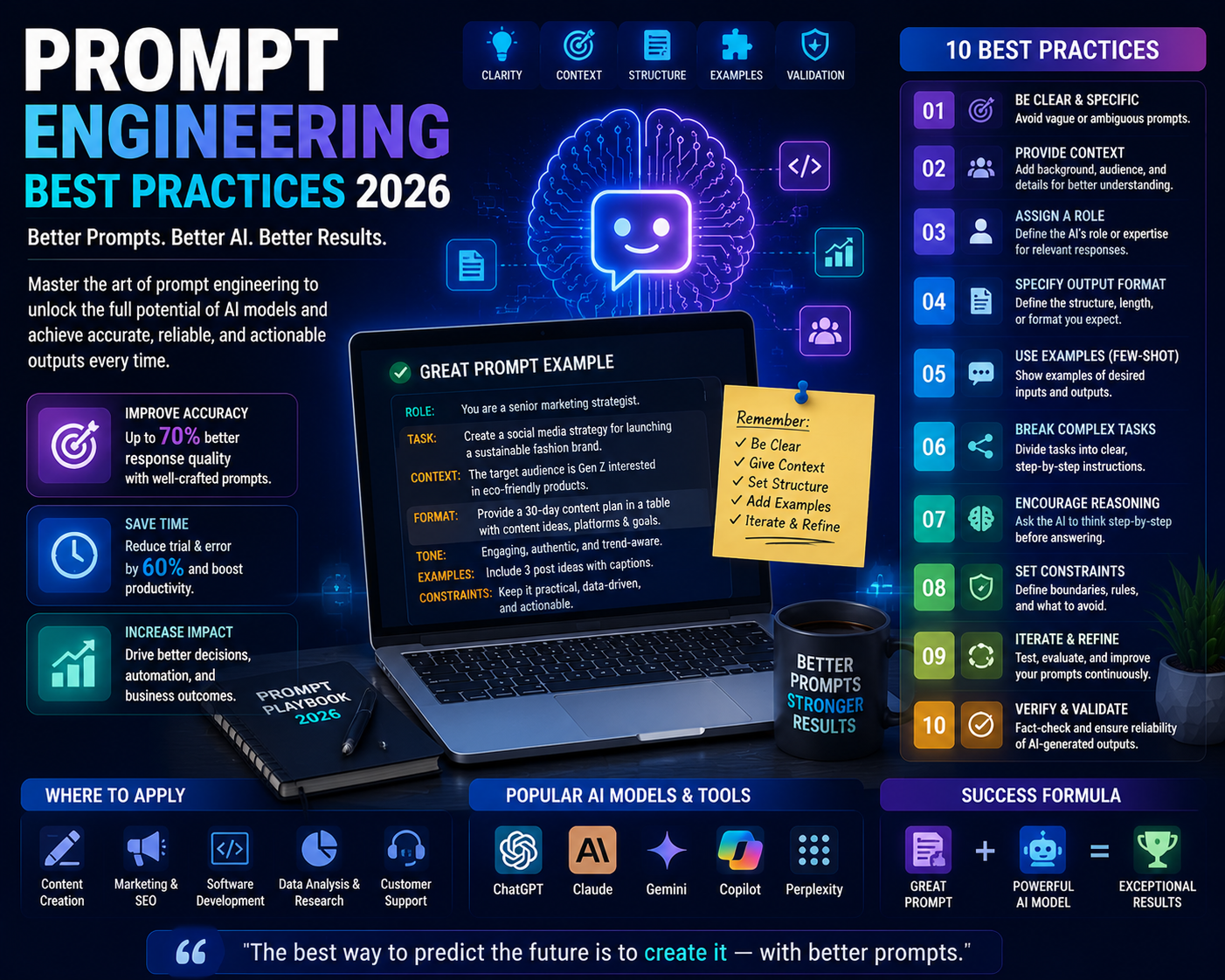
Core Prompt Engineering Best Practices 2026
1. Be Clear and Specific
Avoid vague instructions.
Instead of:
Write about AI.
Use:
Write a 1,500-word beginner-friendly article explaining how generative AI improves customer support for e-commerce businesses.
Specific prompts produce better outputs.
2. Provide Context
The more relevant context the AI receives, the more accurate the response becomes.
Include:
- Audience
- Industry
- Objectives
- Constraints
- Desired outcomes
3. Assign a Role
Tell the AI who it should act as.
Examples:
- Cybersecurity analyst
- SEO expert
- Software architect
- Marketing strategist
- Financial advisor
Role prompting often improves depth and relevance.
4. Specify Output Format
Define exactly how information should be presented.
Examples:
- Bullet lists
- Tables
- JSON
- Markdown
- Reports
- Code blocks
Structured outputs simplify downstream workflows.
5. Break Complex Tasks into Steps
Large requests perform better when divided into smaller tasks.
For example:
- Research
- Create outline
- Draft content
- Edit
- Optimize SEO
Step-by-step prompting improves accuracy.
6. Use Few-Shot Prompting
Provide examples that demonstrate the desired style or format.
This helps AI understand expectations more effectively than instructions alone.
7. Encourage Reasoning
Ask AI to explain its reasoning before generating conclusions when appropriate.
This often improves analytical tasks and reduces logical errors.
8. Request Multiple Alternatives
Instead of one answer, request:
- Three headlines
- Five product names
- Two marketing strategies
This provides more creative options.
9. Verify Facts
Always validate:
- Statistics
- Dates
- Technical information
- Legal guidance
- Medical content
Human oversight remains essential.
10. Iterate Continuously
Small prompt improvements often produce dramatically better results.
Professional prompt engineering is an ongoing optimization process.
Advanced Prompt Engineering Techniques
Chain-of-Thought Prompting
Breaking complex reasoning into sequential steps helps AI solve analytical problems more effectively.
Retrieval-Augmented Generation (RAG)
RAG combines AI models with external knowledge sources to produce more accurate and up-to-date responses.
Multimodal Prompting
Modern AI systems accept:
- Images
- Audio
- Documents
- Video
- Text
Combining multiple input types improves understanding.
Prompt Chaining
One AI output becomes the input for the next task.
Example:
Research → Outline → Draft → Edit → SEO Optimization
Self-Consistency Prompting
Generate multiple reasoning paths and compare results to improve reliability.
Real-World Applications
Content Marketing
AI generates:
- Blog posts
- Product descriptions
- Social media content
- Email campaigns
- Landing pages
Software Development
Developers use prompts for:
- Code generation
- Debugging
- Documentation
- API integration
- Test creation
Customer Support
Organizations deploy AI assistants to answer questions, resolve issues, and automate repetitive interactions.
Cybersecurity
Security teams analyze logs, summarize threats, generate incident reports, and automate documentation using AI prompts.
Education
Educators create:
- Lesson plans
- Quizzes
- Study guides
- Personalized tutoring materials
Business Intelligence
Executives use AI to summarize reports, identify trends, and support strategic decision-making.
Common Prompt Engineering Mistakes
Being Too Vague
Insufficient detail often leads to generic or inaccurate responses.
Ignoring Context
AI performs better when provided with relevant background information.
Combining Too Many Tasks
Large prompts with multiple unrelated objectives reduce response quality.
Assuming AI Is Always Correct
AI-generated content should always be reviewed for factual accuracy.
Forgetting Iteration
Prompt refinement is essential for consistent, high-quality outputs.
Prompt Engineering vs Traditional Search
| Feature | Traditional Search | Prompt Engineering |
|---|---|---|
| Information Retrieval | Static Results | Dynamic Responses |
| Personalization | Limited | Highly Personalized |
| Creativity | None | High |
| Workflow Automation | Minimal | Extensive |
| Context Awareness | Limited | Strong |
| Output Customization | Basic | Advanced |
| Productivity | Moderate | High |
Best Practices for Organizations
Develop Prompt Libraries
Maintain reusable prompt templates for common business tasks.
Train Employees
Teach prompt engineering fundamentals across departments.
Standardize Workflows
Use consistent prompt structures for recurring processes.
Monitor AI Outputs
Review responses for quality, compliance, and accuracy.
Protect Sensitive Data
Avoid including confidential or proprietary information in prompts unless using secure enterprise AI environments.
Expert Insights and Industry Trends
Prompt engineering is rapidly evolving from a specialized technical skill into a core competency across industries. As organizations deploy AI for increasingly complex tasks, structured prompting frameworks are becoming essential for ensuring consistent, high-quality outputs.
A significant trend is the emergence of AI agents capable of executing multi-step workflows with minimal human intervention. Prompt engineering for these autonomous systems emphasizes clear objectives, decision boundaries, and tool usage instructions to maintain reliability.
Another notable development is the integration of prompt management platforms. These systems allow teams to version, test, monitor, and optimize prompts in collaborative environments, bringing software engineering discipline to AI interaction design.
Benefits
Prompt engineering provides numerous advantages.
Improved Accuracy
Well-structured prompts generate more relevant and reliable responses.
Higher Productivity
AI completes tasks faster when instructions are clear.
Better Automation
Organizations automate complex workflows more effectively.
Reduced Hallucinations
Providing context and constraints decreases inaccurate outputs.
Consistent Results
Reusable prompt templates improve quality across teams.
Lower Costs
Efficient AI interactions reduce operational expenses and minimize manual revisions.
Challenges and Limitations
Despite its value, prompt engineering has limitations.
Model Variability
Different AI models may respond differently to identical prompts.
Knowledge Limitations
AI responses depend on training data and available context.
Prompt Maintenance
Prompts require updates as models evolve and business needs change.
Security Risks
Improper prompts may expose sensitive information if governance is weak.
Human Expertise Required
Designing high-quality prompts still requires domain knowledge and critical thinking.
Future Trends
Several innovations will shape prompt engineering in the coming years.
Autonomous AI Agents
AI systems will execute increasingly complex workflows based on high-level goals rather than detailed prompts.
Adaptive Prompting
Future AI models will dynamically adjust prompts based on user intent, context, and previous interactions.
Multimodal Prompt Engineering
Prompts will seamlessly combine text, images, audio, video, and structured data for richer interactions.
Enterprise Prompt Governance
Organizations will implement centralized systems to manage prompt quality, compliance, and security.
AI-Assisted Prompt Optimization
AI will increasingly suggest and refine prompts automatically to improve performance.
Domain-Specific Prompt Libraries
Industries such as healthcare, finance, cybersecurity, and legal services will develop standardized prompt collections tailored to specialized workflows.
Read More About:AI Chatbot Use Cases for E-Commerce: Complete Guide for 2026
Frequently Asked Questions (FAQ)
1. What is prompt engineering?
Prompt engineering is the practice of designing effective instructions that guide AI systems to produce accurate, relevant, and useful responses.
2. Why is prompt engineering important?
Well-crafted prompts improve AI accuracy, consistency, productivity, and automation while reducing errors and hallucinations.
3. What makes a good prompt?
A strong prompt includes a clear objective, relevant context, defined constraints, desired output format, and, when appropriate, examples.
4. Can prompt engineering reduce AI hallucinations?
Yes. Providing detailed context, reliable reference material, and explicit instructions helps minimize inaccurate or fabricated responses, although human verification remains essential.
5. Who should learn prompt engineering?
Developers, marketers, business owners, researchers, educators, cybersecurity professionals, analysts, and anyone who regularly works with AI can benefit from prompt engineering skills.
6. What is multimodal prompt engineering?
Multimodal prompt engineering involves combining text with images, audio, video, or other input types to guide advanced AI systems more effectively.
7. Will prompt engineering remain important as AI improves?
Yes. While AI models are becoming more capable, clear objectives, business context, governance, and structured instructions will continue to play a crucial role in achieving reliable and high-quality results.
Conclusion
Prompt Engineering Best Practices 2026 are essential for maximizing the value of modern AI systems. As artificial intelligence becomes deeply integrated into business operations, software development, marketing, cybersecurity, education, and research, the ability to communicate effectively with AI is becoming a critical professional skill.
By writing clear instructions, providing rich context, defining constraints, leveraging examples, and continuously refining prompts, users can significantly improve AI accuracy, efficiency, and consistency. Advanced techniques such as prompt chaining, retrieval-augmented generation (RAG), multimodal prompting, and adaptive workflows further enhance AI performance across diverse applications.
Although prompt engineering cannot eliminate the need for human oversight, it empowers organizations and individuals to unlock the full potential of AI while minimizing risks. As AI technologies continue to evolve, mastering prompt engineering will remain a valuable investment for anyone seeking to build reliable, scalable, and intelligent AI-powered solutions.
Key Takeaways
- Prompt Engineering Best Practices 2026 focus on creating clear, structured, and context-rich instructions for AI systems.
- Effective prompts improve accuracy, consistency, productivity, and workflow automation.
- Core techniques include role prompting, few-shot examples, step-by-step instructions, output formatting, and iterative refinement.
- Advanced methods such as RAG, prompt chaining, multimodal prompting, and self-consistency enhance complex AI tasks.
- Organizations should develop prompt libraries, train employees, monitor outputs, and implement governance frameworks.
- Human review remains essential for verifying facts, ensuring compliance, and maintaining ethical AI usage.
- Future innovations include autonomous AI agents, adaptive prompting, enterprise prompt management, and AI-assisted prompt optimization.
- Mastering prompt engineering is becoming a foundational skill for professionals across technology, business, cybersecurity, education, and digital marketing.