
Master advanced AI prompt engineering strategies for businesses with proven techniques, real-world use cases, security best practices, and future AI trends.
Introduction
Artificial intelligence has rapidly evolved from a productivity tool into a strategic business asset. Organizations across industries are integrating AI into customer service, software development, cybersecurity, marketing, data analysis, and decision-making processes. However, the effectiveness of these AI systems depends largely on one critical factor: the quality of the prompts they receive.
Advanced AI prompt engineering strategies for businesses have become essential for organizations seeking to maximize AI performance, reduce operational costs, improve decision-making, and maintain a competitive advantage. Modern AI models are capable of understanding complex instructions, analyzing large volumes of data, generating code, summarizing research, automating workflows, and assisting employees across nearly every department. Yet, even the most advanced AI can produce inaccurate or incomplete results when prompted poorly.
Prompt engineering is no longer just about asking better questions. It now involves designing structured workflows, implementing AI governance, reducing security risks, validating outputs, and integrating AI with enterprise knowledge systems. Businesses that adopt advanced prompt engineering techniques can improve accuracy, consistency, productivity, and overall return on investment (ROI) from their AI initiatives.
This comprehensive guide explores the latest prompt engineering strategies, practical implementation methods, industry use cases, AI cybersecurity considerations, and emerging trends that every modern business should understand.
Why Prompt Engineering Matters for Modern Businesses
Artificial intelligence is transforming the way organizations operate. From automating repetitive tasks to supporting executive decision-making, AI is becoming an indispensable business tool.
Without effective prompt engineering, companies often encounter:
- Inconsistent AI responses
- Hallucinated information
- Security vulnerabilities
- Compliance risks
- Increased manual corrections
- Lower productivity
By implementing advanced prompting strategies, businesses can significantly improve AI reliability while minimizing operational risks.
Some measurable business benefits include:
- Faster workflow automation
- Higher employee productivity
- Better customer experiences
- More accurate business insights
- Reduced operational costs
- Improved cybersecurity awareness
Understanding Enterprise Prompt Engineering
What Is Enterprise Prompt Engineering?
Enterprise prompt engineering is the systematic process of designing, testing, documenting, and optimizing AI prompts for business applications.
Unlike casual prompting, enterprise prompting focuses on:
- Standardization
- Repeatability
- Governance
- Security
- Accuracy
- Continuous improvement
Organizations often maintain internal prompt libraries that employees can reuse across departments.
How Enterprise Prompting Differs from Consumer Prompting
| Consumer AI Usage | Enterprise AI Usage |
|---|---|
| Casual conversations | Mission-critical workflows |
| Personal productivity | Business automation |
| Creative writing | Data analysis and reporting |
| Individual prompts | Standardized prompt templates |
| Minimal governance | Strict compliance and security |
Business AI systems require significantly higher reliability because outputs may influence strategic decisions, financial reports, cybersecurity investigations, or customer communications.
Core Advanced AI Prompt Engineering Strategies for Businesses
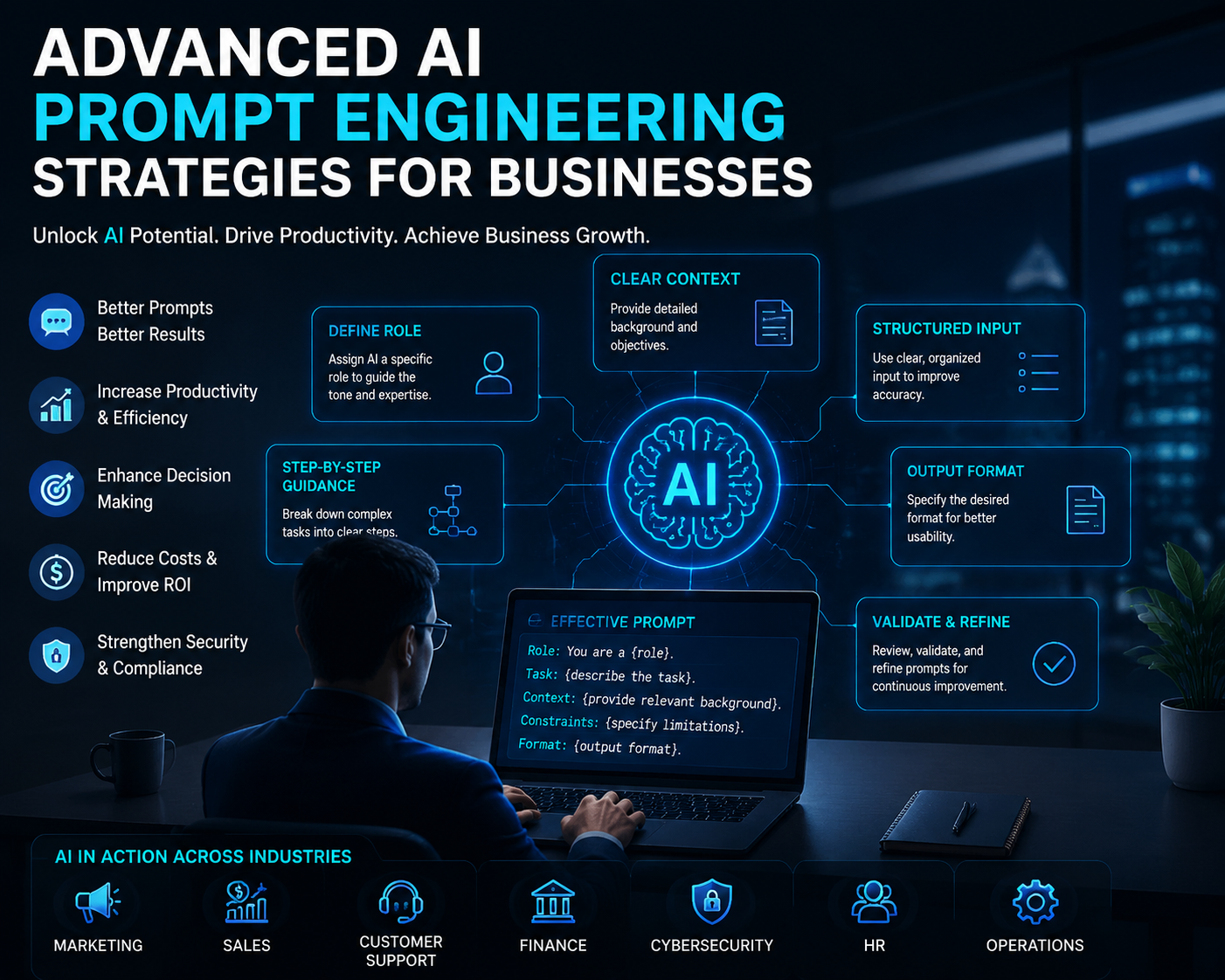
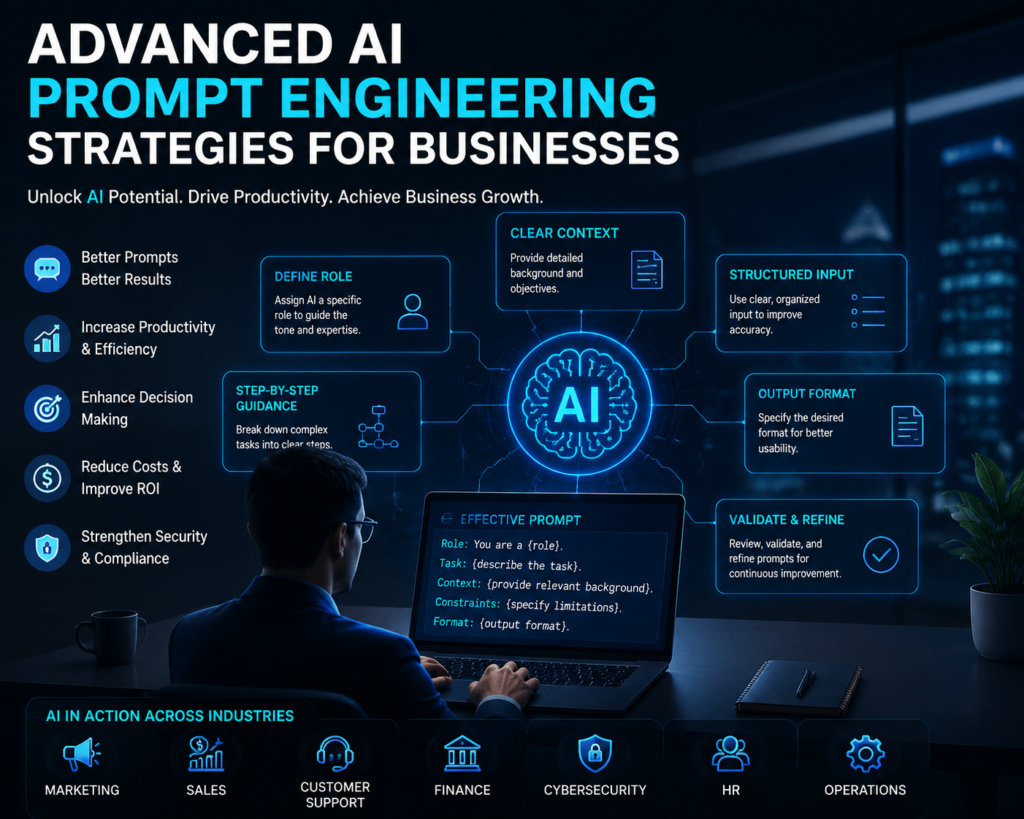
Define Clear Business Objectives
Every successful AI workflow begins with a clearly defined objective.
Instead of asking:
Analyze our sales.
Use:
Analyze quarterly sales performance, identify the top three growth opportunities, summarize key risks, and recommend actionable improvements for executive leadership.
Specific objectives reduce ambiguity and improve response quality.
Provide Rich Business Context
AI performs better when it understands the environment in which it operates.
Useful contextual information includes:
- Company size
- Industry
- Target customers
- Business goals
- Existing challenges
- Regulatory requirements
- Geographic markets
Context allows AI to generate responses that are more relevant and actionable.
Assign Specialized AI Roles
Role prompting remains one of the most effective enterprise techniques.
Examples include:
- Financial analyst
- Cybersecurity consultant
- HR specialist
- Marketing strategist
- Software architect
- Legal advisor
- Customer success manager
Each role influences how the AI approaches the problem and structures its response.
Use Structured Output Formats
Businesses benefit from predictable AI responses.
Specify outputs such as:
- Executive summaries
- Tables
- Bullet-point reports
- Risk assessments
- Checklists
- JSON
- CSV
- SQL queries
- Markdown documentation
Standardized formats simplify automation and integration with business systems.
Break Complex Projects into Multiple Steps
Instead of asking AI to complete a large project in one request, divide it into logical stages.
Example workflow:
- Gather relevant information
- Analyze available data
- Identify trends
- Generate recommendations
- Review assumptions
- Produce the final report
This method improves accuracy while reducing hallucinations.
Define Constraints Clearly
Effective prompts include limitations such as:
- Maximum word count
- Target audience
- Reading level
- Required formatting
- Compliance requirements
- Tone of voice
- Geographic focus
Constraints guide the AI toward producing outputs that meet business standards.
Advanced Prompting Techniques for Enterprises
Few-Shot Prompting
Few-shot prompting provides examples before requesting new output.
Example:
Customer Complaint:
Late delivery.
Ideal Response:
Professional apology with compensation options.
New Complaint:
Received damaged package.
The AI learns the expected response style from the examples provided.
Retrieval-Augmented Prompting (RAG)
Modern enterprise AI increasingly combines prompts with external knowledge sources.
These may include:
- Internal documentation
- Company policies
- Product manuals
- Customer databases
- Knowledge bases
- Compliance guidelines
RAG helps improve factual accuracy by grounding responses in trusted information rather than relying solely on the model’s internal knowledge.
Prompt Chaining
Prompt chaining divides complex workflows into connected stages.
Example:
Research
↓
Summarization
↓
Data Analysis
↓
Recommendation
↓
Quality Review
↓
Final Output
Prompt chaining produces more reliable and organized results than single, lengthy prompts.
AI Agent Collaboration
Many organizations now deploy specialized AI agents that work together.
Example workflow:
Research Agent
↓
Planning Agent
↓
Content Agent
↓
Fact-Checking Agent
↓
Compliance Agent
↓
Publishing Agent
Each agent focuses on a specific task, improving efficiency and quality.
AI Prompt Engineering in Cybersecurity
Cybersecurity has become one of the fastest-growing applications of AI.
Security teams use advanced prompts to:
- Analyze security logs
- Detect phishing attempts
- Investigate malware
- Generate incident reports
- Prioritize vulnerabilities
- Explain attack techniques
- Recommend remediation steps
Example prompt:
Review these authentication logs, identify suspicious login patterns, classify risk levels, and recommend immediate mitigation actions.
Human analysts should always validate AI-generated security recommendations before implementation.
Business Applications Across Industries
Marketing
Marketing teams use AI for:
- Content generation
- SEO optimization
- Campaign planning
- Customer segmentation
- Social media strategy
- Email marketing
Software Development
Developers rely on AI to:
- Generate code
- Debug applications
- Write documentation
- Create unit tests
- Optimize performance
- Review code quality
Finance
Financial organizations automate:
- Forecasting
- Risk analysis
- Budget planning
- Investment research
- Fraud detection
Healthcare
Healthcare organizations use AI for:
- Clinical documentation
- Administrative automation
- Medical coding
- Patient communication
Human oversight remains essential for all clinical decisions.
Customer Support
AI-powered support systems help businesses:
- Resolve customer issues
- Answer FAQs
- Route inquiries
- Summarize conversations
- Improve response times
Comparison Table: Basic vs Advanced Prompt Engineering
| Feature | Basic Prompting | Advanced Business Prompting |
|---|---|---|
| Goal | General answers | Business outcomes |
| Structure | Simple instructions | Multi-step workflows |
| Context | Minimal | Rich organizational context |
| Accuracy | Moderate | High with validation |
| Security | Limited | Governance and compliance focused |
| Automation | Low | Enterprise-scale automation |
| Collaboration | Individual | Shared prompt libraries |
| Output | Free-form | Structured and reusable |
Benefits of Advanced AI Prompt Engineering Strategies for Businesses
Organizations implementing advanced prompting strategies gain measurable advantages.
Improved Productivity
Employees spend less time rewriting AI-generated content and more time on high-value work.
Higher Accuracy
Structured prompts significantly improve response quality.
Better Decision-Making
Executives receive clearer summaries, better analyses, and more reliable recommendations.
Lower Operational Costs
AI automates repetitive business processes while reducing manual effort.
Stronger Cybersecurity
Security-focused prompts improve threat detection and incident response.
Consistent Business Communication
Standardized prompt templates ensure consistent messaging across departments.
Scalable AI Adoption
Reusable prompts enable organizations to expand AI usage efficiently.
Challenges and Limitations
Despite significant advances, businesses still face several challenges.
AI Hallucinations
AI can generate inaccurate information when reliable data is unavailable.
Prompt Injection Attacks
Malicious prompts embedded in external content may attempt to manipulate AI behavior.
Organizations should implement prompt filtering and validation.
Compliance Risks
Industries handling sensitive information must ensure AI complies with regulations and internal governance policies.
Data Privacy
Confidential business information should only be shared with AI systems approved for enterprise use.
Continuous Maintenance
Prompt libraries require regular updates as AI models evolve and business requirements change.
Future Trends
The future of enterprise prompt engineering is rapidly evolving.
AI Agents Will Become Standard
Businesses will increasingly deploy specialized AI agents for research, planning, customer service, coding, and decision support.
Prompt Governance Platforms
Organizations will manage prompt libraries through centralized governance systems with version control, approvals, and performance monitoring.
Personalized Enterprise AI
AI assistants will automatically adapt responses based on employee roles, department objectives, and organizational policies.
Multimodal Prompt Engineering
Businesses will combine text, images, audio, video, and structured data within a single AI workflow.
AI Security by Design
Prompt engineering will become an integral part of cybersecurity strategies, reducing prompt injection risks and protecting sensitive enterprise data.
Expert Insights and Industry Trends
Enterprise AI adoption continues to accelerate as organizations recognize the value of structured prompt engineering. Industry analysts consistently report that businesses using AI-assisted workflows experience measurable productivity gains, particularly in software development, customer support, marketing, and knowledge management. At the same time, AI governance has become a strategic priority, with companies investing in prompt libraries, evaluation frameworks, human review processes, and security controls to ensure reliable and compliant AI outputs.
Leading organizations are also shifting from isolated AI use cases toward integrated AI ecosystems, where prompt engineering serves as the foundation for automation, intelligent assistants, and AI-powered decision support.
Read More About:Prompt Engineering Best Practices 2026: Complete Guide
Frequently Asked Questions
1. What are advanced AI prompt engineering strategies for businesses?
They are structured techniques that help organizations optimize AI performance through clear instructions, contextual information, standardized templates, validation processes, and governance practices.
2. Why is prompt engineering important for enterprises?
Effective prompt engineering improves AI accuracy, reduces operational costs, increases productivity, strengthens security, and delivers more consistent business outcomes.
3. How can businesses improve AI response quality?
Businesses should define clear objectives, provide detailed context, use structured output formats, break complex tasks into smaller steps, and validate AI-generated content before deployment.
4. Can prompt engineering improve cybersecurity?
Yes. Well-designed prompts assist security teams with threat analysis, log review, phishing detection, incident reporting, and vulnerability assessment. However, AI-generated findings should always be reviewed by experienced professionals.
5. What is Retrieval-Augmented Generation (RAG)?
RAG combines AI models with trusted external data sources, such as internal documentation or knowledge bases, enabling more accurate and up-to-date responses than relying solely on the model’s built-in knowledge.
6. Will prompt engineering remain important as AI becomes smarter?
Yes. As AI systems evolve, prompt engineering is expected to shift toward AI orchestration, workflow design, governance, and quality assurance. Clear instructions and robust evaluation will remain essential for business-critical applications.
Conclusion
Advanced AI prompt engineering has become a strategic capability rather than a niche technical skill. Businesses that invest in structured prompting, standardized workflows, AI governance, and security best practices can unlock greater value from artificial intelligence while reducing operational risks.
Whether your organization is deploying AI for cybersecurity, software development, marketing, customer support, or executive decision-making, the quality of your prompts directly influences the quality of your results. By defining clear objectives, supplying meaningful context, adopting retrieval-augmented approaches, validating outputs, and maintaining strong governance, businesses can build AI systems that are more accurate, trustworthy, and scalable.
As AI technologies continue to mature, prompt engineering will remain a core competency for organizations seeking sustainable competitive advantages in an increasingly AI-driven economy.
Key Takeaways
- Advanced prompt engineering improves AI accuracy, consistency, and productivity.
- Enterprise AI requires structured prompts, governance, and security controls.
- Rich context and clearly defined objectives produce higher-quality outputs.
- Retrieval-Augmented Generation (RAG) enhances factual accuracy using trusted data sources.
- Prompt chaining and AI agent collaboration improve complex workflow automation.
- Businesses should implement reusable prompt libraries and standardized templates.
- Human oversight remains essential for sensitive or high-impact decisions.
- AI cybersecurity benefits from well-designed prompts that support threat analysis and incident response.
- Multimodal AI and intelligent agents are shaping the future of enterprise AI.
- Organizations that master prompt engineering will be better positioned to scale AI adoption and achieve long-term business success.