
Explore the future of prompt engineering and generative AI in 2026. Learn emerging trends, business applications, cybersecurity impacts, and expert insights.
Introduction
Artificial intelligence is evolving at an unprecedented pace, transforming the way people work, create, communicate, and solve complex problems. As generative AI becomes more capable and accessible, prompt engineering has emerged as one of the most valuable skills for businesses, developers, cybersecurity professionals, and technology enthusiasts. Understanding the Future of prompt engineering and generative AI in 2026 is no longer optional—it is essential for anyone looking to stay competitive in an AI-driven world.
In the early years of generative AI, prompt engineering focused primarily on crafting better instructions for chatbots and content generation tools. By 2026, however, the discipline has evolved far beyond writing effective prompts. It now encompasses AI workflow design, enterprise automation, multimodal interactions, retrieval-augmented generation (RAG), AI agent collaboration, governance, and security.
Organizations across industries are leveraging advanced prompt engineering to improve productivity, automate business processes, enhance cybersecurity, accelerate software development, and provide better customer experiences. At the same time, AI developers are creating models that require less manual prompting while offering more contextual understanding and autonomous decision-making.
This comprehensive guide explores the future of prompt engineering and generative AI in 2026, examining emerging technologies, industry trends, business applications, cybersecurity implications, challenges, and opportunities that will shape the next generation of artificial intelligence.
What Is Prompt Engineering?
Prompt engineering is the practice of designing structured instructions that help AI systems generate accurate, relevant, and reliable outputs.
Modern prompt engineering goes beyond asking questions. It involves:
- Defining objectives
- Providing contextual information
- Specifying output formats
- Setting constraints
- Integrating external knowledge
- Validating AI responses
- Optimizing workflows
As AI systems become increasingly sophisticated, prompt engineering is evolving into AI orchestration—where humans coordinate multiple AI tools, models, and agents to accomplish complex tasks.
The Evolution of Generative AI
Generative AI has progressed rapidly over the past few years.
Earlier AI models primarily focused on:
- Text generation
- Basic coding
- Simple conversations
Today’s systems can:
- Analyze images
- Process audio
- Generate videos
- Understand documents
- Write software
- Perform research
- Execute business workflows
- Collaborate with AI agents
This evolution is changing how prompt engineering is practiced.
Instead of crafting individual prompts, professionals increasingly design entire AI-powered workflows.
Why Prompt Engineering Will Still Matter in 2026
Some believe prompt engineering will disappear as AI models become smarter.
In reality, its role is changing rather than disappearing.
Future prompt engineering focuses on:
- AI workflow architecture
- Context management
- AI governance
- Security controls
- Business automation
- Knowledge integration
- Human-AI collaboration
Organizations still need professionals who understand how to communicate effectively with AI while ensuring reliable, secure, and compliant outputs.
Major Trends Shaping the Future of Prompt Engineering
AI Agents Will Replace Single-Prompt Workflows
Instead of interacting with one chatbot, businesses increasingly deploy specialized AI agents.
Example workflow:
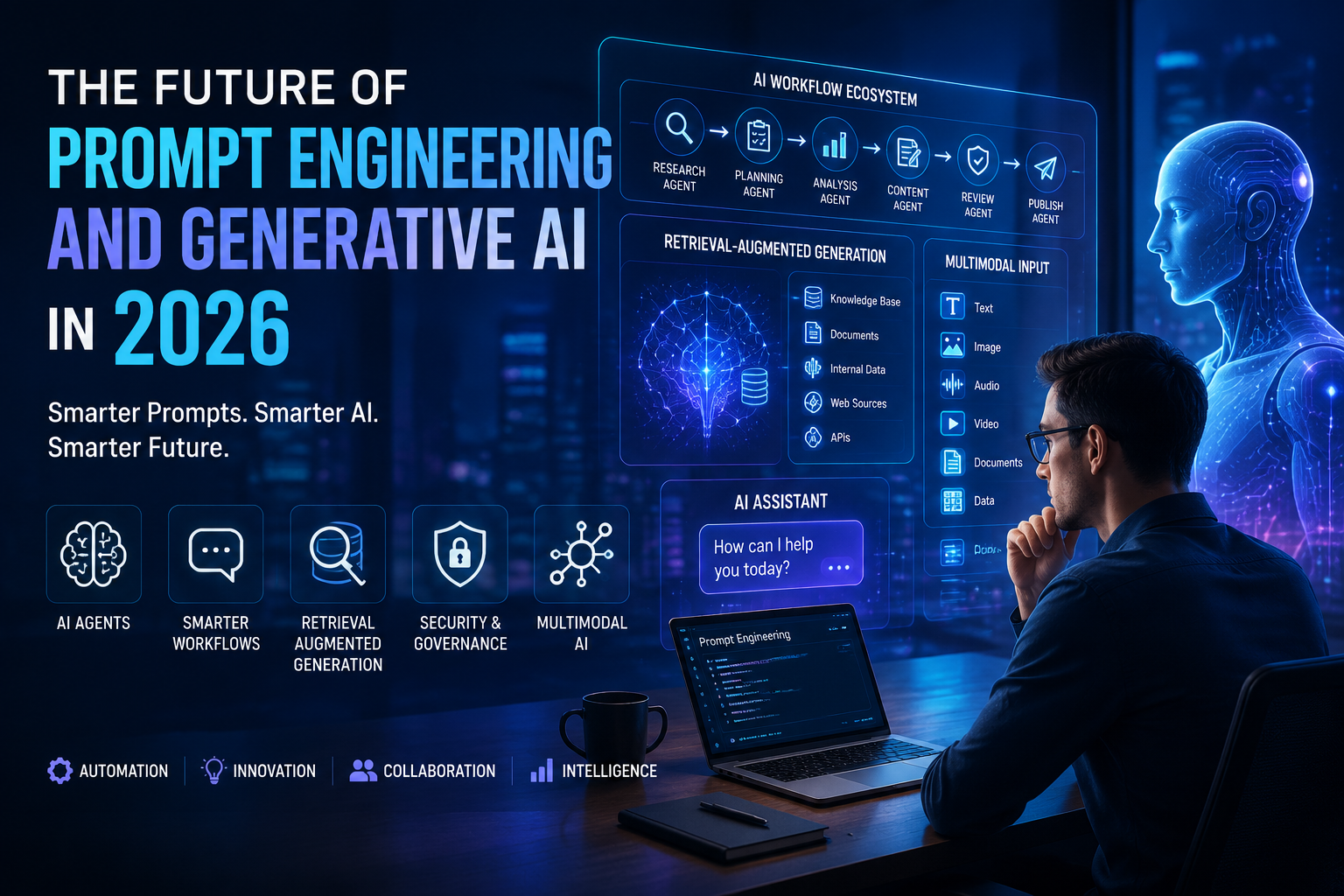
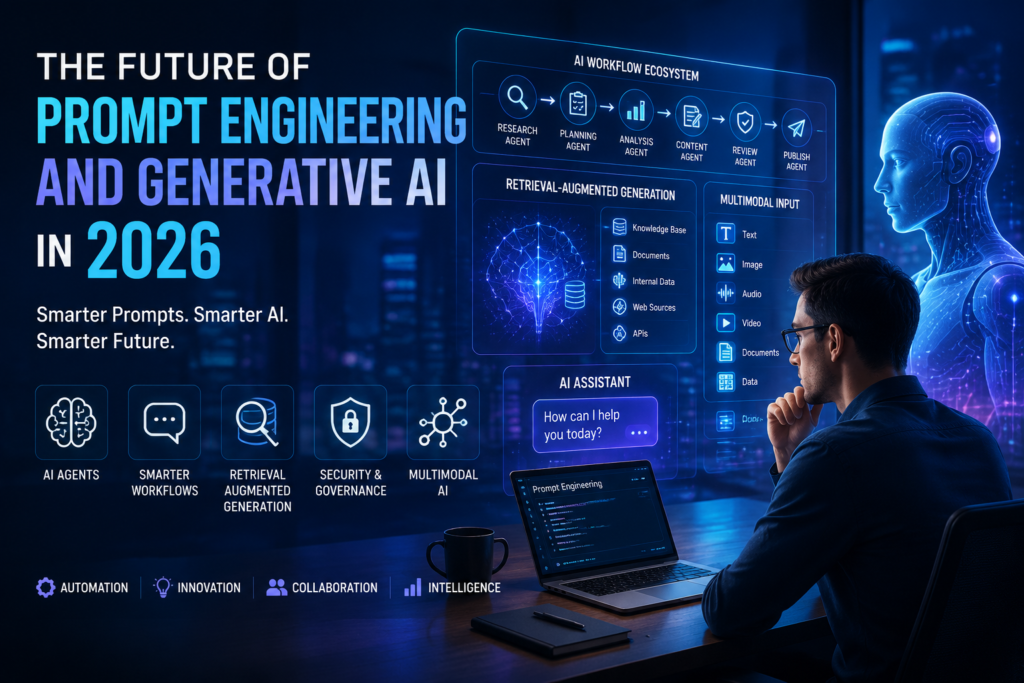
Research Agent
↓
Planning Agent
↓
Data Analysis Agent
↓
Content Creation Agent
↓
Fact-Checking Agent
↓
Publishing Agent
Each agent performs a dedicated task, improving accuracy and efficiency.
Prompt Engineering Will Become Workflow Engineering
Businesses are shifting from individual prompts to complete AI workflows.
Modern workflows include:
- Multiple prompts
- External APIs
- Internal databases
- Human approvals
- Automated quality checks
This approach delivers more reliable enterprise AI solutions.
Retrieval-Augmented Generation (RAG) Will Become Standard
Generative AI performs better when connected to trusted external knowledge.
Businesses increasingly integrate AI with:
- Internal documentation
- Knowledge bases
- Product catalogs
- Customer databases
- Compliance manuals
- Research repositories
RAG reduces hallucinations while improving factual accuracy.
Multimodal Prompt Engineering
AI models are no longer limited to text.
Future prompts combine:
- Images
- Voice
- Video
- Documents
- Spreadsheets
- Code
- Sensor data
Example:
A manufacturing engineer uploads equipment photos, maintenance logs, and sensor readings while asking AI to diagnose potential machine failures.
Enterprise Applications of Generative AI
Customer Support
Businesses automate:
- Live chat
- Email responses
- Technical support
- Knowledge retrieval
- Ticket summarization
Prompt engineering ensures AI provides accurate and professional customer interactions.
Software Development
Developers use AI for:
- Code generation
- Bug detection
- Documentation
- Security reviews
- Test automation
- Architecture planning
Future AI coding assistants will collaborate with human developers rather than simply generating code.
AI Cybersecurity
Cybersecurity professionals increasingly rely on AI to:
- Detect threats
- Analyze malware
- Investigate incidents
- Review security logs
- Generate compliance reports
- Recommend remediation strategies
Security-focused prompts improve both speed and consistency.
Healthcare
Healthcare organizations use AI for:
- Clinical documentation
- Administrative automation
- Patient communication
- Medical coding
- Research assistance
Medical professionals remain responsible for reviewing AI-generated outputs.
Marketing
AI transforms marketing through:
- Content creation
- SEO optimization
- Campaign analysis
- Customer segmentation
- Competitive research
- Advertising optimization
Prompt engineering helps marketers maintain brand consistency while improving efficiency.
AI Governance and Responsible Prompt Engineering
As AI adoption grows, governance becomes increasingly important.
Organizations now establish policies covering:
- Prompt approval
- Data privacy
- Human oversight
- AI transparency
- Output validation
- Security monitoring
Responsible AI governance reduces legal, ethical, and operational risks.
Cybersecurity Challenges in the AI Era
Prompt engineering introduces new security considerations.
Prompt Injection Attacks
Malicious instructions hidden within documents or web pages may attempt to manipulate AI systems.
Businesses mitigate this risk by:
- Input validation
- Prompt isolation
- Human review
- Security monitoring
Sensitive Data Protection
Organizations should never expose confidential information to unauthorized AI systems.
Best practices include:
- Data masking
- Encryption
- Access controls
- Enterprise AI platforms
- Audit logging
Compliance
Highly regulated industries must ensure AI aligns with:
- Internal policies
- Industry standards
- Data protection regulations
- Security requirements
Comparison Table: Prompt Engineering Today vs 2026
| Current Approach | Future Approach (2026) |
|---|---|
| Single prompts | Multi-agent workflows |
| Manual prompting | Automated orchestration |
| Text-only interactions | Multimodal AI systems |
| Generic outputs | Personalized responses |
| Limited context | Enterprise knowledge integration |
| Individual use | Organization-wide AI platforms |
| Basic automation | Intelligent workflow automation |
| Manual optimization | AI-assisted prompt optimization |
Benefits of the Future of Prompt Engineering and Generative AI
Organizations embracing advanced AI strategies gain significant advantages.
Increased Productivity
Employees automate repetitive tasks while focusing on higher-value work.
Better Decision-Making
AI delivers faster insights supported by structured data analysis.
Higher Accuracy
Retrieval-Augmented Generation improves factual reliability.
Improved Customer Experiences
Businesses provide faster, more personalized interactions.
Enhanced Innovation
Teams rapidly prototype products, services, and business ideas.
Stronger Cybersecurity
AI assists with continuous monitoring, threat analysis, and incident response.
Competitive Advantage
Organizations adopting AI early often improve operational efficiency and market responsiveness.
Challenges and Limitations
Despite remarkable progress, several challenges remain.
AI Hallucinations
AI can still generate inaccurate or fabricated information.
Critical decisions require human verification.
Privacy Concerns
Businesses must carefully manage sensitive customer and corporate data.
Ethical Considerations
Responsible AI development requires fairness, transparency, and accountability.
Skill Gaps
Many organizations need employees trained in AI literacy, prompt engineering, governance, and cybersecurity.
Rapid Technological Change
AI capabilities evolve quickly, requiring continuous learning and adaptation.
Future Trends
Several emerging trends are expected to define the future of prompt engineering and generative AI.
Autonomous AI Agents
AI systems will increasingly complete multi-step projects with minimal supervision.
Personalized AI Assistants
AI will adapt automatically to users’ preferences, expertise, and job roles.
AI-to-AI Collaboration
Multiple AI agents will communicate and coordinate tasks without constant human intervention.
Prompt Governance Platforms
Businesses will manage prompt libraries, security policies, performance metrics, and version control through dedicated governance systems.
Industry-Specific AI Models
Organizations will adopt specialized AI models trained for healthcare, finance, cybersecurity, manufacturing, education, and legal services.
Human-AI Collaboration
Rather than replacing professionals, AI will augment human expertise by handling repetitive analysis, documentation, and routine decision support.
Expert Insights and Industry Trends
The AI industry is moving toward integrated ecosystems where prompt engineering supports enterprise automation, intelligent assistants, and collaborative AI agents. Analysts consistently highlight governance, evaluation frameworks, and secure deployment as top priorities for organizations expanding AI adoption.
Businesses are also investing in reusable prompt libraries, AI performance testing, and role-specific assistants that improve consistency across departments. As models continue to evolve, professionals who combine domain expertise with AI literacy will remain in high demand.
Read More About:Advanced AI Prompt Engineering Strategies for Businesses
Frequently Asked Questions
1. What is the future of prompt engineering and generative AI in 2026?
The field is evolving from writing individual prompts to designing secure, scalable AI workflows that integrate automation, external knowledge, governance, and collaboration between specialized AI agents.
2. Will prompt engineering become obsolete?
No. While AI models are becoming better at understanding natural language, organizations will continue to need professionals who can design workflows, manage AI systems, ensure security, and optimize enterprise performance.
3. What industries will benefit the most?
Healthcare, finance, cybersecurity, software development, education, manufacturing, customer service, retail, and marketing are among the industries expected to see the greatest impact.
4. How does Retrieval-Augmented Generation improve AI?
RAG connects AI models with trusted external information sources, improving factual accuracy and reducing hallucinations compared with relying only on the model’s built-in knowledge.
5. What cybersecurity risks are associated with generative AI?
Common risks include prompt injection, data leakage, unauthorized access, and misuse of AI-generated content. Organizations can reduce these risks through governance, monitoring, input validation, and human oversight.
6. What skills should professionals develop for the AI future?
Valuable skills include prompt engineering, AI literacy, workflow design, cybersecurity awareness, data analysis, critical thinking, governance, and domain-specific expertise.
Conclusion
The Future of prompt engineering and generative AI in 2026 is defined by intelligent automation, multimodal AI, enterprise governance, and deeper collaboration between humans and AI systems. Prompt engineering is no longer just about crafting better instructions—it has become a strategic discipline that enables organizations to build reliable, scalable, and secure AI-powered workflows.
Businesses that embrace structured prompting, Retrieval-Augmented Generation, AI agents, and governance frameworks will be better positioned to improve productivity, strengthen cybersecurity, enhance customer experiences, and accelerate innovation. At the same time, responsible human oversight will remain essential to ensure AI systems operate ethically, accurately, and transparently.
As artificial intelligence continues to reshape industries, professionals who understand both the technical and strategic aspects of prompt engineering will play a key role in driving the next wave of digital transformation.
Key Takeaways
- Prompt engineering is evolving into AI workflow and orchestration design.
- Generative AI in 2026 emphasizes automation, governance, and multimodal capabilities.
- AI agents will collaborate to complete complex business tasks more efficiently.
- Retrieval-Augmented Generation improves AI accuracy by using trusted external knowledge.
- Enterprise AI requires strong governance, security, and compliance practices.
- Cybersecurity remains a critical focus as AI adoption expands.
- Human expertise and oversight continue to be essential for high-impact decisions.
- Personalized AI assistants and industry-specific models will drive the next phase of innovation.
- Organizations that invest in AI literacy and prompt engineering today will be better prepared for tomorrow’s AI-driven economy.
- The future of generative AI is centered on collaboration between humans and intelligent systems, not replacement.