
Discover how AI agents for small business customer support improve customer service, reduce costs, automate responses, and boost satisfaction with the latest AI solutions.
Introduction
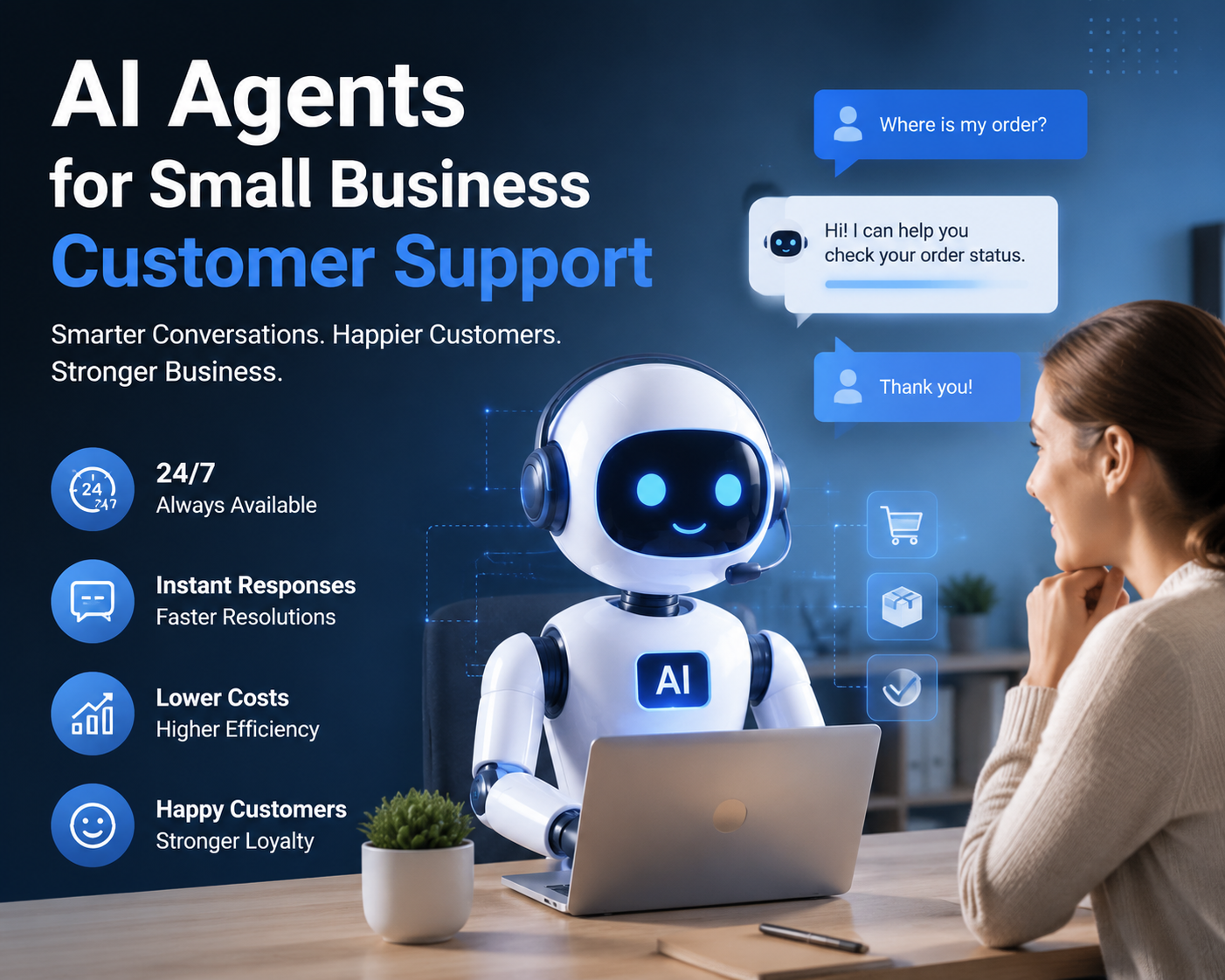
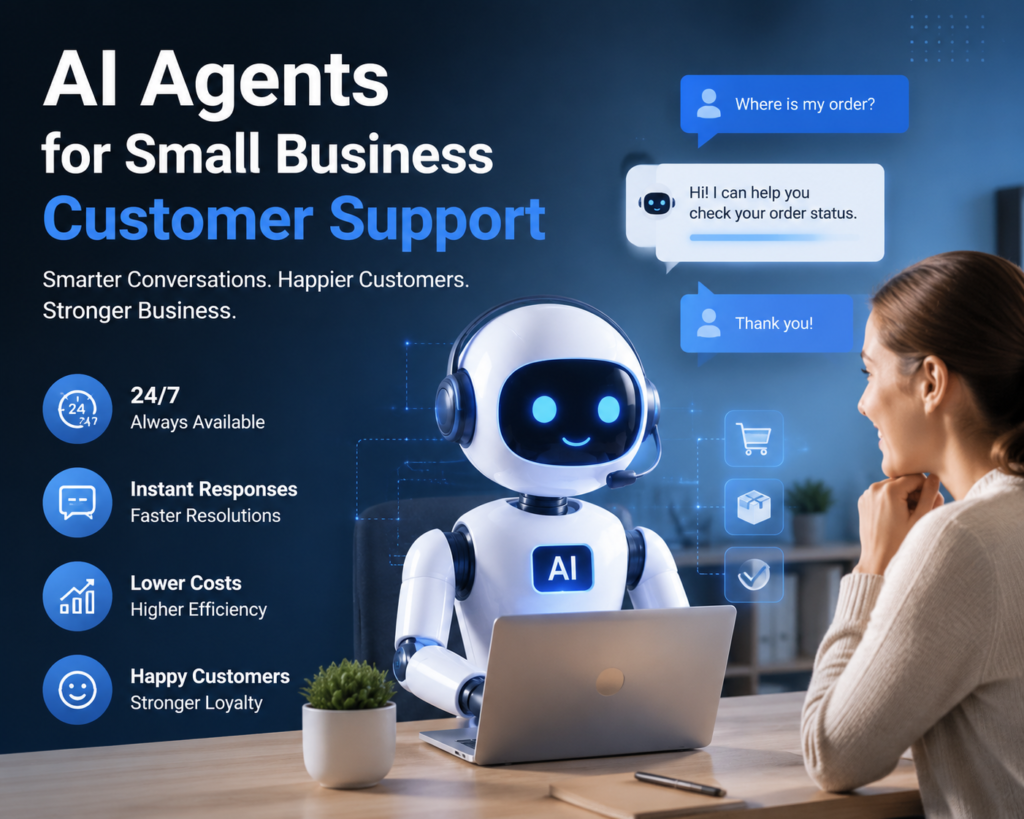
Customer expectations have never been higher. Modern consumers expect businesses to respond within minutes, provide personalized assistance, and remain available around the clock. For many small businesses, meeting these expectations can be challenging due to limited staff and tight budgets. This is where AI agents for small business customer support are transforming the customer experience.
Powered by advancements in artificial intelligence, natural language processing (NLP), and large language models (LLMs), AI agents have evolved beyond simple chatbots. They can understand customer intent, answer complex questions, automate repetitive support tasks, analyze conversations, and even take actions such as processing returns or scheduling appointments.
Whether you own an online store, a SaaS startup, a healthcare clinic, or a local service business, AI-powered customer support can help reduce operational costs while improving response times and customer satisfaction.
In this guide, you’ll learn how AI agents work, their benefits, practical applications, leading platforms, implementation strategies, cybersecurity considerations, industry trends, and future developments. If you’re looking for a smarter way to serve customers while growing your business, this comprehensive guide is for you.
What Are AI Agents for Small Business Customer Support?
AI agents are intelligent software applications designed to communicate with customers, understand requests, and perform tasks with minimal human intervention.
Unlike traditional rule-based chatbots that follow scripted conversations, AI agents use machine learning and generative AI to understand context and provide more natural, personalized responses.
They can:
- Answer customer questions instantly
- Resolve common support issues
- Route complex inquiries to human agents
- Access customer account information
- Generate personalized recommendations
- Automate follow-up communications
- Learn from previous conversations
- Support multiple languages
These capabilities allow small businesses to deliver enterprise-level customer service without hiring large support teams.
Why Small Businesses Are Adopting AI Customer Support
Customer service directly impacts customer retention and brand reputation. Delayed responses often result in lost sales and dissatisfied customers.
AI agents solve several common challenges:
- Limited support staff
- Increasing customer inquiries
- Rising labor costs
- Need for 24/7 availability
- Growing customer expectations
- Seasonal spikes in support requests
Industry research consistently shows that businesses implementing AI-assisted customer service experience faster response times, lower support costs, and improved customer satisfaction scores.
How AI Agents Work
Natural Language Processing
Natural Language Processing enables AI agents to understand human language, identify customer intent, and generate relevant responses.
For example:
Customer:
“I haven’t received my order.”
AI Agent:
- Identifies delivery issue
- Retrieves order information
- Checks shipment status
- Provides estimated delivery
- Offers escalation if necessary
Machine Learning
Machine learning allows AI systems to improve over time by analyzing previous interactions.
The more conversations processed, the better the AI becomes at recognizing patterns and resolving customer issues.
Knowledge Base Integration
Modern AI agents connect with:
- Product documentation
- FAQs
- Internal policies
- CRM systems
- Inventory databases
- Shipping providers
This enables accurate, real-time answers.
Workflow Automation
AI agents don’t simply answer questions.
They can also:
- Create support tickets
- Process refunds
- Reset passwords
- Schedule appointments
- Update customer profiles
- Escalate urgent cases
Key Features of AI Customer Support Agents
24/7 Customer Assistance
Unlike human representatives, AI agents remain available around the clock.
Customers receive immediate responses regardless of time zones or business hours.
Omnichannel Support
Modern AI agents work across:
- Websites
- Mobile apps
- Facebook Messenger
- SMS
- Slack
- Microsoft Teams
This creates a consistent customer experience.
Personalized Responses
AI integrates with CRM platforms to personalize interactions using:
- Customer names
- Purchase history
- Previous conversations
- Preferences
- Account status
Personalization improves engagement and customer loyalty.
Smart Ticket Routing
If an issue requires human intervention, AI automatically routes it to the correct department with conversation history included.
This reduces customer frustration.
Sentiment Analysis
Advanced AI identifies customer emotions such as frustration, satisfaction, or urgency.
Negative interactions can be escalated before they become complaints.
Top AI Agents for Small Business Customer Support
ChatGPT
Best for:
- Customer conversations
- FAQ automation
- Email drafting
- Knowledge management
Strengths:
- Highly conversational
- Strong reasoning
- Flexible integrations
- Excellent multilingual capabilities
Intercom Fin AI
Ideal for businesses with high customer inquiry volumes.
Features include:
- Instant replies
- Ticket automation
- Customer intent recognition
- Human handoff
Zendesk AI
Designed for customer support teams.
Key features include:
- Ticket classification
- Automated replies
- Knowledge base suggestions
- Workflow automation
Freshdesk AI
Suitable for growing businesses.
Capabilities include:
- AI chat
- Ticket summaries
- Agent assistance
- Customer insights
Salesforce Agentforce
Excellent for sales-driven organizations.
Combines:
- CRM
- Customer service
- AI recommendations
- Automated workflows
HubSpot AI
Best for businesses already using HubSpot CRM.
Supports:
- Live chat
- Customer history
- Automated support
- Marketing integration
Comparison Table
| AI Platform | Best For | 24/7 Support | CRM Integration | Multilingual | Ease of Use |
|---|---|---|---|---|---|
| ChatGPT | General Support | Yes | Excellent | Yes | Excellent |
| Intercom Fin AI | Customer Service | Yes | Excellent | Yes | Excellent |
| Zendesk AI | Help Desk | Yes | Excellent | Yes | Very Good |
| Freshdesk AI | Growing Businesses | Yes | Good | Yes | Excellent |
| Salesforce Agentforce | Enterprise CRM | Yes | Outstanding | Yes | Good |
| HubSpot AI | Marketing & Support | Yes | Excellent | Yes | Excellent |
Real-World Use Cases
Ecommerce Stores
AI agents help by:
- Tracking orders
- Processing returns
- Answering shipping questions
- Recommending products
- Managing refunds
This improves customer satisfaction while reducing support workload.
Healthcare Clinics
Healthcare providers use AI for:
- Appointment scheduling
- Insurance inquiries
- Prescription reminders
- General health information
- Patient follow-ups
Sensitive medical decisions remain under qualified healthcare professionals.
SaaS Companies
Software businesses automate:
- Technical FAQs
- Subscription management
- Password resets
- Billing support
- Product tutorials
This allows support engineers to focus on complex technical issues.
Local Service Businesses
Electricians, plumbers, consultants, and repair companies use AI to:
- Schedule appointments
- Provide estimates
- Answer pricing questions
- Send reminders
- Collect customer feedback
AI Cybersecurity Considerations
As AI becomes more integrated into customer support, cybersecurity must remain a priority.
Businesses should implement:
- Data encryption
- Multi-factor authentication
- Role-based access controls
- Regular security audits
- Secure API integrations
- Compliance with privacy regulations
AI should never expose confidential customer information or process sensitive requests without proper authentication.
Benefits of AI Agents for Small Business Customer Support
Faster Response Times
Customers receive answers instantly, reducing wait times and improving satisfaction.
Lower Operational Costs
AI handles repetitive inquiries, allowing businesses to operate with leaner support teams.
Improved Customer Experience
Quick, personalized assistance leads to stronger customer relationships.
Higher Employee Productivity
Support staff can focus on complex or high-value conversations rather than repetitive questions.
Consistent Service Quality
AI provides standardized, accurate responses across all customer interactions.
Business Scalability
As inquiry volumes increase, AI can manage thousands of conversations simultaneously without additional staffing.
Better Customer Insights
AI analyzes conversations to identify trends, recurring issues, and opportunities for service improvement.
Challenges and Limitations
Despite their advantages, AI agents have limitations.
Limited Human Empathy
AI may struggle with emotionally sensitive situations that require compassion and nuanced judgment.
Complex Queries
Some issues still require experienced human agents.
Initial Setup
Training AI with accurate knowledge bases and workflows requires time and planning.
Privacy Concerns
Businesses must ensure responsible handling of customer data and compliance with privacy regulations.
Ongoing Maintenance
Knowledge bases and AI models require regular updates to remain accurate.
Future Trends
AI customer support continues to evolve rapidly.
Autonomous AI Agents
Future systems will complete entire customer support workflows without human intervention.
Voice AI
Voice-enabled AI assistants will provide natural phone support for small businesses.
Hyper-Personalization
AI will tailor every interaction using customer behavior, preferences, and purchase history.
Predictive Customer Support
AI will anticipate customer problems before they contact support.
AI and Cybersecurity Integration
Customer support platforms will increasingly incorporate AI-powered fraud detection, anomaly monitoring, and identity verification.
Multi-Agent Collaboration
Specialized AI agents will work together across customer service, sales, billing, and technical support.
AI Industry News and Trends
The AI industry is advancing rapidly as businesses invest in intelligent customer support solutions powered by generative AI and large language models. Vendors are introducing AI agents capable of handling increasingly complex conversations, integrating seamlessly with CRM systems, and automating entire workflows. At the same time, growing attention to responsible AI, data privacy, and cybersecurity is shaping how organizations deploy these technologies. Small businesses now have access to enterprise-grade AI capabilities that were once available only to large corporations.
Read More About:Enterprise prompt engineering guide for AI automation
Frequently Asked Questions
1. What are AI agents for small business customer support?
AI agents are intelligent software systems that automate customer interactions, answer questions, resolve issues, and assist support teams using artificial intelligence and natural language processing.
2. Are AI agents better than traditional chatbots?
Yes. AI agents understand context, maintain conversations, learn from interactions, and perform tasks beyond simple scripted responses, making them more capable than traditional rule-based chatbots.
3. Can AI completely replace human customer service representatives?
No. AI is most effective when handling repetitive and routine inquiries. Human agents remain essential for complex cases, negotiations, and situations requiring empathy or specialized expertise.
4. Are AI customer support systems secure?
Leading platforms include encryption, authentication, access controls, and compliance features. Businesses should still follow cybersecurity best practices and protect sensitive customer information.
5. How much do AI customer support solutions cost?
Pricing varies depending on the platform, number of users, and features. Many providers offer free trials or entry-level plans, while advanced enterprise solutions typically use subscription-based pricing.
6. Which industries benefit the most from AI customer support?
Retail, e-commerce, healthcare, financial services, education, hospitality, SaaS, logistics, and professional service firms all benefit from AI-powered customer support by improving response times and operational efficiency.
Conclusion
AI agents for small business customer support are no longer a futuristic concept—they are a practical tool that helps businesses deliver faster, more consistent, and more personalized customer experiences. By automating repetitive inquiries, integrating with CRM systems, and supporting customers across multiple channels, AI enables small businesses to compete with much larger organizations while controlling operational costs.
However, successful implementation requires thoughtful planning, ongoing monitoring, and a balanced approach that combines AI efficiency with human expertise. Organizations should prioritize secure deployments, maintain accurate knowledge bases, and continuously evaluate customer feedback to optimize performance.
As AI technology continues to evolve, businesses that embrace intelligent customer support today will be better positioned to improve customer loyalty, increase productivity, and adapt to future market demands.
Key Takeaways
- AI agents provide 24/7 customer support with fast and accurate responses.
- They automate repetitive tasks such as FAQs, ticket routing, appointment scheduling, and order tracking.
- Small businesses can reduce costs while improving customer satisfaction and operational efficiency.
- Integration with CRM, knowledge bases, and communication platforms enables highly personalized support.
- AI complements rather than replaces human support teams, allowing staff to focus on complex customer needs.
- Strong cybersecurity practices and responsible AI governance are essential for protecting customer data.
- Future innovations, including autonomous workflows, predictive support, and voice AI, will further transform customer service.