
Master enterprise prompt engineering for AI automation with best practices, frameworks, security, governance, and real-world use cases for modern businesses.
Introduction
Artificial intelligence is transforming the way organizations operate, but achieving consistent, reliable, and secure AI outputs requires more than simply asking a chatbot a question. This is where an Enterprise prompt engineering guide for AI automation becomes essential.
Prompt engineering has evolved from a niche technical skill into a strategic business capability. Enterprises are now integrating large language models (LLMs) into customer support, software development, cybersecurity, marketing, finance, HR, and business intelligence. However, without structured prompts, governance, and standardized workflows, organizations risk inaccurate responses, inconsistent results, compliance issues, and reduced return on investment.
This comprehensive Enterprise prompt engineering guide for AI automation explains how organizations can design effective prompts, establish enterprise-wide standards, improve AI reliability, enhance cybersecurity, and maximize productivity. Whether you are an AI professional, developer, cybersecurity specialist, executive, or business owner, this guide will help you understand modern enterprise prompt engineering strategies and their role in the rapidly evolving AI industry.
What Is Enterprise Prompt Engineering?
Enterprise prompt engineering is the structured process of designing, testing, optimizing, documenting, and governing prompts used by AI systems across an organization.
Unlike casual AI usage, enterprise prompt engineering focuses on:
- Consistency
- Accuracy
- Security
- Scalability
- Compliance
- Business outcomes
Rather than relying on individual employees to create prompts independently, enterprises develop reusable prompt templates, standardized workflows, governance policies, and evaluation methods.
Why It Matters
As organizations deploy AI across thousands of employees, even small improvements in prompt quality can significantly impact:
- Employee productivity
- Customer satisfaction
- Operational efficiency
- AI reliability
- Regulatory compliance
Prompt engineering has become a core component of enterprise AI strategy rather than simply an experimental technique.
Why AI Automation Depends on Effective Prompt Engineering
AI automation combines artificial intelligence with business workflows to reduce manual work and accelerate decision-making.
Examples include:
- Automated customer support
- AI-powered document summarization
- Financial report generation
- Security alert analysis
- Code generation
- Knowledge management
- Legal document drafting
- HR onboarding
The effectiveness of these automations depends largely on prompt quality.
Poor prompts often produce:
- Hallucinated information
- Missing context
- Generic responses
- Inconsistent formatting
- Security risks
Well-designed prompts dramatically improve output quality.
Example
Instead of asking:
Summarize this document.
A better enterprise prompt would be:
You are a compliance analyst. Summarize the following policy document into five executive bullet points. Highlight regulatory risks, financial implications, implementation deadlines, and required actions. Maintain a professional tone and avoid assumptions beyond the provided content.
The second prompt clearly defines:
- Role
- Objective
- Output format
- Audience
- Constraints
This structure consistently generates higher-quality responses.
Core Principles of Enterprise Prompt Engineering
1. Define the AI’s Role
Assigning a role provides context.
Examples:
- Cybersecurity analyst
- Financial advisor
- Software architect
- Marketing strategist
- Legal consultant
Role prompting improves response quality.
2. Provide Context
Enterprise AI performs better when supplied with relevant information.
Include:
- Company policies
- Product details
- Customer history
- Business goals
- Industry regulations
3. Specify Desired Output
Clearly define:
- Length
- Format
- Tone
- Structure
- Audience
Example:
- Markdown report
- Executive summary
- JSON response
- Bullet list
- Technical documentation
4. Define Constraints
Effective prompts specify limitations.
Examples include:
- Do not fabricate facts.
- Cite only provided sources.
- Keep responses under 300 words.
- Follow GDPR compliance.
- Avoid confidential information.
5. Iterate and Optimize
Prompt engineering is an iterative process.
Organizations should:
- Test prompts
- Compare outputs
- Measure quality
- Improve wording
- Document best-performing versions
Enterprise Prompt Engineering Framework
A structured framework improves consistency.
| Stage | Purpose | Outcome |
|---|---|---|
| Define Objective | Identify business goal | Clear requirements |
| Gather Context | Supply relevant information | Better AI understanding |
| Create Prompt | Design structured instruction | Reliable outputs |
| Test Responses | Evaluate quality | Performance metrics |
| Optimize | Refine prompts | Improved accuracy |
| Govern | Standardize usage | Enterprise consistency |
Prompt Design Best Practices
Use Clear Instructions
Avoid ambiguity.
Instead of:
Analyze this.
Use:
Analyze customer satisfaction survey results and identify the top five recurring complaints with suggested business improvements.
Break Complex Tasks into Steps
Complex prompts perform better when divided.
Example:
- Summarize
- Categorize
- Analyze
- Recommend actions
Encourage Reasoned Responses
Ask AI to explain reasoning where appropriate.
Example:
Explain your recommendation and identify any assumptions.
Standardize Templates
Organizations benefit from reusable prompt libraries.
Templates improve:
- Productivity
- Consistency
- Governance
- Collaboration
Enterprise Prompt Templates
Customer Support
You are a senior customer support specialist.

Respond professionally.

Use company policy.

Provide step-by-step instructions.

Escalate only when necessary.

Maintain empathy.
Cybersecurity Investigation
You are a cybersecurity analyst.

Review the security logs.

Identify suspicious activity.

Assign severity.

Recommend mitigation steps.

Avoid unsupported conclusions.
Marketing Content
You are a B2B marketing strategist.

Create a blog outline.

Target enterprise decision-makers.

Use SEO best practices.

Include CTA.
AI Automation Use Cases Across Industries
Customer Service
AI automates:
- Ticket routing
- FAQ generation
- Chatbots
- Email drafting
Software Development
Developers use AI for:
- Code generation
- Documentation
- Bug analysis
- Testing
- Refactoring
Cybersecurity
Prompt engineering supports:
- Threat intelligence
- Malware analysis
- Incident reporting
- Risk assessments
- Vulnerability summaries
Healthcare
AI assists with:
- Clinical documentation
- Medical coding
- Patient communication
- Administrative tasks
Human oversight remains essential for patient safety and regulatory compliance.
Finance
Financial institutions use AI for:
- Fraud analysis
- Report generation
- Investment research
- Risk management
- Regulatory reporting
Prompt Engineering and AI Cybersecurity
Cybersecurity teams increasingly rely on AI.
However, prompt engineering must prioritize security.
Potential risks include:
- Prompt injection attacks
- Data leakage
- Unauthorized access
- Sensitive information exposure
- Model manipulation
Security Best Practices
- Never include confidential credentials.
- Mask personally identifiable information.
- Validate AI outputs.
- Restrict data access.
- Maintain audit logs.
- Monitor prompt usage.
- Apply role-based permissions.
Security-aware prompt engineering reduces enterprise risk while improving trust.
Comparison Table: Basic vs Enterprise Prompt Engineering
| Feature | Basic Prompting | Enterprise Prompt Engineering |
|---|---|---|
| Goal | Simple responses | Business outcomes |
| Governance | None | Centralized |
| Security | Limited | Strong controls |
| Reusability | Low | High |
| Testing | Rare | Continuous |
| Documentation | Minimal | Comprehensive |
| Compliance | Optional | Mandatory |
| Scalability | Limited | Enterprise-wide |
Measuring Prompt Performance
Successful organizations measure prompt quality using key performance indicators (KPIs).
Important metrics include:
- Accuracy
- Response consistency
- User satisfaction
- Hallucination rate
- Task completion
- Cost per request
- Processing time
- Human review rate
Continuous evaluation ensures prompt libraries remain effective as AI models evolve.
Industry Trends and Expert Insights
Enterprise adoption of generative AI continues to expand across industries. Organizations are moving beyond experimental chatbot deployments toward production-grade AI platforms integrated with customer relationship management (CRM), enterprise resource planning (ERP), cybersecurity operations, and knowledge management systems.
Industry analysts consistently highlight governance, responsible AI practices, prompt optimization, and retrieval-augmented generation (RAG) as key priorities for enterprise AI maturity. Businesses are also investing in internal AI centers of excellence to standardize prompt libraries, evaluation methods, and employee training.
As AI capabilities improve, prompt engineering is becoming a collaborative discipline involving developers, domain experts, compliance teams, and business leaders rather than a responsibility limited to technical staff.
Benefits
Organizations implementing structured enterprise prompt engineering gain numerous advantages.
Increased Productivity
Employees complete repetitive tasks faster with consistent AI assistance.
Better Output Quality
Structured prompts produce more reliable and accurate responses.
Enhanced Security
Standardized prompts reduce accidental data exposure.
Improved Compliance
Prompt governance helps organizations align with legal and regulatory requirements.
Cost Savings
Automation reduces manual effort and operational expenses.
Consistent Brand Voice
Marketing and customer service teams maintain unified messaging.
Faster Decision-Making
Executives receive structured reports and actionable insights more quickly.
Better Collaboration
Shared prompt libraries reduce duplication and improve knowledge sharing.
Challenges or Limitations
Despite its benefits, enterprise prompt engineering presents several challenges.
Model Hallucinations
AI can generate inaccurate or fabricated information.
Rapid Technology Changes
Models evolve frequently, requiring prompt updates and continuous testing.
Security Risks
Improper prompts may expose sensitive business information.
Governance Complexity
Large organizations need policies, approvals, and documentation.
Employee Training
Staff require education on prompt design, AI limitations, and responsible usage.
Regulatory Compliance
Organizations operating in regulated industries must ensure AI systems comply with privacy, security, and industry-specific requirements.
Future Trends
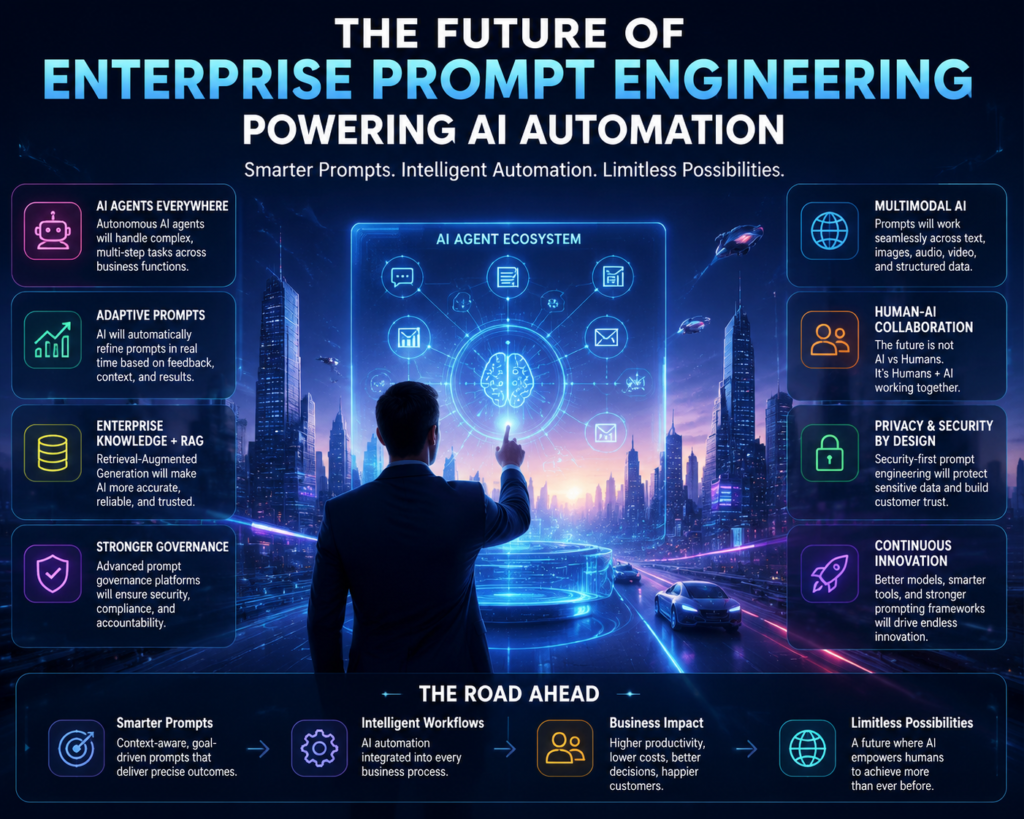
Enterprise prompt engineering is expected to evolve significantly over the next several years.
AI Agents
Autonomous AI agents will execute multi-step business workflows with minimal human intervention.
Adaptive Prompt Optimization
AI systems will increasingly refine prompts automatically based on user feedback and performance metrics.
Multimodal AI
Organizations will engineer prompts for text, images, audio, video, and structured data within unified workflows.
Retrieval-Augmented Generation (RAG)
AI systems will rely more heavily on trusted enterprise knowledge bases, reducing hallucinations and improving factual accuracy.
Prompt Governance Platforms
Dedicated enterprise platforms will manage prompt libraries, version control, permissions, testing, and compliance reporting.
Human-AI Collaboration
Prompt engineering will shift from one-time instruction writing to ongoing collaboration between employees and intelligent AI assistants.
Read More About:Prompt Engineering Trends and Emerging AI Technologies in 2026
Frequently Asked Questions (FAQ)
1. What is enterprise prompt engineering?
Enterprise prompt engineering is the systematic creation, testing, governance, and optimization of prompts used by AI systems across an organization to improve consistency, security, and business outcomes.
2. Why is prompt engineering important for AI automation?
High-quality prompts improve AI accuracy, reduce errors, enhance productivity, support compliance, and enable reliable automation across business processes.
3. Which industries benefit most from enterprise prompt engineering?
Industries including healthcare, finance, cybersecurity, software development, manufacturing, retail, education, legal services, and customer support all benefit from structured prompt engineering practices.
4. What are the biggest risks of poor prompt engineering?
Common risks include hallucinated information, inconsistent outputs, data leakage, prompt injection attacks, compliance violations, and reduced user trust.
5. How can businesses improve prompt quality?
Businesses should establish prompt standards, create reusable templates, test outputs regularly, monitor performance, provide employee training, and implement governance policies.
6. Does prompt engineering require programming knowledge?
Not necessarily. While technical expertise can be helpful, many effective prompt engineering techniques rely on clear communication, structured thinking, and domain knowledge rather than coding skills.
7. Will prompt engineering remain important as AI advances?
Yes. Although AI models are becoming more capable, organizations will continue to need governance, structured workflows, evaluation frameworks, and security controls to ensure AI systems produce trustworthy, business-ready outputs.
Conclusion
Enterprise AI adoption is accelerating across virtually every industry, making prompt engineering a strategic capability rather than an optional skill. A well-defined Enterprise prompt engineering guide for AI automation enables organizations to create consistent, secure, and scalable AI workflows that deliver measurable business value.
By following structured prompt engineering principles—such as defining roles, providing context, specifying outputs, applying governance, and continuously evaluating performance—businesses can significantly improve AI reliability while minimizing operational and security risks.
As AI technologies continue to evolve, organizations that invest in prompt engineering frameworks, employee education, cybersecurity best practices, and responsible AI governance will be better positioned to achieve sustainable competitive advantages. Prompt engineering is no longer simply about asking better questions; it is about designing intelligent interactions that align AI capabilities with real-world business goals.
Key Takeaways
- Enterprise prompt engineering improves AI consistency, accuracy, and scalability.
- Effective prompts define roles, context, objectives, constraints, and output formats.
- AI automation depends heavily on well-structured prompt design.
- Standardized prompt libraries enhance collaboration and governance.
- Security, privacy, and compliance should be integrated into every prompt engineering workflow.
- Continuous testing and optimization are essential as AI models evolve.
- Industries such as finance, healthcare, cybersecurity, and software development are rapidly adopting enterprise prompt engineering.
- Future advancements will include AI agents, adaptive prompts, multimodal AI, and enterprise governance platforms.
- Organizations that prioritize prompt engineering today will be better prepared for the next generation of AI-powered automation.