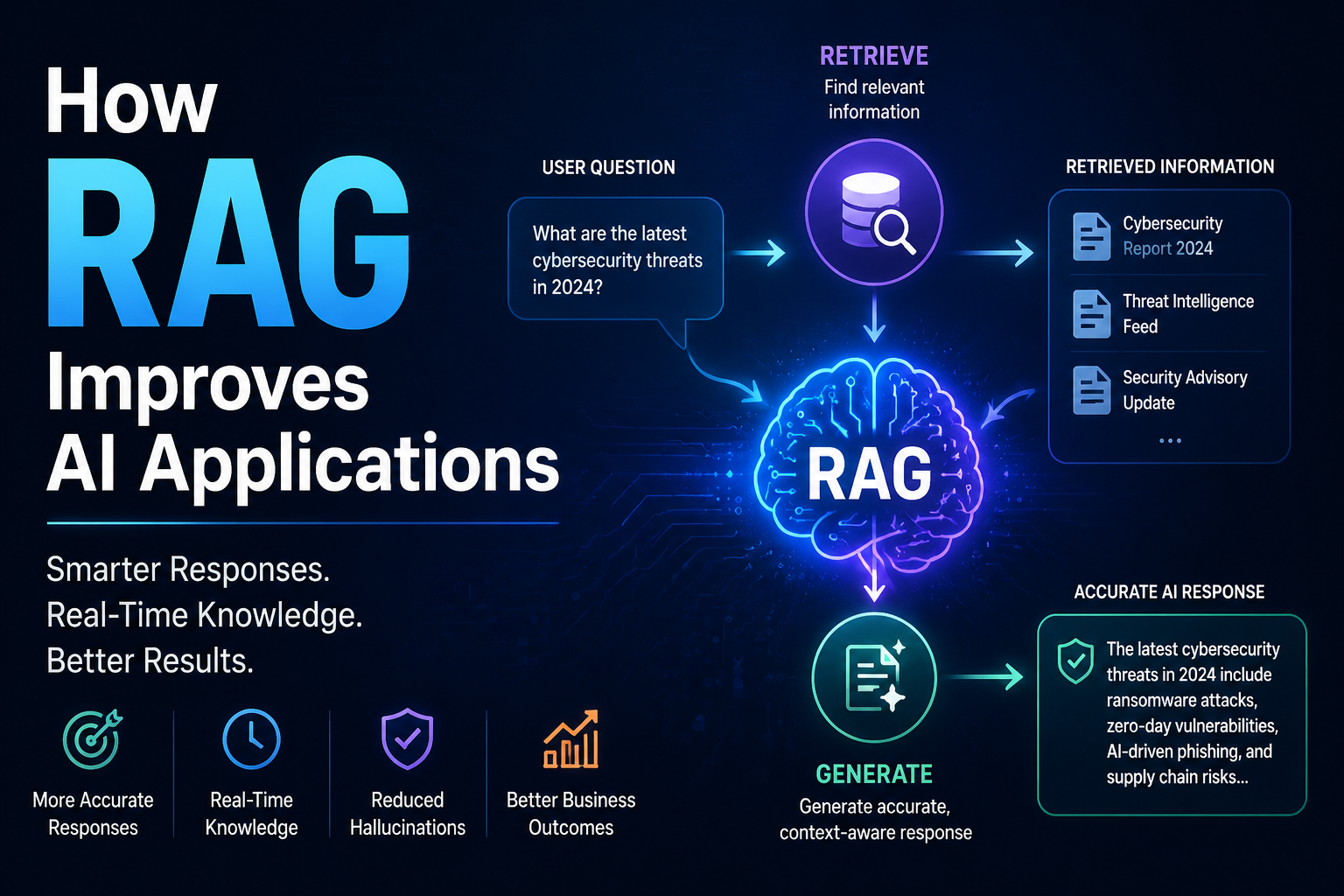

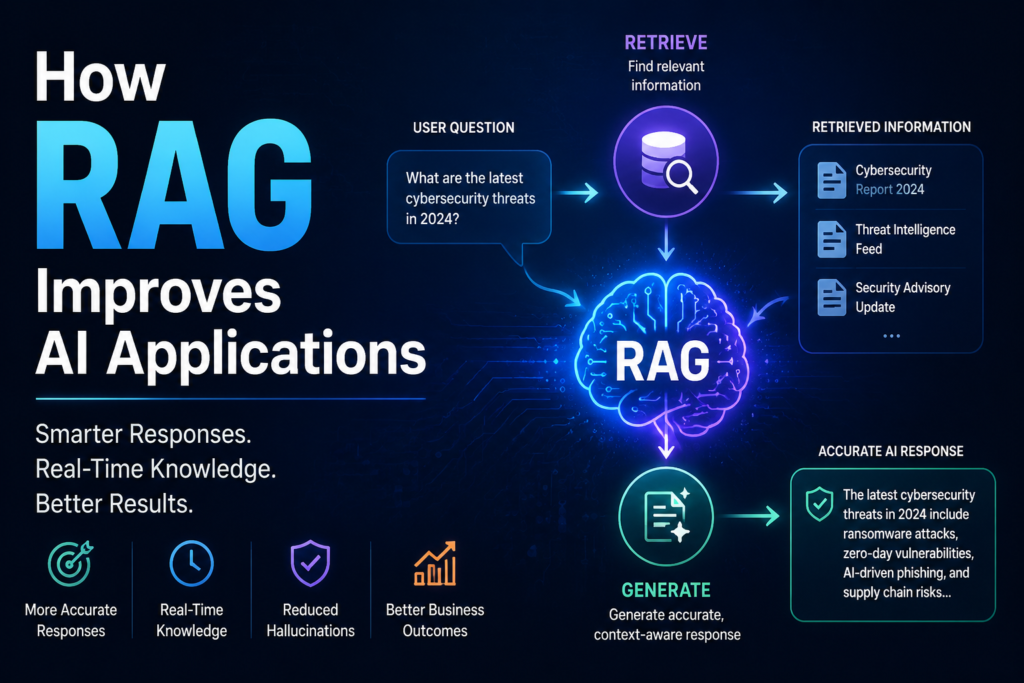
Discover how RAG improves AI applications by boosting accuracy, reducing hallucinations, enabling real-time knowledge, and enhancing enterprise AI performance.
Introduction
Artificial Intelligence has evolved rapidly over the past few years, but one persistent challenge continues to affect even the most advanced large language models (LLMs): hallucinations—confidently generating incorrect or outdated information. This is where Retrieval-Augmented Generation (RAG) has emerged as one of the most important breakthroughs in modern AI.
Understanding How RAG Improves AI Applications is becoming increasingly valuable for developers, businesses, cybersecurity experts, and AI enthusiasts alike. Rather than relying solely on information stored during model training, RAG enables AI systems to retrieve relevant, up-to-date information from trusted external sources before generating responses. The result is significantly more accurate, context-aware, and trustworthy AI outputs.
From enterprise chatbots and healthcare assistants to cybersecurity platforms and legal research tools, RAG is transforming how AI delivers information. It bridges the gap between static language models and dynamic knowledge bases, making AI systems smarter, more reliable, and better suited for real-world applications.
In this comprehensive guide, you’ll learn how RAG works, why it has become a cornerstone of modern AI development, its benefits and limitations, practical use cases, future trends, and why industry leaders increasingly view Retrieval-Augmented Generation as essential for next-generation AI systems.
What Is Retrieval-Augmented Generation (RAG)?
Retrieval-Augmented Generation (RAG) is an AI architecture that combines two powerful capabilities:
- Information retrieval
- Natural language generation
Instead of generating answers exclusively from its training data, a RAG system first searches trusted external knowledge sources for relevant information. It then uses the retrieved content as context while generating its response.
This allows AI models to produce answers that are:
- More accurate
- Better grounded in facts
- Current and up-to-date
- Easier to verify
- More relevant to user queries
In simple terms, RAG gives AI models an “open-book exam” instead of forcing them to rely entirely on memory.
How RAG Improves AI Applications
Reduces AI Hallucinations
One of the biggest weaknesses of traditional LLMs is hallucination.
Hallucinations occur when an AI confidently generates false information because it lacks the correct knowledge.
RAG dramatically reduces this problem by retrieving factual information before generating an answer.
For example:
Without RAG:
“The CEO of Company X is John Smith.”
Even if the CEO changed months ago.
With RAG:
The AI first checks the latest company database or documentation before responding.
This significantly improves reliability.
Provides Real-Time Knowledge
Traditional AI models have a knowledge cutoff date.
They cannot automatically know about:
- Recent AI news
- Product launches
- Cybersecurity threats
- Government regulations
- Financial reports
RAG connects AI to live or regularly updated data sources.
Examples include:
- Company databases
- Internal documentation
- Websites
- APIs
- Knowledge bases
- News repositories
- Research papers
This makes AI applications far more useful in dynamic industries.
Improves Response Accuracy
Accuracy is essential in industries where mistakes are costly.
These include:
- Healthcare
- Finance
- Cybersecurity
- Law
- Engineering
RAG enables AI to cite current documentation before generating answers.
Instead of relying on probabilities, it retrieves supporting evidence.
This significantly increases factual correctness.
Delivers Better Context
Modern businesses often have thousands of documents.
Examples include:
- Policies
- Product manuals
- HR documentation
- Security procedures
- Technical documentation
- Customer records
RAG retrieves the most relevant documents before answering.
This allows AI to understand context much more effectively.
Enables Personalized Responses
Many organizations maintain proprietary knowledge.
Examples include:
- Customer purchase history
- CRM systems
- Internal support documents
- Business workflows
RAG allows AI assistants to use organization-specific information while keeping the foundation model unchanged.
This enables highly personalized interactions.
How RAG Works
The RAG process generally follows these steps.
Step 1: User Asks a Question
Example:
“What is our company’s remote work policy?”
Step 2: Query Processing
The AI converts the question into semantic embeddings.
These embeddings capture the meaning rather than exact keywords.
Step 3: Information Retrieval
The system searches:
- Vector databases
- Document repositories
- Internal knowledge bases
- Enterprise search systems
Step 4: Context Selection
The most relevant documents are selected.
Only the highest-quality information is passed to the language model.
Step 5: AI Generates Response
The LLM uses both:
- User prompt
- Retrieved documents
to create an accurate response.
Step 6: Final Output
The user receives an answer grounded in real information rather than assumptions.
Traditional AI vs RAG
| Feature | Traditional LLM | RAG-Based AI |
|---|---|---|
| Uses external knowledge | No | Yes |
| Real-time information | Limited | Excellent |
| Hallucination risk | Higher | Lower |
| Enterprise data support | Limited | Strong |
| Easy knowledge updates | No retraining required? No | Yes |
| Response accuracy | Moderate | High |
| Personalization | Limited | Excellent |
| Scalability | Moderate | High |
Real-World Applications of RAG
Enterprise Knowledge Management
Large organizations use RAG-powered assistants to search millions of internal documents instantly.
Employees receive accurate answers without manually searching documentation.
AI Customer Support
Customer service chatbots become dramatically more effective when connected to:
- Product manuals
- FAQs
- Knowledge bases
- Support tickets
This improves customer satisfaction while reducing support costs.
AI Cybersecurity
Cybersecurity teams use RAG to search:
- Threat intelligence feeds
- Security policies
- Incident reports
- Vulnerability databases
Analysts receive faster and more accurate recommendations.
Healthcare
Hospitals use RAG systems to retrieve:
- Medical guidelines
- Research publications
- Clinical protocols
Doctors receive evidence-based assistance while making informed decisions.
Legal Research
Law firms use RAG to search:
- Case law
- Regulations
- Contracts
- Legal databases
This saves countless hours of manual research.
Financial Services
Banks and financial institutions use RAG for:
- Compliance monitoring
- Risk assessment
- Fraud detection
- Regulatory analysis
Accurate, current information is essential in these highly regulated industries.
AI Coding Assistants
Modern coding assistants retrieve:
- Documentation
- Internal code repositories
- API references
- Company coding standards
Developers receive significantly better recommendations.
Why Businesses Are Investing in RAG
Businesses increasingly recognize that AI is only as valuable as the quality of information it uses.
Key business drivers include:
- Reduced misinformation
- Improved customer experiences
- Lower operational costs
- Faster employee onboarding
- Better knowledge sharing
- Enhanced regulatory compliance
- Increased productivity
- More reliable decision-making
Many enterprises now view RAG as a foundational technology for deploying trustworthy AI.
Benefits of RAG
RAG offers numerous advantages that make it a preferred architecture for enterprise AI.
Higher Accuracy
AI responses are grounded in relevant, verified information rather than generated solely from statistical patterns.
Lower Hallucination Rates
Retrieving factual documents before generation significantly reduces fabricated answers.
Access to Current Information
Organizations can update their knowledge bases without retraining the underlying language model.
Cost Efficiency
Updating documents is typically faster and less expensive than retraining large AI models whenever information changes.
Better Enterprise Search
Employees can query large internal repositories using natural language instead of navigating complex folder structures.
Improved Transparency
Many RAG systems can provide references or citations to the documents used, making answers easier to verify and audit.
Enhanced Security
Organizations can restrict retrieval to approved internal knowledge sources, reducing the risk of exposing sensitive or unauthorized information.
Challenges and Limitations
Despite its advantages, RAG is not without challenges.
Retrieval Quality
Poor retrieval leads to poor answers. The AI can only generate accurate responses if the retrieved documents are relevant.
Data Quality Issues
Outdated, duplicated, or inaccurate documents can negatively affect response quality.
Increased System Complexity
RAG systems require additional infrastructure such as:
- Vector databases
- Embedding models
- Search engines
- Knowledge pipelines
- Monitoring tools
Latency
Searching external data sources adds processing time compared to using a standalone language model.
Security Concerns
Organizations must carefully manage permissions to ensure AI only accesses authorized information.
Maintenance Requirements
Knowledge bases require ongoing updates, indexing, and quality assurance to remain effective.
Best Practices for Implementing RAG
Organizations can maximize the value of RAG by following these best practices:
- Maintain clean, well-structured documentation.
- Regularly update knowledge repositories.
- Remove outdated or duplicate content.
- Use high-quality embedding models.
- Optimize chunk sizes for document retrieval.
- Monitor retrieval accuracy continuously.
- Secure sensitive enterprise information.
- Include source attribution when possible.
- Test responses using realistic user scenarios.
- Combine RAG with human oversight for critical workflows.
Expert Insights and Industry Trends
Industry adoption of RAG has accelerated as organizations seek reliable AI systems that can work with proprietary and constantly changing information. Major cloud providers, enterprise software vendors, and AI startups now offer managed services for vector search, document indexing, and retrieval pipelines, making RAG easier to implement than ever before.
Research and enterprise case studies consistently show that grounding AI responses with retrieved context can significantly improve factual accuracy compared to relying solely on a model’s internal knowledge. As organizations increasingly prioritize trustworthy AI, retrieval-based architectures are becoming a standard component of production AI systems.
Another notable trend is the integration of RAG with multimodal AI. Modern systems are beginning to retrieve not only text but also images, diagrams, audio transcripts, videos, and structured databases, allowing AI assistants to answer more complex questions across multiple content formats.
Future Trends
The future of Retrieval-Augmented Generation is closely tied to the next generation of intelligent AI systems.
Multimodal RAG
Future systems will retrieve information from:
- Images
- Videos
- Audio recordings
- Charts
- PDFs
- Databases
This will enable richer and more comprehensive responses.
Agentic AI
AI agents will autonomously determine when to retrieve additional information, validate sources, and complete multi-step tasks with minimal human intervention.
Better Vector Search
Advances in vector databases and semantic search will improve retrieval speed, scalability, and relevance.
Hybrid Search Techniques
Combining semantic search with traditional keyword search will improve retrieval performance, especially for technical documents and compliance content.
Industry-Specific RAG
Specialized RAG solutions will emerge for:
- Healthcare
- Finance
- Manufacturing
- Education
- Cybersecurity
- Government
These systems will incorporate domain-specific knowledge and regulatory requirements.
Stronger Governance and Explainability
Future RAG platforms will provide improved auditing, explainable retrieval paths, and built-in governance features to support responsible AI adoption.
Read More About:AI Productivity Tools for Remote Teams: Complete 2026 Guide
Frequently Asked Questions (FAQ)
1. What does RAG stand for in artificial intelligence?
RAG stands for Retrieval-Augmented Generation. It combines information retrieval with language generation to produce more accurate and context-aware AI responses.
2. How does RAG reduce AI hallucinations?
RAG retrieves relevant information from trusted knowledge sources before generating an answer. This grounding process reduces the likelihood of fabricated or inaccurate responses.
3. Is RAG better than traditional large language models?
For applications requiring current, domain-specific, or verifiable information, RAG generally outperforms standalone language models because it supplements the model with external knowledge instead of relying only on training data.
4. Which industries benefit the most from RAG?
Industries with large volumes of knowledge and strict accuracy requirements benefit greatly, including healthcare, finance, cybersecurity, legal services, education, manufacturing, and customer support.
5. Does RAG require retraining an AI model?
No. One of RAG’s biggest advantages is that organizations can update their knowledge base without retraining the underlying language model, making it more efficient and cost-effective.
6. Can RAG improve AI cybersecurity applications?
Yes. RAG enables cybersecurity tools to retrieve the latest threat intelligence, vulnerability reports, incident response playbooks, and internal security documentation, helping analysts make faster and better-informed decisions.
7. What technologies are commonly used in RAG systems?
Typical RAG implementations include language models, embedding models, vector databases, document indexing systems, semantic search engines, and orchestration frameworks that connect retrieval with text generation.
Conclusion
Understanding How RAG Improves AI Applications is essential for anyone interested in the future of artificial intelligence. By combining intelligent information retrieval with advanced language generation, RAG addresses some of the biggest limitations of traditional AI systems, including hallucinations, outdated knowledge, and limited access to proprietary information.
Its ability to deliver accurate, context-aware, and up-to-date responses makes it a powerful solution across industries such as healthcare, cybersecurity, finance, legal services, customer support, and enterprise knowledge management. Rather than replacing large language models, RAG enhances them by grounding responses in trusted data sources, resulting in more reliable and actionable outputs.
As AI adoption continues to accelerate, organizations that implement well-designed RAG systems will be better positioned to improve productivity, strengthen decision-making, reduce operational risks, and build greater trust with users. Investing in high-quality data, robust retrieval mechanisms, and continuous governance will ensure that RAG-powered applications remain accurate, secure, and scalable in an increasingly AI-driven world.
Key Takeaways
- How RAG Improves AI Applications centers on combining retrieval with language generation for more reliable responses.
- RAG significantly reduces AI hallucinations by grounding answers in trusted external data.
- It enables access to real-time and organization-specific knowledge without retraining the model.
- Enterprise AI benefits from higher accuracy, personalization, transparency, and operational efficiency.
- RAG is widely used in customer support, cybersecurity, healthcare, legal research, finance, and software development.
- Success depends on high-quality data, effective retrieval strategies, secure access controls, and ongoing maintenance.
- Emerging innovations such as multimodal retrieval, agentic AI, hybrid search, and explainable AI will further expand RAG’s capabilities.
- For businesses seeking trustworthy, scalable AI solutions, Retrieval-Augmented Generation is rapidly becoming a core architectural pattern rather than an optional enhancement.