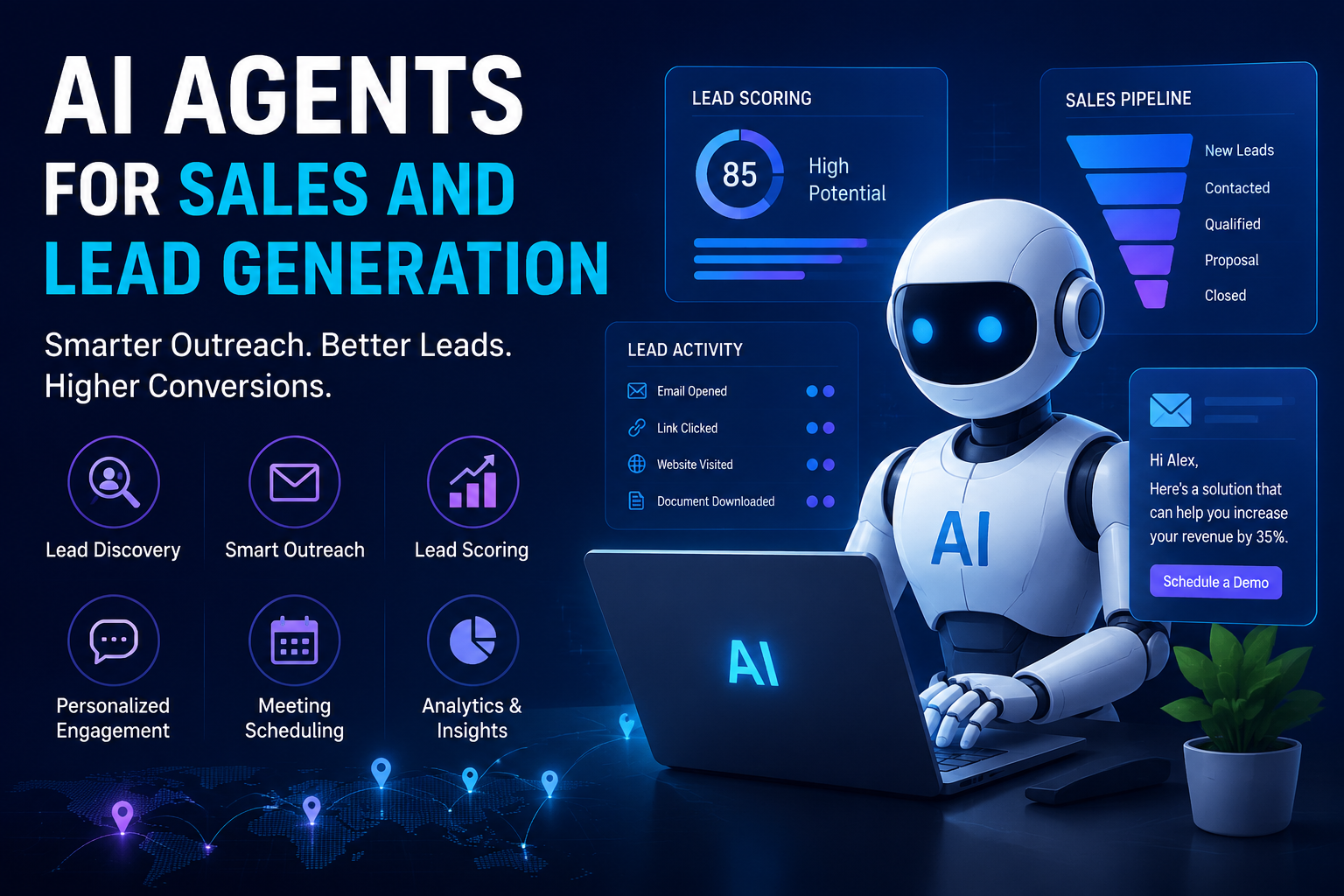

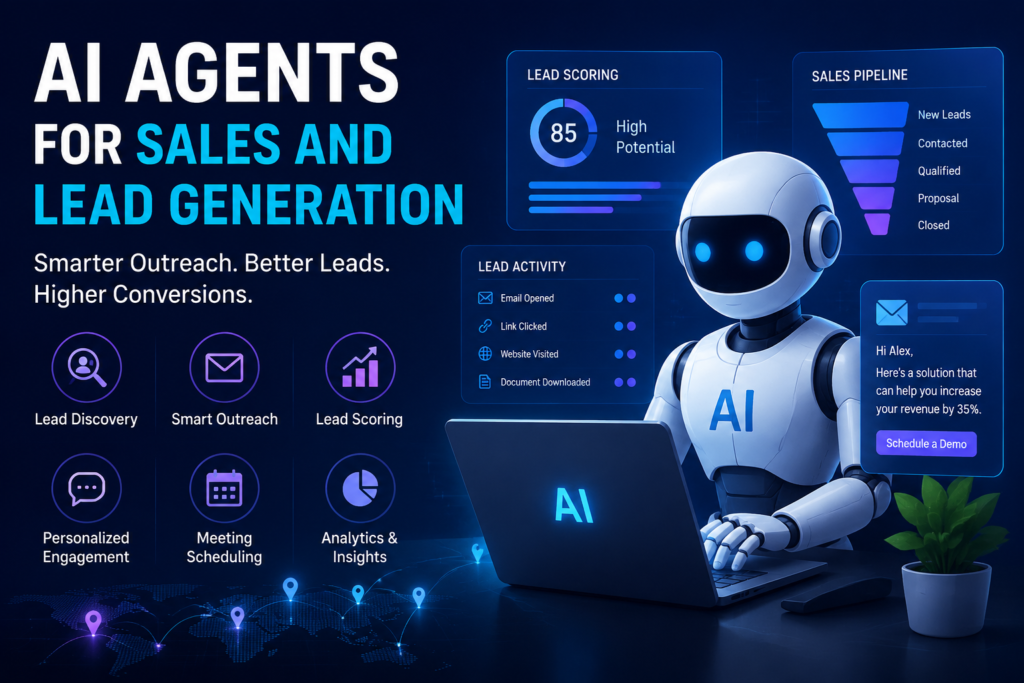
Discover how AI agents for sales and lead generation automate prospecting, personalize outreach, boost conversions, and transform modern business growth.
Introductionw
The rise of AI agents for sales and lead generation is transforming how businesses identify prospects, engage potential customers, and close deals faster than ever before. Unlike traditional automation tools that simply follow predefined workflows, AI agents can analyze customer behavior, make intelligent decisions, personalize communications, and continuously improve their performance through machine learning.
As artificial intelligence becomes a core business technology, organizations of every size are adopting AI-powered sales assistants to reduce repetitive tasks, improve lead quality, and increase revenue. From startups looking to scale quickly to multinational enterprises managing thousands of customer interactions daily, AI agents are reshaping sales operations.
Recent developments highlighted across the broader landscape of AI news show that advancements in large language models (LLMs), autonomous AI systems, predictive analytics, and generative AI have accelerated the capabilities of intelligent sales assistants. Businesses are now able to automate complex sales workflows while maintaining highly personalized customer experiences.
This comprehensive guide explains everything you need to know about AI agents for sales and lead generation, including how they work, their benefits, real-world applications, challenges, future trends, and best practices for implementation.
What Are AI Agents for Sales and Lead Generation?
AI agents for sales and lead generation are intelligent software systems that autonomously perform sales-related tasks using artificial intelligence technologies such as:
- Machine Learning
- Natural Language Processing (NLP)
- Large Language Models (LLMs)
- Predictive Analytics
- Customer Data Analysis
- Generative AI
- Decision Intelligence
Unlike basic chatbots or marketing automation software, AI agents can understand context, make recommendations, initiate actions, and optimize sales strategies with minimal human intervention.
Their primary objective is to help businesses:
- Find qualified leads
- Engage prospects automatically
- Personalize communication
- Schedule meetings
- Score leads
- Follow up consistently
- Increase conversion rates
- Improve customer relationships
How AI Agents Work
Data Collection
AI agents gather information from multiple sources, including:
- CRM systems
- Company websites
- Email interactions
- Social media platforms
- Customer behavior analytics
- Marketing campaigns
- Sales history
This data creates detailed customer profiles for smarter decision-making.
Lead Qualification
Instead of assigning every lead equal priority, AI evaluates numerous factors such as:
- Company size
- Industry
- Budget
- Purchase intent
- Website engagement
- Email interactions
- Buying history
The result is accurate lead scoring that allows sales teams to focus on high-value prospects.
Personalized Outreach
Modern AI agents generate highly personalized emails and messages by analyzing:
- Customer interests
- Previous conversations
- Pain points
- Industry
- Buying stage
This personalization significantly improves open rates and engagement.
Continuous Learning
Unlike traditional automation, AI agents continuously improve by learning from:
- Customer responses
- Sales outcomes
- Conversion rates
- Marketing performance
- Feedback loops
Over time, they become more accurate and effective.
Key Features of AI Sales Agents
Intelligent Prospecting
AI searches databases, company directories, social media, and public information to identify potential customers.
Automated Lead Scoring
Machine learning models rank leads according to their likelihood of converting.
Smart Email Generation
Generative AI creates customized outreach emails that sound natural and relevant.
Meeting Scheduling
AI agents coordinate calendars, suggest meeting times, and handle appointment booking.
CRM Management
AI automatically updates CRM records after every interaction, reducing manual work.
Sales Forecasting
Predictive analytics estimate future sales performance using historical and real-time data.
Customer Insights
AI identifies buying signals before human sales representatives notice them.
Multichannel Communication
AI agents communicate through:
- SMS
- Live Chat
- Voice Assistants
- Customer Portals
Types of AI Agents Used in Sales
Prospecting Agents
Automatically discover new leads across various online sources.
Outreach Agents
Generate personalized sales messages and follow-up campaigns.
Conversational Agents
Engage prospects using intelligent conversations through chat or voice.
CRM Agents
Manage customer records, update pipelines, and automate documentation.
Analytics Agents
Generate insights from sales performance and customer behavior.
Revenue Intelligence Agents
Analyze opportunities and recommend actions to maximize deal closures.
AI Agents vs Traditional Sales Automation
| Feature | Traditional Automation | AI Agents |
|---|---|---|
| Rule-Based | Yes | No |
| Learns Over Time | No | Yes |
| Personalization | Limited | Advanced |
| Decision Making | No | Yes |
| Context Awareness | Low | High |
| Predictive Analytics | Limited | Excellent |
| Autonomous Actions | Minimal | Extensive |
| Natural Conversations | Basic | Human-like |
Real-World Applications
B2B Sales
AI agents identify decision-makers, research companies, personalize outreach, and schedule product demonstrations.
SaaS Companies
Software businesses use AI to:
- Qualify inbound leads
- Nurture free-trial users
- Recommend upgrades
- Predict churn
- Automate renewals
E-commerce
Retail businesses leverage AI agents for:
- Product recommendations
- Cart recovery
- Upselling
- Customer engagement
- Loyalty programs
Real Estate
AI qualifies buyers, schedules property visits, and answers questions around the clock.
Financial Services
Banks and fintech companies use AI for customer onboarding, loan qualification, and financial product recommendations.
Healthcare
Healthcare providers automate appointment scheduling, patient engagement, and service recommendations while maintaining compliance requirements.
Practical Use Cases
Lead Qualification
Instead of manually reviewing thousands of leads, AI instantly ranks prospects based on purchase intent.
Personalized Email Campaigns
An AI agent generates unique emails for each prospect rather than sending identical templates.
Sales Pipeline Management
AI predicts which deals are likely to close and recommends the next best action.
Customer Retention
AI identifies customers at risk of leaving and recommends proactive engagement.
Meeting Preparation
AI summarizes previous conversations, company information, and customer interests before sales calls.
Industries Benefiting from AI Sales Agents
- Technology
- Healthcare
- Manufacturing
- Retail
- Real Estate
- Insurance
- Banking
- Education
- Telecommunications
- Professional Services
- Logistics
- Hospitality
Benefits of AI Agents for Sales and Lead Generation
Businesses adopting AI-powered sales solutions gain significant competitive advantages.
Increased Productivity
Sales representatives spend more time closing deals instead of performing administrative tasks.
Higher Lead Quality
AI prioritizes high-intent prospects, improving conversion rates.
Better Customer Experience
Personalized communication builds stronger relationships and increases customer satisfaction.
Faster Response Times
AI engages prospects instantly, reducing the chances of losing potential customers.
Improved Forecasting
Predictive analytics support more accurate revenue planning and resource allocation.
Lower Operational Costs
Automation reduces repetitive work and enables leaner sales operations.
24/7 Availability
AI agents engage prospects across time zones without interruption.
Scalable Growth
Businesses can handle larger volumes of leads without proportional increases in staffing.
Best Practices for Implementing AI Sales Agents
Define Clear Objectives
Identify whether your primary goal is lead generation, qualification, customer engagement, or sales forecasting.
Start with High-Impact Tasks
Automate repetitive activities first, such as email follow-ups and CRM updates.
Maintain Human Oversight
Use AI to support—not replace—sales professionals, especially during complex negotiations.
Integrate with Existing Systems
Ensure compatibility with CRM platforms, marketing tools, and communication channels.
Monitor Performance
Track key performance indicators (KPIs) such as:
- Conversion rates
- Response times
- Cost per lead
- Revenue growth
- Customer satisfaction
- Pipeline velocity
Challenges and Limitations
Despite impressive capabilities, AI agents are not without limitations.
Data Quality Issues
Poor or outdated customer data can reduce AI accuracy.
Privacy and Compliance
Organizations must comply with regulations such as GDPR, CCPA, and industry-specific privacy standards when handling customer information.
Integration Complexity
Connecting AI systems with legacy software may require technical expertise.
Human Trust
Some customers still prefer interacting with human representatives during high-value purchasing decisions.
Bias in AI Models
Poorly trained AI models may unintentionally introduce biased recommendations or lead scoring.
Ongoing Costs
Advanced AI platforms require investment in software, infrastructure, training, and maintenance.
Future Trends
The future of AI agents for sales and lead generation is evolving rapidly.
Autonomous Sales Teams
AI agents will increasingly collaborate to manage entire sales pipelines with minimal supervision.
Hyper-Personalization
Future systems will deliver deeply personalized experiences using real-time behavioral data.
Voice-Based AI Sales Assistants
Voice-enabled AI will conduct richer customer conversations and streamline support.
Emotion Recognition
AI systems may adapt conversations by detecting customer sentiment through text and speech analysis.
Predictive Customer Intent
AI will anticipate customer needs before they explicitly express interest.
Deeper CRM Integration
Sales platforms will embed AI into every stage of the customer lifecycle.
AI Collaboration
Multiple specialized AI agents will work together across marketing, customer support, and sales to create unified customer experiences.
Industry Insights and Statistics
Several industry trends underscore the growing impact of AI in sales:
- Businesses increasingly use generative AI to automate personalized sales outreach.
- Predictive lead scoring helps sales teams prioritize high-value opportunities more effectively than manual methods.
- AI-assisted customer engagement often improves response speed and operational efficiency.
- Organizations adopting AI across sales and marketing continue to expand investments as AI capabilities mature.
- Modern CRM platforms are embedding AI assistants directly into daily workflows, reducing administrative overhead and improving decision-making.
These developments, frequently covered in AI news, indicate that AI-driven sales operations are becoming a standard competitive advantage rather than an experimental technology.
Read More About:Best Autonomous AI Agents for Business Operations (2026 Guide)
Frequently Asked Questions
1. What are AI agents for sales and lead generation?
AI agents are intelligent software systems that automate prospecting, lead qualification, customer engagement, personalized outreach, and sales workflows using artificial intelligence technologies.
2. How are AI agents different from chatbots?
Chatbots mainly answer predefined questions, while AI agents can reason, analyze customer data, make decisions, personalize communication, and execute multi-step sales tasks autonomously.
3. Can small businesses benefit from AI sales agents?
Yes. Small businesses can automate repetitive tasks, improve lead management, increase productivity, and compete more effectively without significantly expanding their sales teams.
4. Will AI replace human salespeople?
No. AI is best viewed as an assistant that enhances productivity by automating repetitive work. Human sales professionals remain essential for building trust, handling complex negotiations, and managing strategic relationships.
5. Which industries use AI sales agents the most?
Technology, SaaS, healthcare, finance, retail, manufacturing, insurance, education, telecommunications, and real estate are among the leading adopters.
6. Is customer data secure when using AI agents?
Security depends on the platform and implementation. Organizations should choose vendors with strong encryption, access controls, compliance certifications, and responsible AI practices while following applicable privacy regulations.
Conclusion
AI agents for sales and lead generation have evolved from simple automation tools into intelligent business assistants capable of transforming the modern sales process. By combining machine learning, natural language processing, predictive analytics, and generative AI, these systems help organizations identify better prospects, personalize customer interactions, improve sales efficiency, and drive sustainable revenue growth.
While challenges such as data privacy, implementation complexity, and model bias remain important considerations, the long-term advantages far outweigh the limitations for many organizations. Businesses that thoughtfully integrate AI into their sales strategy—while maintaining human oversight and focusing on customer value—are well positioned to gain a competitive edge.
As AI technology continues to advance and headlines in AI news demonstrate rapid innovation, AI-powered sales agents are expected to become even more autonomous, accurate, and collaborative. Organizations that begin adopting and refining these capabilities today will be better prepared for the increasingly intelligent future of sales.
Key Takeaways
- AI agents automate prospecting, lead qualification, outreach, follow-ups, and CRM management.
- They leverage machine learning, natural language processing, predictive analytics, and generative AI.
- Intelligent lead scoring enables sales teams to prioritize high-value opportunities.
- Personalized, AI-generated communication improves engagement and conversion rates.
- AI agents enhance productivity while allowing human sales professionals to focus on relationship building and strategic selling.
- Successful implementation depends on quality data, responsible governance, regulatory compliance, and integration with existing systems.
- Future innovations will deliver autonomous sales workflows, hyper-personalization, predictive customer intent, and deeper collaboration between AI systems and human teams.
- Businesses that adopt AI strategically can improve customer experiences, reduce costs, and achieve scalable revenue growth in an increasingly competitive marketplace.