
Discover the best autonomous AI agents for business operations, compare top platforms, explore real-world use cases, benefits, challenges, and future AI trends.
Introduction
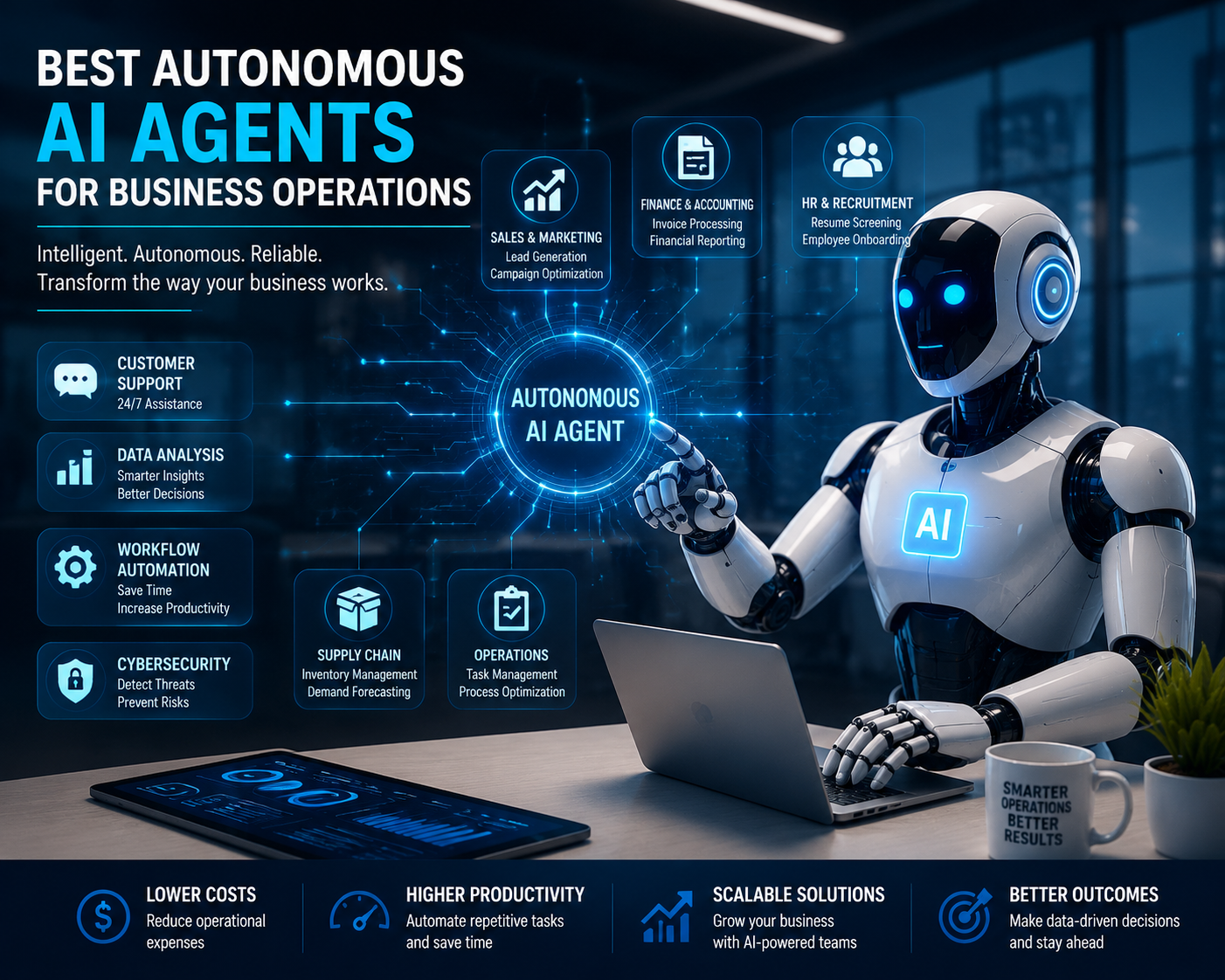
Artificial intelligence has evolved far beyond chatbots and simple automation tools. Today’s best autonomous AI agents for business operations can independently complete multi-step tasks, make informed decisions, coordinate with software systems, and continuously improve workflows with minimal human intervention.
Unlike traditional AI assistants that simply respond to prompts, autonomous AI agents actively plan, execute, monitor, and optimize business processes. They can manage customer support, analyze financial data, automate marketing campaigns, detect cybersecurity threats, schedule meetings, generate reports, and even collaborate with other AI agents to complete complex workflows.
As businesses face increasing operational costs, labor shortages, and growing customer expectations, autonomous AI agents are becoming essential productivity tools. Organizations adopting AI-driven automation are reporting significant improvements in efficiency, faster decision-making, and lower operating expenses.
This comprehensive guide explores the best autonomous AI agents for business operations, how they work, their practical applications, industry trends, emerging AI news, benefits, limitations, implementation strategies, and what businesses should expect in the coming years.
What Are Autonomous AI Agents?
Autonomous AI agents are intelligent software systems capable of independently completing tasks by combining artificial intelligence, machine learning, large language models (LLMs), planning algorithms, memory, and tool integrations.
Unlike conventional chatbots that require constant user input, autonomous agents can:
- Understand goals
- Break projects into smaller tasks
- Gather information
- Make decisions
- Execute workflows
- Monitor progress
- Adapt based on results
Rather than simply answering questions, they function like virtual employees capable of managing business operations.
How Autonomous AI Agents Work
Most autonomous AI agents follow a continuous decision-making cycle.
Goal Understanding
The agent receives a high-level objective, such as:
- Increase online sales
- Reduce customer response time
- Analyze monthly revenue
- Monitor cybersecurity threats
Planning
The AI creates an action plan by dividing large objectives into manageable tasks.
Execution
The agent interacts with:
- Business software
- APIs
- Databases
- Email systems
- CRM platforms
- Cloud applications
Learning
Modern AI agents remember previous interactions and improve future performance.
Optimization
The system continuously evaluates results and modifies its strategy for better outcomes.
Why Businesses Are Adopting Autonomous AI Agents
Businesses increasingly need automation that goes beyond repetitive rule-based tasks.
Autonomous AI provides:
- Faster operations
- Reduced labor costs
- Improved productivity
- Continuous optimization
- Better customer experiences
- Smarter decision-making
These advantages make AI agents valuable across nearly every industry.
Best Autonomous AI Agents for Business Operations
OpenAI ChatGPT Agent
One of the most versatile AI platforms available.
Ideal for:
- Content creation
- Research
- Coding
- Customer support
- Business planning
- Document analysis
- Workflow automation
Strengths include natural language understanding, extensive integrations, and enterprise-grade capabilities.
Microsoft Copilot
Deeply integrated into Microsoft 365.
Best for:
- Outlook
- Excel
- Word
- PowerPoint
- Teams
- Business reporting
Organizations already using Microsoft products benefit from seamless workflow automation.
Google Gemini
Google’s AI ecosystem excels at:
- Document analysis
- Workspace automation
- Search-powered insights
- Meeting assistance
- Data organization
Its integration with Google Workspace makes it attractive for modern businesses.
Salesforce Agentforce
Designed specifically for customer relationship management.
Key capabilities:
- Sales automation
- Customer service
- Lead qualification
- Personalized recommendations
- Workflow optimization
IBM Watsonx
Popular among enterprise organizations requiring:
- Predictive analytics
- AI governance
- Risk management
- Regulatory compliance
- Large-scale automation
UiPath AI Agents
UiPath combines robotic process automation (RPA) with AI.
Ideal for automating:
- Invoice processing
- HR onboarding
- Financial reporting
- Claims management
- Data migration
CrewAI
CrewAI allows multiple autonomous agents to collaborate on complex business projects.
Use cases include:
- Research
- Marketing campaigns
- Software development
- Project management
AutoGen
Developed for collaborative AI workflows.
Businesses use AutoGen to coordinate multiple specialized AI agents working toward shared goals.
Comparison Table
| AI Agent | Best For | Key Features | Suitable Business Size |
|---|---|---|---|
| ChatGPT Agent | General automation | Research, writing, coding | Small to Enterprise |
| Microsoft Copilot | Office productivity | Microsoft 365 integration | Medium to Enterprise |
| Google Gemini | Workspace automation | Google ecosystem | Small to Enterprise |
| Salesforce Agentforce | CRM | Sales and customer service | Medium to Large |
| IBM Watsonx | Enterprise AI | Governance and analytics | Large Enterprises |
| UiPath AI | Process automation | RPA + AI workflows | Medium to Enterprise |
| CrewAI | Multi-agent collaboration | Task delegation | Developers and enterprises |
| AutoGen | Autonomous workflows | Agent collaboration | AI development teams |
Business Operations Improved by Autonomous AI
Customer Support
AI agents provide:
- Instant responses
- Ticket routing
- Issue resolution
- Personalized recommendations
- 24/7 service
Human Resources
HR departments automate:
- Resume screening
- Employee onboarding
- Interview scheduling
- Policy questions
- Performance reporting
Finance
Financial automation includes:
- Expense analysis
- Invoice processing
- Cash-flow forecasting
- Fraud detection
- Budget planning
Marketing
Marketing AI agents manage:
- Email campaigns
- SEO optimization
- Social media scheduling
- Content creation
- Customer segmentation
Sales
Sales teams benefit from:
- Lead qualification
- CRM updates
- Proposal generation
- Customer follow-ups
- Revenue forecasting
IT Operations
AI agents automate:
- System monitoring
- Software deployment
- Performance optimization
- Incident response
Autonomous AI in Cybersecurity
Cybersecurity is one of the fastest-growing applications of autonomous AI.
Threat Detection
AI monitors networks continuously.
It identifies:
- Malware
- Phishing
- Insider threats
- Suspicious logins
- Data breaches
Automated Response
Instead of waiting for human intervention, AI agents can:
- Block malicious traffic
- Disable compromised accounts
- Alert administrators
- Isolate infected devices
Security Analytics
AI analyzes millions of security events far faster than human analysts.
This dramatically improves response time.
Real-World Business Use Cases
Ecommerce
Online retailers use AI agents to:
- Recommend products
- Manage inventory
- Optimize pricing
- Handle customer support
- Predict demand
Healthcare
Hospitals automate:
- Patient scheduling
- Medical documentation
- Insurance verification
- Administrative workflows
Financial Services
Banks leverage autonomous AI for:
- Fraud detection
- Loan processing
- Customer assistance
- Regulatory reporting
Manufacturing
Factories deploy AI agents to:
- Predict equipment failures
- Optimize production
- Schedule maintenance
- Improve quality control
Logistics
Shipping companies automate:
- Route optimization
- Warehouse management
- Fleet monitoring
- Delivery scheduling
AI Industry News and Emerging Trends
The latest AI news highlights a rapid shift from simple assistants to autonomous digital workers.
Current trends include:
Multi-Agent Collaboration
Businesses increasingly deploy specialized AI agents that cooperate on complex projects rather than relying on a single model.
AI Agents with Long-Term Memory
New systems remember previous projects, customer interactions, and organizational knowledge, improving performance over time.
Autonomous Decision Making
Modern AI agents can independently prioritize tasks, allocate resources, and recommend strategic actions.
AI Governance
Organizations are investing heavily in governance frameworks to ensure AI decisions remain transparent, compliant, and ethical.
Expert Insights
Industry leaders emphasize that autonomous AI agents deliver the greatest value when paired with well-defined business processes. Instead of automating every task immediately, successful organizations typically begin with one high-impact workflow, measure outcomes, and expand gradually.
Experts also recommend maintaining human oversight for strategic decisions, compliance-sensitive activities, and customer interactions that require empathy or nuanced judgment. Combining AI efficiency with human expertise creates more resilient and trustworthy business operations.
Benefits
Autonomous AI agents provide numerous advantages.
- Reduce operational costs
- Improve employee productivity
- Operate 24/7
- Accelerate decision-making
- Automate repetitive tasks
- Improve customer satisfaction
- Increase business scalability
- Enhance cybersecurity
- Reduce human error
- Improve compliance monitoring
- Deliver data-driven insights
- Enable faster innovation
Challenges and Limitations
Despite rapid advancements, autonomous AI still has limitations.
Data Privacy
Businesses must ensure sensitive information remains secure and complies with privacy regulations.
Integration Complexity
Older software systems may require custom integration.
Human Oversight
AI decisions should be reviewed in high-risk business environments.
Hallucinations
Generative AI models occasionally produce inaccurate information.
Verification remains essential.
Regulatory Compliance
Businesses operating in healthcare, finance, and legal sectors must ensure AI complies with industry regulations.
Future Trends
Autonomous AI continues evolving rapidly.
Fully Autonomous Digital Employees
Future AI agents will manage complete departments with limited human supervision.
Collaborative Agent Networks
Multiple AI specialists will work together across marketing, finance, cybersecurity, and operations.
Predictive Business Intelligence
AI will increasingly forecast market trends, customer behavior, and financial risks before they occur.
AI-Powered Executive Assistants
Business leaders will rely on AI to summarize meetings, recommend strategies, monitor KPIs, and coordinate cross-functional teams.
Stronger AI Cybersecurity
Self-healing networks and autonomous threat response systems will become standard features in enterprise environments.
Read More About:AI Tools to Reduce Costs for Small Businesses: The Complete 2026 Guide
Frequently Asked Questions
1. What are autonomous AI agents?
Autonomous AI agents are intelligent software systems that independently plan, execute, monitor, and optimize tasks using artificial intelligence with minimal human intervention.
2. How do autonomous AI agents differ from chatbots?
Traditional chatbots respond to prompts, while autonomous AI agents can make decisions, perform multi-step workflows, integrate with business software, and continuously improve performance.
3. Which industries benefit most from autonomous AI?
Retail, finance, healthcare, manufacturing, logistics, marketing, customer service, and cybersecurity all benefit significantly from autonomous AI solutions.
4. Are autonomous AI agents secure?
When implemented properly with encryption, access controls, monitoring, and governance, autonomous AI agents can improve security while reducing operational risks.
5. Can small businesses use autonomous AI agents?
Yes. Many AI platforms offer affordable cloud-based services that allow startups and small businesses to automate customer support, marketing, accounting, and administrative tasks without enterprise-level budgets.
6. Will autonomous AI replace employees?
Rather than replacing employees entirely, autonomous AI typically handles repetitive and data-intensive work, allowing people to focus on creative thinking, strategic planning, relationship management, and complex problem-solving.
Conclusion
The best autonomous AI agents for business operations are transforming the way organizations operate by automating complex workflows, improving decision-making, enhancing cybersecurity, and reducing operational costs. Unlike traditional automation tools, these intelligent systems can independently plan, execute, learn, and optimize tasks across departments, making them valuable digital collaborators rather than simple assistants.
From customer service and marketing to finance, IT, and cybersecurity, autonomous AI agents are enabling businesses of all sizes to operate more efficiently while delivering better customer experiences. As AI capabilities continue to advance, organizations that adopt these technologies thoughtfully—supported by clear governance, human oversight, and measurable objectives—will be better positioned to compete in an increasingly AI-driven economy.
Businesses should begin with targeted, high-value use cases, evaluate results, and scale adoption over time. This practical approach helps maximize return on investment while building confidence in autonomous AI systems that will play an increasingly central role in the future of business.
Key Takeaways
- Autonomous AI agents independently plan, execute, and optimize business workflows.
- They go beyond traditional chatbots by handling complex, multi-step tasks.
- Leading platforms include ChatGPT Agent, Microsoft Copilot, Google Gemini, Salesforce Agentforce, IBM Watsonx, UiPath, CrewAI, and AutoGen.
- AI agents improve productivity across customer service, HR, finance, sales, marketing, IT, and cybersecurity.
- Multi-agent collaboration and long-term memory are shaping the next generation of enterprise AI.
- Human oversight remains essential for strategic decisions, compliance, and quality assurance.
- Small businesses can adopt cloud-based AI agents without enterprise-scale budgets.
- Strong governance and data security are critical for responsible AI deployment.
- Organizations that implement autonomous AI strategically can reduce costs, increase efficiency, and gain a lasting competitive advantage.