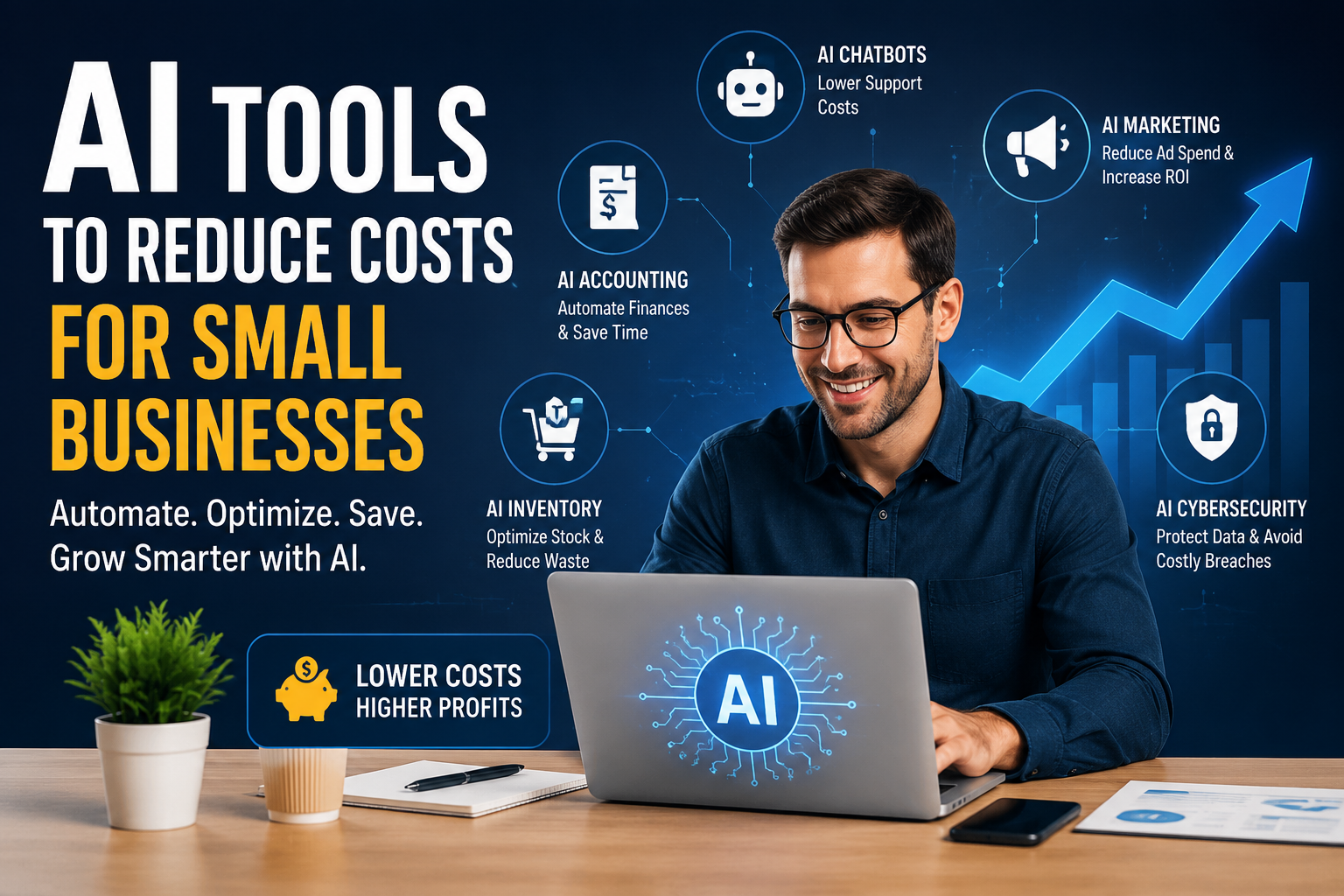

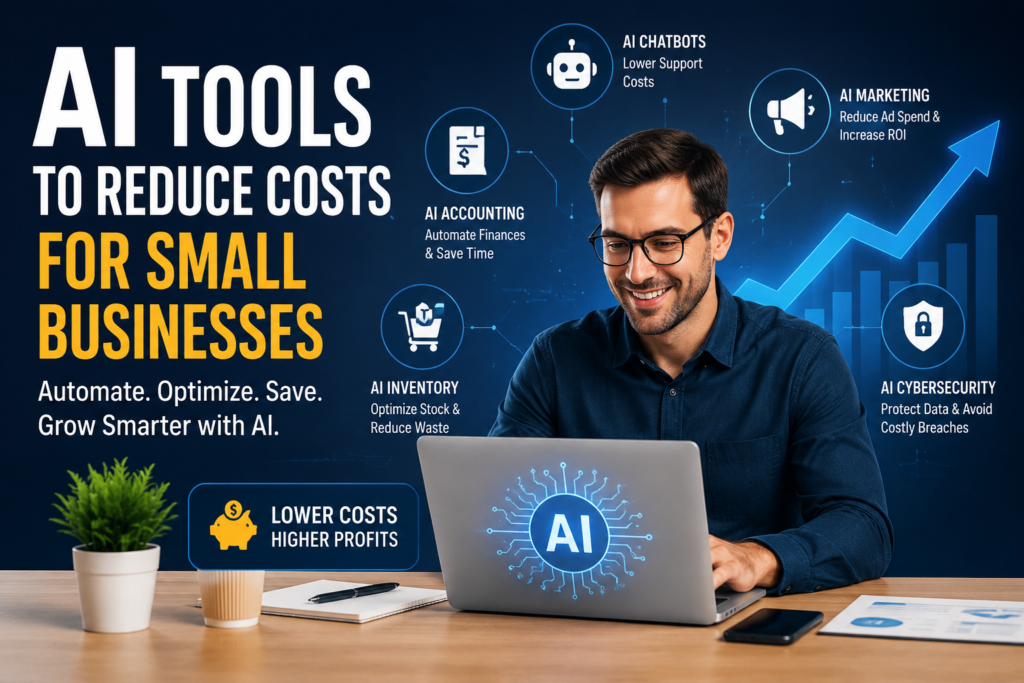
Discover the best AI tools to reduce costs for small businesses, automate operations, improve productivity, and increase profits with practical strategies and expert insights.
Introduction
Running a small business has never been easy. Rising operational expenses, labor shortages, increasing customer expectations, and growing competition force business owners to find smarter ways to operate without sacrificing quality. Fortunately, AI tools to reduce costs for small businesses have become more accessible and affordable than ever before.
Artificial intelligence is no longer reserved for large enterprises with million-dollar budgets. Today’s AI-powered software helps small businesses automate repetitive work, improve customer service, streamline marketing, strengthen cybersecurity, optimize inventory, and make data-driven decisions—all while reducing operational costs.
According to industry research, businesses adopting AI-powered automation frequently report significant improvements in productivity and reductions in administrative expenses. As AI technology continues to evolve, even startups and local businesses can leverage enterprise-level capabilities through affordable subscription-based tools.
This guide explores how AI helps small businesses save money, the best categories of AI solutions available, practical implementation strategies, current AI news and industry trends, real-world use cases, benefits, limitations, and future developments that every business owner should know.
Why AI Is Becoming Essential for Small Businesses
Artificial intelligence allows businesses to automate processes that traditionally required human effort. Instead of replacing employees, AI often enables teams to focus on higher-value activities while repetitive tasks are handled automatically.
Small businesses typically face challenges such as:
- Limited budgets
- Small teams
- Time-consuming administrative work
- Customer service demands
- Marketing costs
- Cybersecurity risks
- Inventory management
AI addresses many of these issues by increasing efficiency and reducing unnecessary spending.
How AI Tools Reduce Business Costs
Automating Repetitive Tasks
Administrative work consumes countless hours every week.
AI can automate:
- Email responses
- Appointment scheduling
- Invoice generation
- Data entry
- Report creation
- Document summarization
- Meeting transcription
This reduces payroll costs while improving productivity.
Improving Customer Support
AI chatbots now provide customer service around the clock.
They can:
- Answer common questions
- Track orders
- Book appointments
- Handle refunds
- Recommend products
- Escalate complex issues
Businesses often reduce customer support expenses while improving response times.
Smarter Marketing
Marketing campaigns traditionally require designers, copywriters, and analysts.
AI assists with:
- Writing content
- Designing graphics
- Creating advertisements
- Email marketing
- SEO optimization
- Audience segmentation
- Performance analysis
This allows smaller marketing teams to produce significantly more content.
Better Financial Management
AI-powered accounting software can:
- Categorize expenses
- Detect unusual transactions
- Forecast cash flow
- Generate invoices
- Predict revenue
- Reduce accounting errors
These capabilities help reduce bookkeeping costs and improve financial planning.
Inventory Optimization
Retail businesses often lose money due to overstocking or understocking.
AI predicts demand using:
- Historical sales
- Seasonal trends
- Customer behavior
- Weather data
- Market conditions
Smarter inventory management reduces waste and storage expenses.
Best Categories of AI Tools for Small Businesses
AI Writing and Content Creation
These tools help businesses produce:
- Blog posts
- Product descriptions
- Social media posts
- Marketing emails
- Website copy
- Customer responses
Ideal for:
- Ecommerce
- Agencies
- Freelancers
- Consultants
- Local businesses
AI Customer Service Platforms
Customer support AI reduces staffing costs by automating routine interactions.
Key features include:
- Live chat
- Knowledge bases
- FAQ automation
- CRM integration
- Ticket routing
- Multilingual support
AI Accounting Solutions
Modern AI accounting systems simplify:
- Expense tracking
- Invoice processing
- Tax preparation
- Payroll management
- Financial forecasting
AI Marketing Platforms
Marketing automation includes:
- Campaign optimization
- Customer segmentation
- Predictive analytics
- Lead scoring
- Personalized recommendations
AI Cybersecurity Solutions
Cybersecurity is increasingly important for small businesses.
AI-powered security tools help detect:
- Phishing attacks
- Malware
- Ransomware
- Unauthorized access
- Network anomalies
These systems monitor threats continuously while reducing reliance on manual security monitoring.
AI Cybersecurity: Reducing Costs While Increasing Protection
Cyberattacks can be devastating for small businesses.
AI cybersecurity tools help reduce costs by:
Threat Detection
Machine learning identifies suspicious behavior before damage occurs.
Automated Monitoring
Instead of manually checking logs, AI continuously monitors:
- Servers
- Devices
- Employee accounts
- Cloud services
Faster Incident Response
AI detects unusual activity within seconds, allowing businesses to respond before attackers cause significant damage.
Reduced Downtime
Early detection minimizes operational disruptions, preventing revenue loss.
Real-World Applications
Retail Store
A clothing retailer uses AI to:
- Forecast inventory
- Recommend products
- Answer customer questions
- Create marketing campaigns
Result:
- Lower inventory costs
- Increased sales
- Reduced support expenses
Local Marketing Agency
An agency automates:
- Content writing
- SEO optimization
- Proposal generation
- Client reporting
Result:
- Faster project delivery
- Reduced labor hours
- Higher profitability
Medical Practice
AI handles:
- Appointment scheduling
- Patient reminders
- Medical documentation
- Billing assistance
Result:
- Fewer administrative staff hours
- Improved patient satisfaction
Restaurant
Restaurants use AI to:
- Predict food demand
- Optimize staffing
- Reduce food waste
- Improve online ordering
This lowers operational costs while improving customer experiences.
Comparison Table: Common AI Tool Categories
| AI Tool Category | Primary Purpose | Cost Savings | Best For |
|---|---|---|---|
| AI Writing | Content creation | Marketing expenses | Blogs, Ecommerce |
| AI Chatbots | Customer support | Labor costs | Service businesses |
| AI Accounting | Financial automation | Bookkeeping costs | All businesses |
| AI Marketing | Campaign optimization | Advertising ROI | Small marketing teams |
| AI Cybersecurity | Threat detection | Security management | Every business |
| AI Analytics | Business insights | Decision-making efficiency | Growing companies |
| AI Inventory | Stock optimization | Inventory expenses | Retail and Ecommerce |
Choosing the Right AI Tool
Consider the following before investing:
Business Size
Not every business needs enterprise software.
Choose scalable solutions that grow with your company.
Integration
Ensure the AI tool integrates with:
- CRM
- Accounting software
- Email platforms
- Ecommerce systems
- Project management software
Ease of Use
The best AI software requires minimal training.
Look for intuitive dashboards and strong customer support.
Pricing
Compare:
- Monthly subscriptions
- Usage-based pricing
- Free plans
- Enterprise packages
Always calculate the expected return on investment before purchasing.
AI Industry News and Emerging Trends
The AI industry continues evolving rapidly.
Some important AI news trends include:
Generative AI Expansion
Businesses increasingly use generative AI for:
- Marketing
- Software development
- Customer service
- Product design
AI Agents
Autonomous AI agents are beginning to handle entire business workflows rather than individual tasks.
AI Personalization
Businesses can now deliver personalized experiences using customer behavior analysis.
Industry-Specific AI
Specialized AI platforms are emerging for:
- Healthcare
- Manufacturing
- Retail
- Finance
- Legal services
- Education
Expert Insights
Industry experts consistently emphasize that successful AI adoption depends on solving specific business problems rather than implementing AI simply because it is trendy.
Organizations that clearly identify repetitive, measurable workflows before introducing AI often achieve stronger returns on investment. Experts also recommend beginning with one or two automation projects, measuring results, and expanding gradually as teams become comfortable with AI-assisted processes.
Another important insight is that human oversight remains essential. AI performs best when employees review outputs, make strategic decisions, and continuously improve workflows based on business goals.
Benefits of AI Tools for Small Businesses
The advantages extend far beyond simple automation.
Key benefits include:
- Lower operational expenses
- Increased productivity
- Better customer experiences
- Faster decision-making
- Improved marketing efficiency
- Stronger cybersecurity
- Reduced human error
- Better financial forecasting
- Improved inventory management
- Greater scalability
- 24/7 customer support
- Competitive advantage
Challenges and Limitations
Despite their advantages, AI tools also present challenges.
Initial Learning Curve
Employees may require training before using AI effectively.
Data Privacy
Businesses should ensure customer information is protected and comply with applicable privacy regulations.
Subscription Costs
Although AI saves money over time, monthly software fees should be evaluated carefully.
Accuracy Issues
Generative AI can occasionally produce inaccurate or outdated information.
Human review remains necessary.
Integration Challenges
Older software systems may not integrate smoothly with newer AI platforms.
Future Trends
Artificial intelligence continues advancing rapidly.
Expect the following developments over the next few years:
Autonomous Business Operations
AI systems will increasingly manage complete workflows with minimal human intervention.
Predictive Decision-Making
Businesses will rely on AI to forecast customer demand, financial risks, and operational issues with greater accuracy.
Affordable Enterprise AI
Powerful AI capabilities once limited to large corporations will become increasingly affordable for startups and small businesses.
Improved AI Cybersecurity
Cybersecurity platforms will detect sophisticated attacks faster while reducing false positives.
Hyper-Personalized Customer Experiences
AI will deliver highly customized recommendations, communications, and marketing campaigns based on individual customer behavior.
Read More About:How AI Agents Help Small Businesses Grow: A Complete Guide to Smarter Business Success
Frequently Asked Questions
1. What are AI tools to reduce costs for small businesses?
They are software solutions that use artificial intelligence to automate tasks, improve productivity, optimize operations, and reduce expenses across areas such as customer service, accounting, marketing, cybersecurity, and inventory management.
2. Can small businesses afford AI tools?
Yes. Many AI platforms offer affordable monthly subscriptions, free tiers, or usage-based pricing designed specifically for startups and small businesses.
3. Which department benefits most from AI?
Nearly every department can benefit, including customer support, finance, marketing, operations, sales, and cybersecurity. The greatest savings often come from automating repetitive administrative work.
4. Are AI cybersecurity tools worth the investment?
Yes. AI cybersecurity solutions help detect threats early, reduce downtime, automate monitoring, and protect sensitive business data, potentially preventing costly cyber incidents.
5. Will AI replace employees?
In most small businesses, AI is more likely to enhance employee productivity than replace workers. It automates repetitive tasks, allowing employees to focus on creative, strategic, and customer-facing responsibilities.
6. How should a small business begin using AI?
Start by identifying one repetitive process that consumes significant time, such as customer support or content creation. Implement one AI solution, measure results, train staff, and expand gradually based on measurable improvements.
Conclusion
Artificial intelligence has become one of the most practical technologies available to modern entrepreneurs. The growing ecosystem of AI tools to reduce costs for small businesses enables organizations to automate repetitive tasks, improve customer service, strengthen cybersecurity, optimize marketing, and make smarter decisions without requiring enterprise-level budgets.
Rather than viewing AI as a replacement for employees, successful businesses treat it as a productivity partner that allows teams to accomplish more with fewer resources. By selecting the right tools, integrating them thoughtfully, and maintaining human oversight, small businesses can achieve meaningful cost savings while improving customer satisfaction and remaining competitive in an increasingly digital marketplace.
As AI innovation continues to accelerate, early adopters who invest strategically today will be better positioned to adapt to future market demands, capitalize on emerging opportunities, and build resilient, efficient operations for years to come.
Key Takeaways
- AI tools help small businesses reduce operational expenses through automation.
- Customer service chatbots provide 24/7 support while lowering labor costs.
- AI-powered accounting improves financial accuracy and forecasting.
- AI marketing platforms enhance campaign performance and productivity.
- AI cybersecurity strengthens protection while reducing monitoring costs.
- Inventory optimization minimizes waste and improves profitability.
- Successful AI adoption begins with solving specific business challenges.
- Human oversight remains essential for quality, compliance, and strategic decision-making.
- Emerging AI trends such as autonomous agents and predictive analytics will further expand business opportunities.
- Businesses that adopt AI strategically can improve efficiency, profitability, and long-term competitiveness.