
Discover the best AI tools for content marketing in 2026, their benefits, challenges, use cases, trends, and expert insights to boost SEO, engagement, and ROI.
Introduction
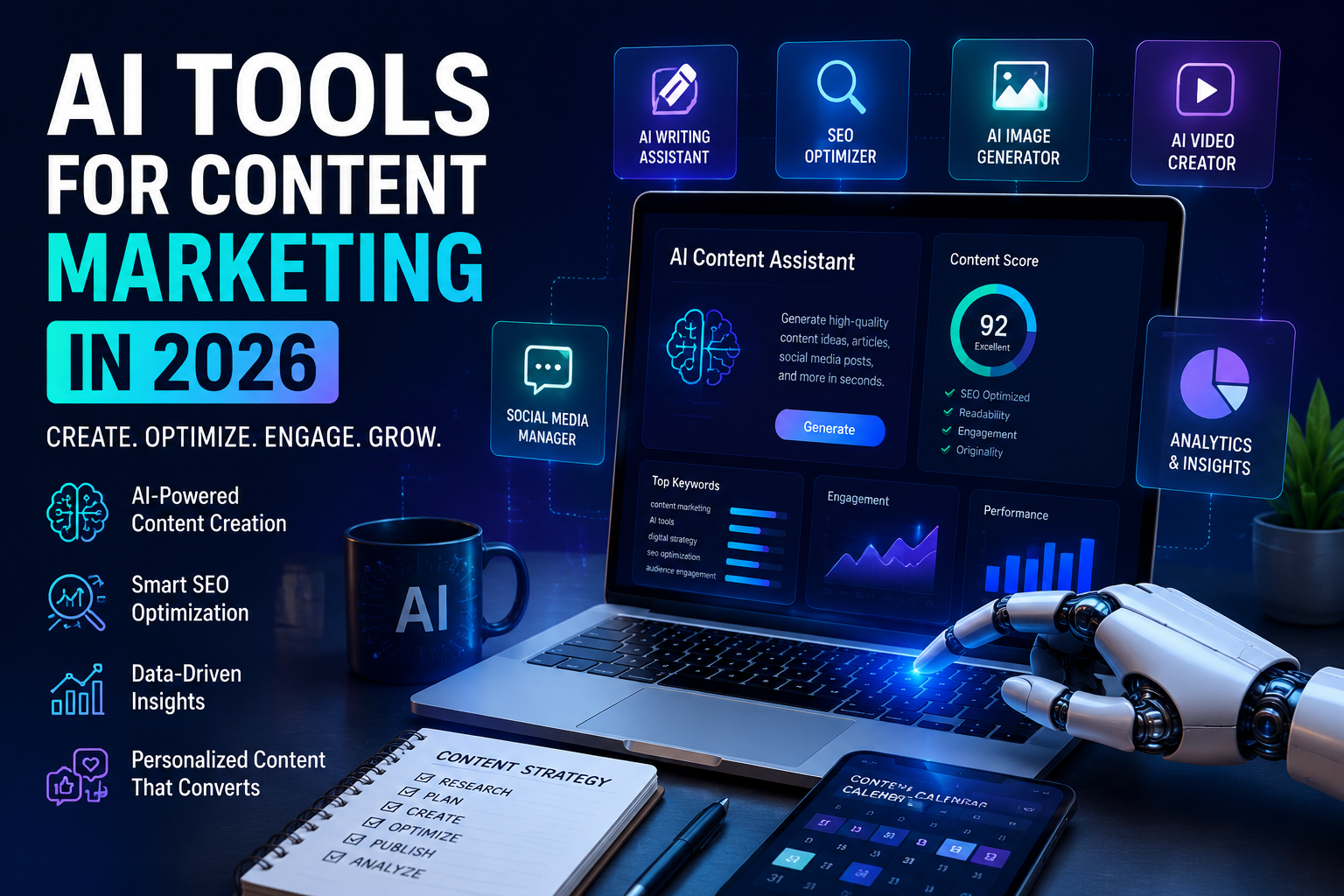
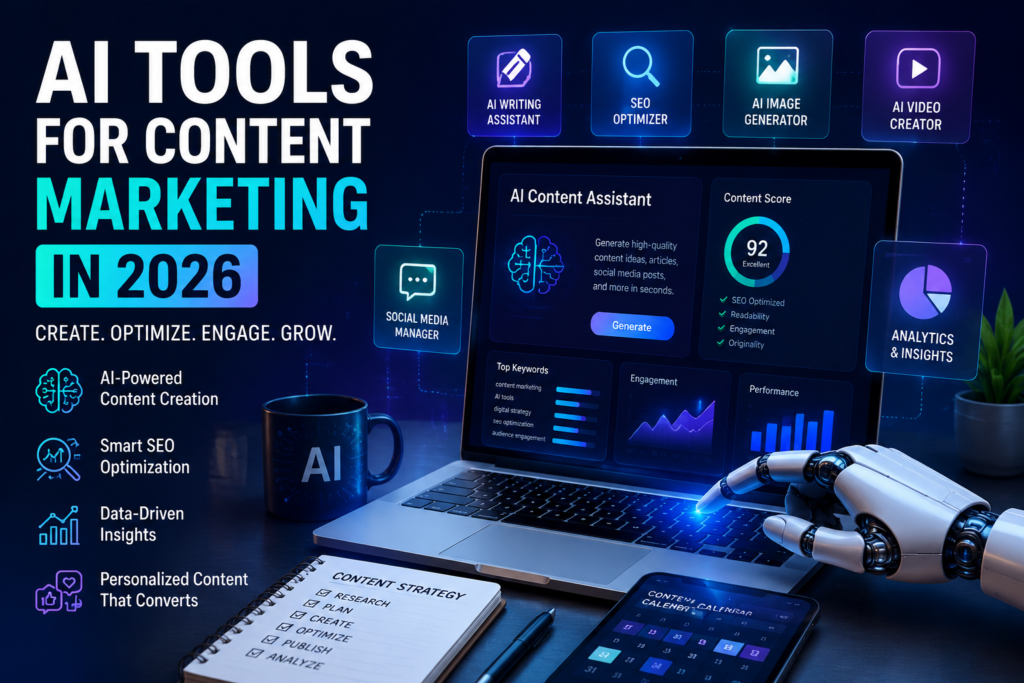
AI Tools for Content Marketing in 2026 are transforming how businesses create, optimize, distribute, and analyze digital content. From generating blog posts and social media updates to optimizing search engine rankings and personalizing customer experiences, artificial intelligence has become a core component of modern marketing strategies.
In 2026, AI-powered content marketing is no longer just about saving time—it is about producing higher-quality content, understanding audience intent more accurately, and making data-driven decisions at scale. Businesses of every size, from startups to multinational enterprises, are leveraging AI to improve productivity while maintaining brand consistency.
This comprehensive guide explores the latest AI tools, practical applications, industry trends, benefits, challenges, and future developments that are shaping content marketing in 2026. Whether you are a marketer, developer, entrepreneur, or AI enthusiast, this article will help you understand how AI is redefining digital marketing.
What Are AI Tools for Content Marketing in 2026?
AI content marketing tools are software platforms that use technologies such as:
- Large Language Models (LLMs)
- Natural Language Processing (NLP)
- Machine Learning (ML)
- Predictive Analytics
- Computer Vision
- Voice AI
- Marketing Automation
These technologies automate repetitive tasks, improve decision-making, generate high-quality content, and provide actionable marketing insights.
Unlike earlier AI writing assistants that focused mainly on text generation, modern AI platforms integrate with SEO software, customer relationship management (CRM) systems, analytics platforms, design software, video production tools, and social media management platforms.
Why AI Content Marketing Matters in 2026
Digital competition has never been higher.
Millions of blog posts, videos, podcasts, newsletters, and social media posts are published every day. Standing out requires more than simply producing content—it requires creating relevant, personalized, and optimized experiences.
AI enables marketers to:
- Research topics faster
- Discover trending keywords
- Understand audience behavior
- Generate multiple content formats
- Optimize SEO automatically
- Personalize customer journeys
- Improve conversion rates
- Measure campaign performance in real time
Organizations that effectively combine AI with human expertise often achieve faster production cycles and stronger engagement while maintaining quality standards.
Top AI Tools for Content Marketing in 2026
AI Writing Assistants
Modern AI writing assistants can create:
- Blog posts
- Landing pages
- Product descriptions
- Email campaigns
- Press releases
- Social media posts
- Video scripts
Popular capabilities include:
- Brand voice adaptation
- Grammar improvement
- SEO optimization
- Readability enhancement
- Content expansion
- Content summarization
These tools help marketing teams produce more content without sacrificing quality.
AI SEO Optimization Platforms
SEO-focused AI tools assist marketers by:
- Finding high-value keywords
- Identifying ranking opportunities
- Performing competitor analysis
- Suggesting internal links
- Optimizing metadata
- Improving topical authority
- Detecting technical SEO issues
Instead of relying solely on keyword density, modern AI systems analyze user intent, semantic relevance, and search behavior to improve search visibility.
AI Image Generation Tools
Visual content plays an increasingly important role in digital marketing.
AI image generators enable marketers to create:
- Blog illustrations
- Social media graphics
- Advertising creatives
- Website banners
- Product mockups
- Infographics
This significantly reduces production time while enabling rapid experimentation with creative concepts.
AI Video Creation Platforms
Video remains one of the most engaging content formats.
AI video platforms help marketers create:
- Marketing videos
- Product demonstrations
- Animated explainers
- Training materials
- Short-form social media clips
Many tools now include AI-generated voiceovers, captions, translations, and editing automation.
AI Social Media Management Tools
These platforms automate:
- Content scheduling
- Caption generation
- Hashtag research
- Audience engagement analysis
- Performance reporting
- Posting optimization
AI can even recommend the ideal posting times based on audience behavior.
AI Analytics Platforms
Modern analytics platforms provide:
- Predictive insights
- Conversion forecasting
- Customer segmentation
- Content attribution
- Campaign recommendations
- Real-time performance monitoring
These insights help marketers optimize campaigns continuously rather than waiting for post-campaign reports.
Comparison Table: Popular Categories of AI Content Marketing Tools
| Tool Category | Primary Purpose | Best For | Key Features |
|---|---|---|---|
| AI Writing Tools | Content creation | Bloggers & businesses | Articles, emails, copywriting |
| AI SEO Platforms | Search optimization | SEO specialists | Keyword research, audits, ranking improvements |
| AI Image Tools | Visual creation | Designers & marketers | Graphics, banners, illustrations |
| AI Video Platforms | Video production | Marketing teams | AI editing, subtitles, voiceovers |
| AI Analytics Tools | Performance analysis | Agencies & enterprises | Dashboards, forecasting, ROI analysis |
| AI Social Media Tools | Automation | Social marketers | Scheduling, analytics, engagement |
Real-World Applications of AI Content Marketing
E-commerce
Online retailers use AI to:
- Generate product descriptions
- Recommend products
- Personalize emails
- Improve search rankings
- Create promotional campaigns
This reduces manual work while increasing conversion rates.
SaaS Companies
Software businesses use AI for:
- Knowledge base articles
- Technical documentation
- Customer onboarding
- Email automation
- Lead nurturing
AI helps maintain consistency across extensive documentation.
News and Media
Publishers leverage AI to:
- Summarize breaking news
- Generate headlines
- Recommend related articles
- Personalize content feeds
- Translate multilingual content
This accelerates publishing workflows while broadening audience reach.
Healthcare
Healthcare organizations employ AI to produce:
- Educational content
- Patient guides
- Wellness newsletters
- FAQ pages
- Appointment reminders
Human review remains essential to ensure medical accuracy and compliance.
Financial Services
Banks and fintech companies use AI to create:
- Investment newsletters
- Educational resources
- Customer support content
- Fraud awareness campaigns
Strict editorial oversight helps ensure regulatory compliance.
How AI Improves SEO in 2026
Search engines increasingly prioritize:
- Helpful content
- User intent
- Experience
- Expertise
- Originality
- Authority
- Trustworthiness
AI supports these goals by helping marketers:
Improve Keyword Research
AI identifies:
- Long-tail keywords
- Semantic keywords
- Emerging search trends
- User intent clusters
Enhance Content Structure
AI recommends:
- Better headings
- Internal linking
- Content depth
- Improved readability
Optimize User Experience
AI analyzes:
- Bounce rates
- Engagement metrics
- Click-through rates
- Scroll depth
- Conversion behavior
These insights enable continuous content optimization.
Expert Insights and Industry Trends
Several industry trends are shaping AI-powered content marketing in 2026:
- AI is becoming a strategic assistant rather than just a writing tool.
- Multimodal AI enables seamless creation of text, images, audio, and video.
- Personalized content experiences are replacing one-size-fits-all campaigns.
- AI copilots are increasingly integrated into marketing workflows.
- Human editors remain essential for fact-checking, creativity, ethics, and brand voice.
Organizations adopting responsible AI governance are better positioned to build audience trust and maintain compliance with evolving regulations.
Benefits of AI Tools for Content Marketing in 2026
AI offers numerous advantages for marketing teams:
- Faster content creation
- Improved productivity
- Better SEO optimization
- Higher marketing ROI
- Enhanced personalization
- Reduced operational costs
- Improved content consistency
- Better audience insights
- Real-time analytics
- Scalable content production
- Stronger campaign performance
- Faster experimentation and A/B testing
Businesses that combine AI with experienced human editors often achieve the best balance between efficiency and authenticity.
Challenges and Limitations
Despite rapid advancements, AI content marketing still presents several challenges.
Accuracy Issues
AI-generated content may contain factual errors or outdated information if not properly reviewed.
Limited Original Experience
AI cannot replace firsthand expertise, interviews, or unique business insights.
Ethical Concerns
Marketers should disclose AI use where appropriate and avoid misleading audiences with fully automated content.
Copyright and Intellectual Property
Organizations must ensure AI-generated assets comply with copyright laws and licensing requirements.
Brand Voice Consistency
Without careful prompting and editorial oversight, AI-generated content may not fully reflect a company’s unique tone.
Privacy and Compliance
Businesses handling customer data must comply with privacy regulations and implement secure AI workflows.
Future Trends
The future of AI Tools for Content Marketing in 2026 looks promising.
Hyper-Personalized Content
AI will generate individualized experiences based on user preferences, browsing history, and behavioral data.
Autonomous Marketing Agents
AI agents will increasingly manage complete workflows, from planning content calendars to analyzing performance and suggesting improvements.
Voice and Conversational Search
As voice assistants become more capable, marketers will optimize content for conversational queries and natural language interactions.
Real-Time Content Optimization
AI systems will adjust headlines, visuals, calls to action, and recommendations dynamically based on user engagement.
Advanced Multimodal Content
Future AI models will seamlessly create and coordinate articles, podcasts, videos, graphics, and interactive experiences from a single prompt.
Stronger AI Governance
Organizations will invest more heavily in transparency, security, bias mitigation, and responsible AI practices to build long-term trust.
Read More About:How to Build an AI Workflow: A Complete Step-by-Step Guide
Frequently Asked Questions (FAQ)
1. What are AI tools for content marketing in 2026?
They are AI-powered platforms that help businesses create, optimize, distribute, and analyze digital content using technologies such as machine learning, natural language processing, and predictive analytics.
2. Can AI completely replace human content writers?
No. AI significantly improves productivity, but human expertise remains essential for creativity, strategic thinking, fact-checking, storytelling, and maintaining authentic brand voice.
3. Are AI-generated articles good for SEO?
Yes, provided they are accurate, original, well-structured, and reviewed by experienced editors. Search engines reward helpful, trustworthy content rather than content produced by any specific method.
4. Which industries benefit most from AI content marketing?
Industries including e-commerce, SaaS, healthcare, finance, education, media, travel, and technology benefit from AI-driven content creation and optimization.
5. Is AI content marketing affordable for small businesses?
Yes. Many AI platforms offer affordable subscription plans, allowing startups and small businesses to compete more effectively without building large content teams.
6. What skills should marketers develop alongside AI?
Marketers should strengthen skills in prompt engineering, SEO, analytics, storytelling, editing, strategic planning, data interpretation, and ethical AI usage.
Conclusion
AI has evolved into an indispensable partner for modern content marketing. The latest AI Tools for Content Marketing in 2026 empower organizations to produce high-quality content faster, optimize campaigns more effectively, personalize customer experiences, and make smarter decisions using data-driven insights.
However, sustainable success requires more than automation. Businesses should combine AI efficiency with human creativity, editorial judgment, industry expertise, and ethical practices. By focusing on originality, user value, and E-E-A-T principles, organizations can build stronger audience trust while improving search visibility and marketing performance.
As AI capabilities continue to expand, marketers who embrace responsible innovation, continuous learning, and customer-centric strategies will be best positioned to thrive in the evolving digital landscape.
Key Takeaways
- AI tools have become essential for modern content marketing in 2026.
- AI accelerates content creation, SEO, analytics, and campaign optimization.
- Multimodal AI enables integrated text, image, video, and audio production.
- Human oversight remains critical for quality, accuracy, creativity, and trust.
- AI-powered personalization improves engagement and conversion rates.
- SEO success increasingly depends on helpful, authoritative, user-focused content.
- Ethical AI governance and transparency are becoming competitive advantages.
- Businesses of all sizes can benefit from AI-driven marketing workflows.
- Continuous testing, analytics, and optimization maximize long-term ROI.
- Combining AI efficiency with human expertise delivers the strongest content marketing results.
If you’d like, I can also provide this article with schema-ready FAQ markup, internal linking suggestions, external authority references, and WordPress SEO optimization (Yoast/Rank Math) for even better publishing performance.