
Learn the best AI SEO strategies for beginners in 2026. Discover AI-powered SEO tools, practical tips, ranking techniques, and future trends to improve search visibility.
Introduction
Search engine optimization (SEO) has evolved dramatically over the last few years, and artificial intelligence (AI) is now at the center of that transformation. AI SEO Strategies for Beginners are helping website owners, bloggers, businesses, and marketers optimize their content faster, understand search intent more accurately, and compete in increasingly competitive search results.
Modern AI-powered SEO tools go far beyond simple keyword suggestions. They analyze search intent, identify ranking opportunities, generate optimized content outlines, recommend internal links, monitor competitors, and even predict future search trends. This allows beginners to implement professional SEO practices without years of experience.
Whether you’re launching your first blog, growing an online business, or learning digital marketing, understanding AI-driven SEO is becoming an essential skill. This comprehensive guide explains how AI is changing SEO in 2026, the best strategies for beginners, practical use cases, common mistakes, and future trends that will shape search optimization in the years ahead.
What Are AI SEO Strategies?
AI SEO strategies involve using artificial intelligence technologies such as machine learning, natural language processing (NLP), predictive analytics, and large language models (LLMs) to improve website visibility in search engines.
Unlike traditional SEO, which often relies on manual keyword research and optimization, AI automates many repetitive tasks while providing deeper insights into user behavior and search engine algorithms.
AI can help with:
- Keyword research
- Content planning
- Search intent analysis
- On-page optimization
- Technical SEO audits
- Competitor research
- Internal linking
- Content updates
- Performance monitoring
- Predictive SEO recommendations
Rather than replacing human expertise, AI enhances productivity and supports smarter SEO decision-making.
Why AI Matters for SEO in 2026
Search engines have become significantly more sophisticated. Instead of focusing solely on keywords, they evaluate:
- Content quality
- User intent
- Page experience
- Expertise
- Authority
- Trustworthiness
- Originality
- User engagement
AI helps beginners create content that aligns with these ranking factors while reducing the learning curve.
Some key reasons AI is transforming SEO include:
- Faster optimization workflows
- Better understanding of semantic search
- More accurate keyword clustering
- Improved content personalization
- Real-time performance analysis
- Automated technical SEO improvements
Core AI SEO Strategies for Beginners
Understand Search Intent First
One of the biggest SEO mistakes beginners make is targeting keywords without understanding user intent.
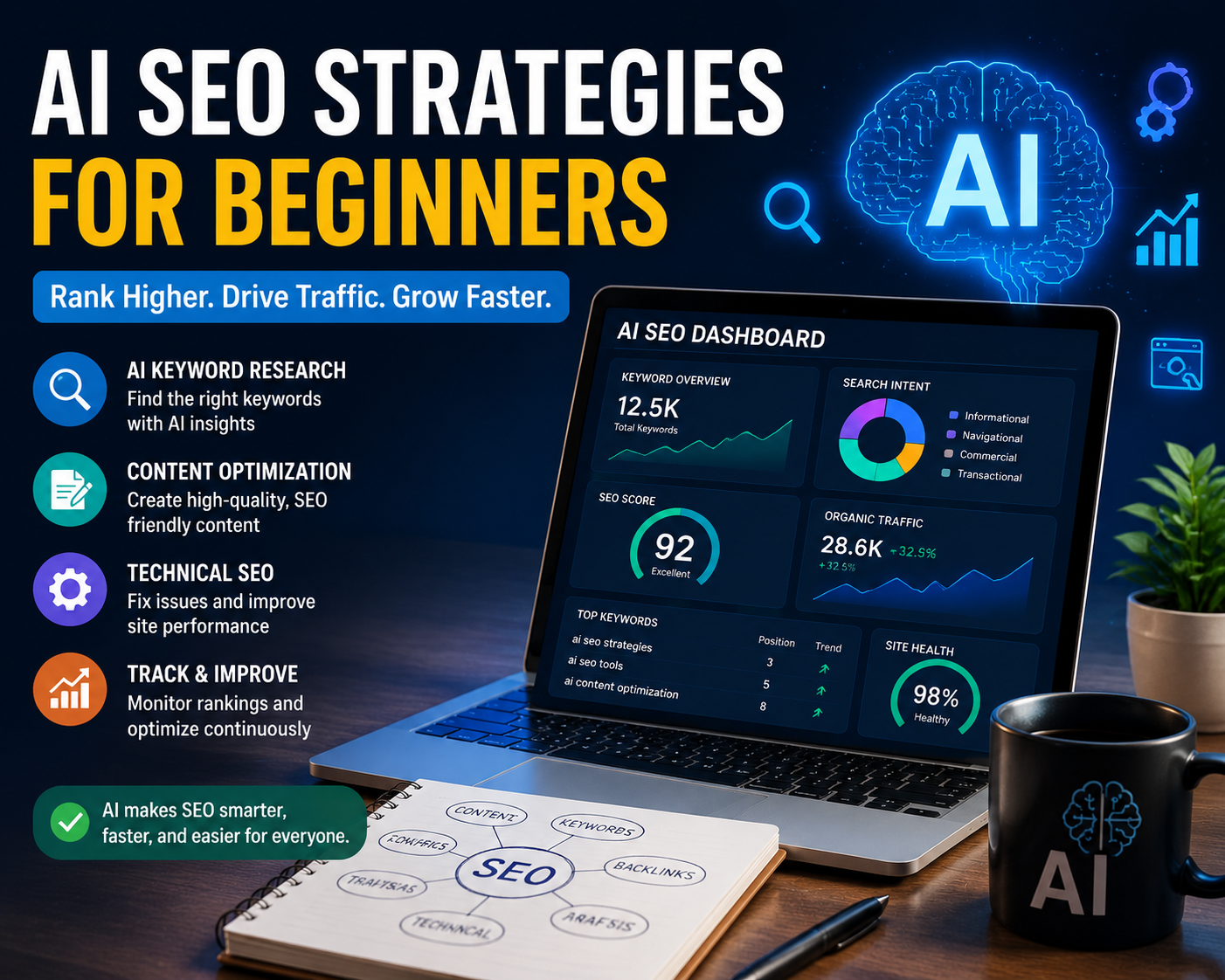
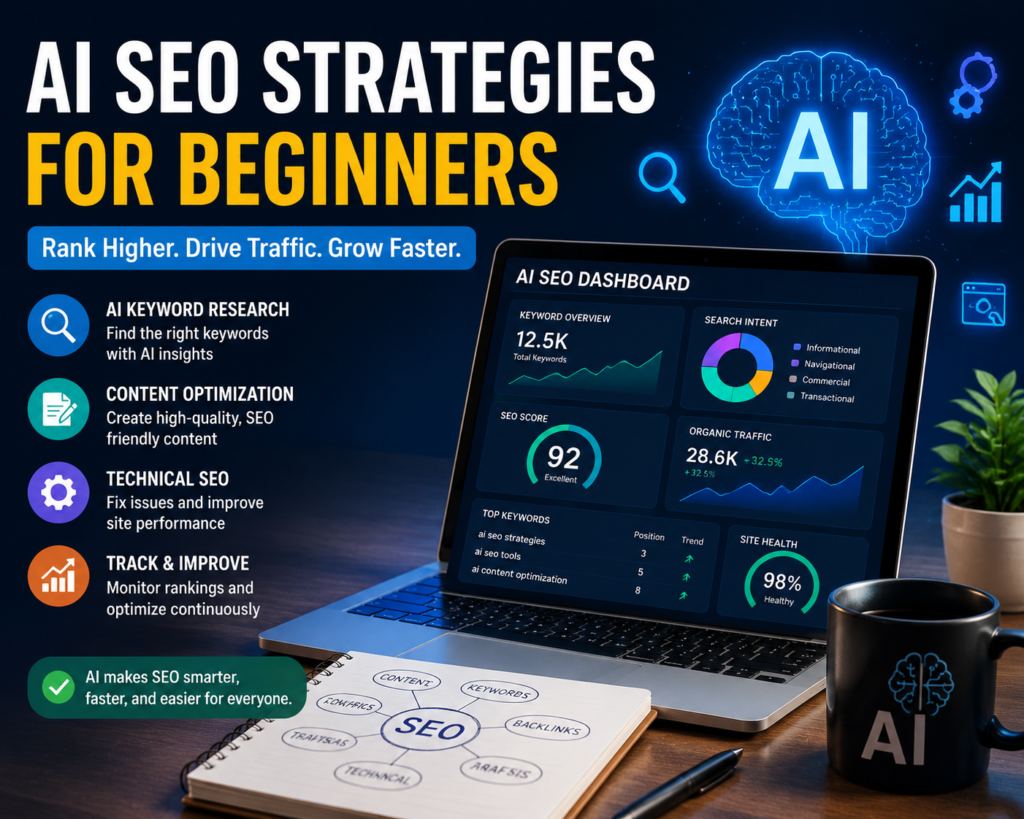
AI tools classify search intent into categories such as:
- Informational
- Navigational
- Commercial
- Transactional
For example:
Keyword: “Best AI laptops”
Intent:
- Product comparisons
- Buying guides
- Reviews
AI identifies this automatically and recommends content that better matches user expectations.
Use AI for Keyword Research
Modern AI keyword research tools identify opportunities beyond simple search volume.
Look for:
- Long-tail keywords
- Low-competition keywords
- Question-based searches
- Related semantic keywords
- Seasonal trends
Example:
Primary keyword:
AI SEO Strategies for Beginners
Related keywords:
- AI SEO tools
- AI search optimization
- Beginner SEO guide
- AI keyword research
- AI content optimization
- SEO automation
- AI digital marketing
Using related keywords naturally improves topical relevance.
Create Helpful, Original Content
Search engines increasingly reward content that genuinely helps readers.
AI can assist by:
- Generating outlines
- Organizing ideas
- Suggesting FAQs
- Identifying missing topics
- Improving readability
However, human expertise should always add:
- Personal experience
- Original examples
- Expert analysis
- Updated information
- Unique perspectives
This combination aligns with Google’s E-E-A-T principles.
Optimize On-Page SEO with AI
AI-powered SEO tools recommend improvements for:
- SEO titles
- Meta descriptions
- Heading structure
- Image alt text
- Internal linking
- Keyword placement
- Readability
- Page structure
These recommendations make optimization faster while improving user experience.
Improve Technical SEO
AI also assists with technical website optimization by identifying:
- Broken links
- Duplicate content
- Slow-loading pages
- Mobile usability issues
- Crawl errors
- Structured data problems
Even beginners can use AI-generated reports to fix issues that might otherwise require technical expertise.
Best AI SEO Workflow for Beginners
Following a structured workflow ensures consistent results.
Step 1: Research Keywords
Use AI to discover:
- Search volume
- Keyword difficulty
- Related topics
- User questions
Step 2: Analyze Competitors
AI tools compare your content with top-ranking pages and identify:
- Missing headings
- Content gaps
- Backlink opportunities
- Word count benchmarks
Step 3: Build a Detailed Outline
Generate a logical content structure that covers the topic comprehensively.
Step 4: Write High-Quality Content
Focus on:
- User value
- Clear explanations
- Practical examples
- Accurate information
AI can assist with drafting, but human review is essential.
Step 5: Optimize SEO Elements
Ensure:
- Keyword-rich title
- Compelling meta description
- Proper heading hierarchy
- Internal links
- Optimized images
Step 6: Monitor Performance
Use AI analytics to track:
- Rankings
- Organic traffic
- Click-through rate
- Bounce rate
- User engagement
Update content regularly based on performance insights.
Real-World Applications
Blogging
Bloggers use AI to:
- Find trending topics
- Generate article outlines
- Improve readability
- Refresh outdated posts
- Optimize internal linking
Small Businesses
Local businesses use AI SEO to:
- Rank for local keywords
- Optimize Google Business Profiles
- Create service pages
- Monitor competitors
E-commerce
Online stores benefit from AI by:
- Writing product descriptions
- Optimizing category pages
- Improving product search
- Recommending related products
SaaS Companies
Software companies leverage AI for:
- Technical documentation
- Landing page optimization
- Lead generation
- Content marketing
Comparison Table: Traditional SEO vs AI SEO
| Feature | Traditional SEO | AI SEO |
|---|---|---|
| Keyword Research | Manual | Automated with insights |
| Content Planning | Time-consuming | AI-generated outlines |
| Technical Audits | Manual tools | Automated recommendations |
| Competitor Analysis | Manual | AI-powered comparison |
| Content Optimization | Manual editing | Real-time suggestions |
| Performance Tracking | Basic analytics | Predictive insights |
| Scalability | Moderate | High |
Common Beginner Mistakes
Avoid these frequent SEO mistakes:
- Publishing thin content
- Keyword stuffing
- Ignoring search intent
- Forgetting internal links
- Using outdated information
- Copying AI output without editing
- Neglecting mobile optimization
- Ignoring page speed
- Failing to update older content
AI can identify many of these issues, but human judgment remains critical.
AI SEO and Google’s E-E-A-T Principles
Google emphasizes:
- Experience
- Expertise
- Authoritativeness
- Trustworthiness
To meet these standards:
- Share firsthand knowledge
- Cite reliable sources
- Keep content accurate
- Update articles regularly
- Demonstrate industry expertise
- Maintain transparency
AI should support—not replace—these quality signals.
Industry Insights and Trends
Recent developments show several major trends:
- Search engines increasingly evaluate content quality over keyword density.
- AI-powered search experiences are reshaping how users discover information.
- Semantic search continues to replace exact-match keyword optimization.
- Voice and conversational search are becoming more influential.
- Businesses are investing in AI-assisted SEO workflows to improve efficiency while maintaining editorial oversight.
Organizations that combine AI automation with expert human review are better positioned to achieve sustainable search performance.
Benefits of AI SEO Strategies for Beginners
Implementing AI SEO offers several advantages:
- Faster keyword research
- Better content organization
- Improved search rankings
- Higher productivity
- Enhanced user experience
- Better technical optimization
- Smarter competitor analysis
- Time savings
- Improved content consistency
- Better decision-making using data
- Easier SEO learning curve
- Scalable optimization for growing websites
Challenges and Limitations
Despite its advantages, AI SEO also has limitations.
AI Can Make Mistakes
Generated recommendations may occasionally be inaccurate or outdated, requiring manual verification.
Human Expertise Is Still Essential
AI cannot replace real-world experience, critical thinking, or subject-matter expertise.
Risk of Generic Content
Overreliance on AI can result in repetitive articles that lack originality and unique insights.
Constant Algorithm Changes
Search engine algorithms evolve continuously, making ongoing learning and content updates necessary.
Ethical Considerations
Content creators should prioritize transparency, avoid deceptive practices, and ensure originality to build long-term trust.
Future Trends
The future of AI-powered SEO will continue to evolve rapidly.
Hyper-Personalized Search
AI will increasingly tailor search results based on user preferences, behavior, and context.
AI Search Assistants
Conversational AI will influence how users discover and interact with online content, requiring optimization beyond traditional search results.
Predictive SEO
AI will forecast emerging topics, allowing marketers to create content before competitors.
Automated Content Optimization
AI systems will continuously improve headlines, internal links, metadata, and calls to action based on real-time performance.
Multimodal Search
Text, images, videos, voice, and interactive content will become equally important in search optimization strategies.
Responsible AI
Businesses will place greater emphasis on ethical AI usage, transparency, privacy, and compliance to maintain audience trust.
Read More About:AI Tools for Content Marketing in 2026: Complete Guide to Smarter Content
Frequently Asked Questions (FAQ)
1. What are AI SEO strategies for beginners?
AI SEO strategies involve using artificial intelligence tools to simplify keyword research, content optimization, technical SEO, and performance analysis, making search optimization more accessible for newcomers.
2. Can beginners use AI for SEO without technical knowledge?
Yes. Many AI SEO platforms provide intuitive dashboards, automated recommendations, and step-by-step guidance, allowing beginners to implement effective SEO practices.
3. Does AI guarantee higher Google rankings?
No. AI improves efficiency and provides valuable insights, but rankings depend on content quality, user experience, competition, authority, and search engine algorithms.
4. Is AI-generated content good for SEO?
AI-generated content can perform well when it is accurate, original, thoroughly edited, and genuinely helpful to readers. Human oversight remains essential.
5. What is the biggest advantage of AI SEO?
The biggest advantage is automation. AI reduces time spent on repetitive SEO tasks while helping marketers make smarter, data-driven decisions.
6. Should beginners rely entirely on AI?
No. AI should be used as an assistant rather than a replacement for strategic thinking, creativity, and expert knowledge.
Conclusion
Artificial intelligence is reshaping search engine optimization by making advanced SEO techniques more accessible than ever. AI SEO Strategies for Beginners provide practical ways to research keywords, understand search intent, optimize content, improve technical SEO, and monitor performance without requiring years of experience.
However, successful SEO still depends on creating original, trustworthy, and user-focused content. AI can accelerate workflows and uncover valuable insights, but long-term success comes from combining automation with human creativity, expertise, and continuous learning.
As search engines continue to evolve toward semantic understanding, personalized experiences, and AI-driven search interfaces, beginners who embrace responsible AI tools while focusing on quality content will be well-positioned to achieve sustainable organic growth.
Key Takeaways
- AI simplifies SEO for beginners through automation and intelligent insights.
- Understanding search intent is more important than focusing solely on keywords.
- AI enhances keyword research, content planning, and technical optimization.
- High-quality, original content remains the foundation of successful SEO.
- Following Google’s E-E-A-T principles builds trust and improves rankings.
- AI supports, but does not replace, human expertise and editorial judgment.
- Regular content updates and performance monitoring are essential for long-term success.
- Ethical AI usage and user-focused content strategies will define the future of SEO.