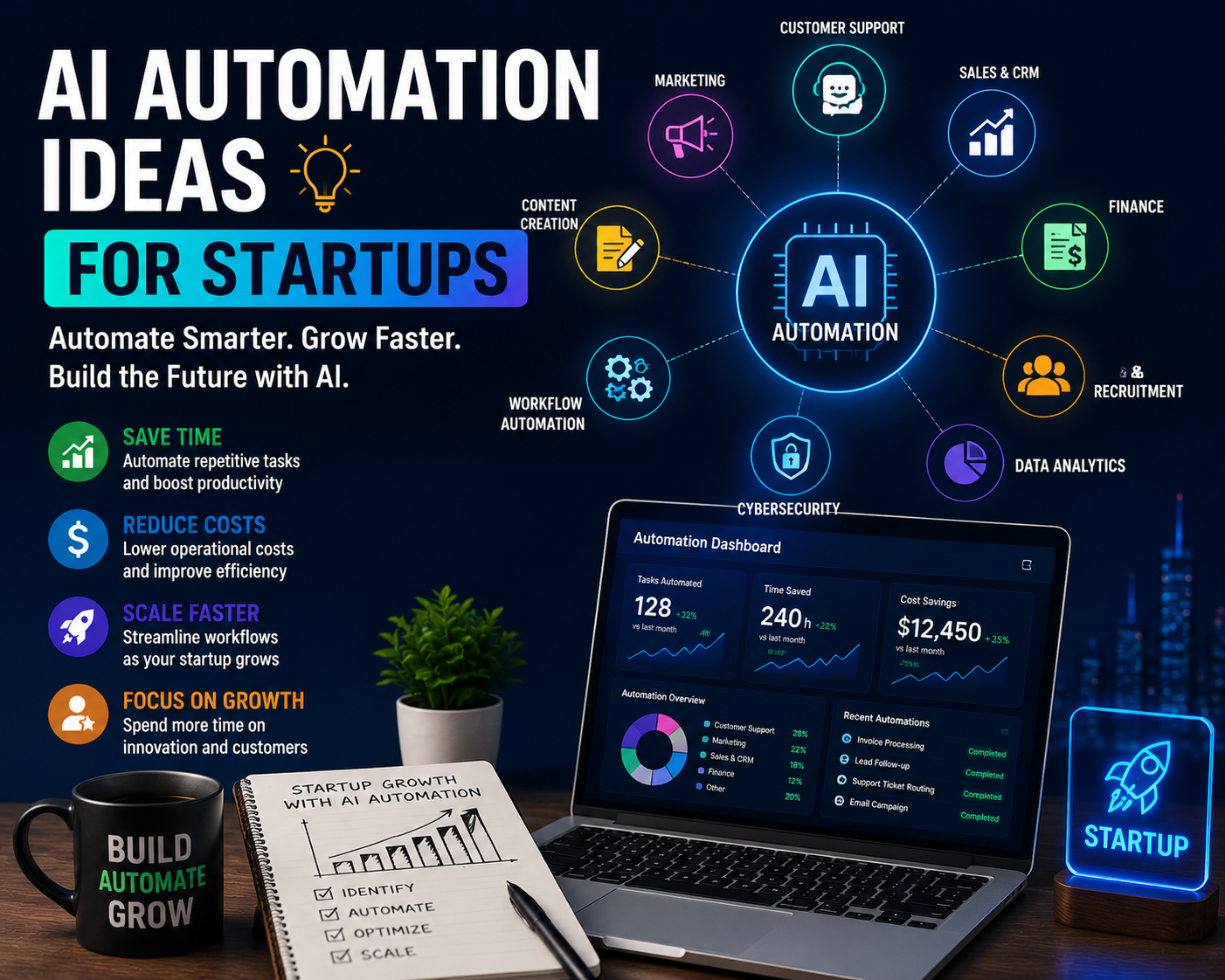

Discover the best AI automation ideas for startups in 2026. Learn practical use cases, benefits, challenges, AI tools, and strategies to boost productivity and growth.
Introduction
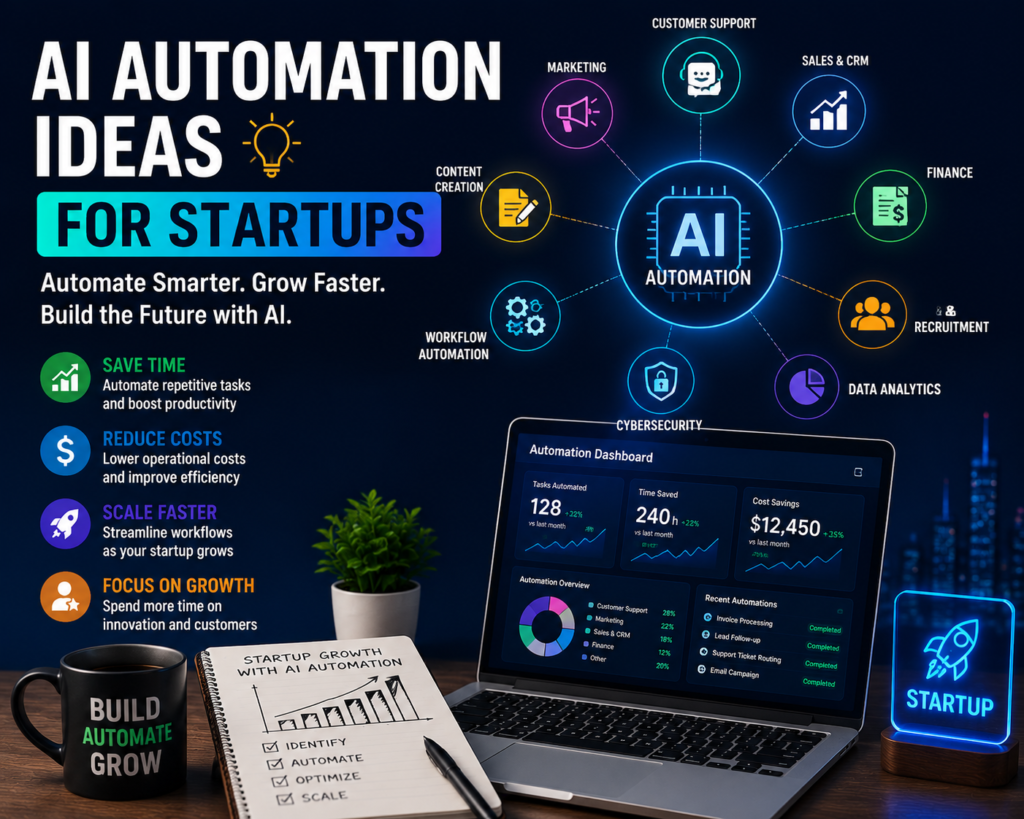
Artificial intelligence is no longer reserved for large enterprises with massive budgets. Today, startups of every size are using AI to automate repetitive tasks, improve customer experiences, reduce operational costs, and scale faster than ever before. AI Automation Ideas for Startups have become a competitive advantage, enabling founders to accomplish more with smaller teams and limited resources.
In 2026, AI-powered automation extends far beyond chatbots and content generation. Modern AI solutions can streamline sales, marketing, customer support, finance, cybersecurity, human resources, software development, and business analytics. By automating routine workflows, startup teams can focus on innovation, product development, and strategic decision-making.
Whether you’re building a SaaS company, launching an e-commerce business, developing AI products, or managing a digital agency, this comprehensive guide explores the most effective AI automation ideas, real-world use cases, implementation strategies, and future trends to help your startup thrive.
Why AI Automation Matters for Startups
Startups often face common challenges such as:
- Limited budgets
- Small teams
- Rapid growth expectations
- Tight deadlines
- Resource constraints
- Increasing competition
AI automation helps overcome these challenges by reducing manual work and improving efficiency.
Some major advantages include:
- Faster business operations
- Improved customer experiences
- Lower operational costs
- Better data-driven decisions
- Higher employee productivity
- Scalable business processes
Rather than replacing employees, AI allows startup teams to spend more time solving complex problems and building innovative products.
What Is AI Automation?
AI automation combines artificial intelligence with workflow automation to perform tasks that normally require human intervention.
Unlike traditional automation, AI systems can:
- Learn from data
- Understand natural language
- Recognize patterns
- Make recommendations
- Predict outcomes
- Improve over time
Common AI technologies include:
- Large Language Models (LLMs)
- Machine Learning (ML)
- Natural Language Processing (NLP)
- Computer Vision
- Speech Recognition
- Predictive Analytics
- Robotic Process Automation (RPA)
These technologies work together to automate both simple and complex business processes.
Best AI Automation Ideas for Startups
AI Customer Support
Customer service is one of the easiest areas to automate.
AI-powered assistants can:
- Answer FAQs
- Resolve common issues
- Route support tickets
- Provide multilingual support
- Handle order tracking
- Collect customer feedback
Practical Example
An online store uses an AI chatbot to answer shipping questions 24/7, reducing response times and allowing support agents to focus on more complex inquiries.
AI Content Marketing
Content creation is time-consuming for startup teams.
AI can automate:
- Blog writing
- Email campaigns
- Product descriptions
- Social media captions
- Video scripts
- Newsletter creation
Human editing remains essential to ensure originality, accuracy, and alignment with the brand voice.
AI Sales Automation
Sales teams benefit from AI through:
- Lead scoring
- CRM updates
- Follow-up reminders
- Personalized email generation
- Meeting scheduling
- Sales forecasting
AI helps sales representatives prioritize high-value opportunities and improve conversion rates.
AI Email Automation
Email marketing becomes more effective with AI by automating:
- Welcome sequences
- Lead nurturing
- Customer onboarding
- Personalized recommendations
- Re-engagement campaigns
AI can also optimize subject lines and send times based on recipient behavior.
AI Recruitment
Hiring is often expensive and time-consuming.
AI assists with:
- Resume screening
- Candidate ranking
- Interview scheduling
- Skill assessments
- Employee onboarding
Recruiters should always review AI recommendations to avoid bias and ensure fair hiring decisions.
AI Finance Automation
Financial workflows that can be automated include:
- Invoice processing
- Expense categorization
- Budget forecasting
- Cash flow analysis
- Fraud detection
- Financial reporting
This improves accuracy while reducing manual bookkeeping tasks.
AI Software Development
Developers increasingly use AI for:
- Code suggestions
- Bug detection
- Documentation generation
- Code reviews
- Test automation
- API integration assistance
These tools accelerate development while improving code quality.
AI Cybersecurity
Cybersecurity automation is becoming essential for startups.
AI helps detect:
- Suspicious login attempts
- Malware activity
- Phishing attacks
- Insider threats
- Network anomalies
Automated monitoring strengthens security while reducing the workload for IT teams.
AI Data Analytics
Modern AI analytics platforms can:
- Build dashboards
- Forecast revenue
- Detect trends
- Segment customers
- Recommend business actions
- Monitor KPIs
These insights help founders make smarter strategic decisions.
AI Workflow Automation
General business workflows suitable for automation include:
- Document approval
- Task assignment
- File organization
- Calendar management
- Meeting summaries
- Internal reporting
Automating administrative work allows employees to focus on higher-value activities.
How to Implement AI Automation Successfully
Step 1: Identify Repetitive Tasks
Begin by listing daily tasks that consume significant time.
Examples include:
- Data entry
- Scheduling
- Reporting
- Email responses
- Customer inquiries
Step 2: Prioritize High-Impact Processes
Choose automation projects that provide measurable business value.
Focus on:
- Customer service
- Marketing
- Sales
- Finance
Step 3: Select the Right AI Tools
Consider factors such as:
- Ease of use
- Integration capabilities
- Scalability
- Security
- Cost
- Vendor support
Step 4: Test Before Full Deployment
Launch AI automation on a small scale before expanding organization-wide.
Monitor:
- Accuracy
- User satisfaction
- Productivity improvements
- Cost savings
Step 5: Continuously Optimize
AI systems improve over time when monitored and refined.
Review performance regularly and adjust workflows as business needs evolve.
Real-World Startup Use Cases
SaaS Startup
A SaaS company automates customer onboarding with AI-generated tutorials, support chatbots, and personalized email sequences, reducing onboarding time and increasing user adoption.
E-commerce Startup
An online retailer uses AI to generate product descriptions, recommend products, optimize inventory forecasting, and provide instant customer support.
Digital Marketing Agency
An agency leverages AI for keyword research, content creation, SEO optimization, campaign reporting, and social media scheduling, enabling it to serve more clients with a lean team.
FinTech Startup
A financial technology startup uses AI for fraud detection, transaction monitoring, risk analysis, and automated customer support while maintaining human oversight for critical decisions.
HealthTech Startup
A healthcare startup automates appointment reminders, patient education materials, and administrative workflows while ensuring compliance with healthcare regulations.
Comparison Table: Traditional Processes vs AI Automation
| Business Function | Traditional Approach | AI Automation |
|---|---|---|
| Customer Support | Manual responses | AI chatbots and ticket routing |
| Marketing | Manual campaigns | Automated personalized campaigns |
| Sales | Manual lead tracking | AI lead scoring and forecasting |
| Finance | Spreadsheet reporting | Automated analytics and reporting |
| Recruitment | Manual resume review | AI candidate screening |
| Software Development | Manual testing | AI-assisted coding and testing |
| Cybersecurity | Reactive monitoring | AI-powered threat detection |
Expert Insights and Industry Trends
Several key trends are shaping AI automation for startups in 2026:
- AI copilots are becoming integral to daily business operations.
- Workflow automation platforms are increasingly incorporating generative AI capabilities.
- Predictive analytics are enabling proactive decision-making rather than reactive responses.
- AI agents are handling multi-step business tasks with minimal human intervention.
- Responsible AI governance is gaining importance as startups address data privacy, transparency, and compliance.
Successful startups view AI as a collaborative partner that augments human capabilities rather than replacing employees.
Benefits of AI Automation for Startups
Adopting AI automation offers numerous advantages:
- Increased operational efficiency
- Lower business costs
- Faster customer support
- Improved employee productivity
- Better decision-making through analytics
- Enhanced customer satisfaction
- Scalable business operations
- Reduced human error
- Improved marketing performance
- Stronger cybersecurity monitoring
- Faster software development cycles
- Greater competitive advantage
Challenges and Limitations
Despite its benefits, AI automation also presents several challenges.
Initial Implementation Costs
Some AI platforms require investment in software, training, and integration.
Data Quality
AI systems depend on accurate and high-quality data. Poor data can lead to unreliable recommendations.
Integration Complexity
Connecting AI tools with existing systems may require technical expertise.
Privacy and Compliance
Businesses must comply with regulations related to customer data, cybersecurity, and AI governance.
Human Oversight
AI should support—not replace—critical human judgment, especially in hiring, finance, healthcare, and legal decisions.
Future Trends
AI automation is expected to become even more sophisticated over the next few years.
Autonomous AI Agents
AI systems will independently manage complex workflows such as project coordination, customer service, and business reporting.
Hyper-Personalization
AI will deliver highly personalized customer experiences across websites, emails, and digital products.
Predictive Business Intelligence
Future AI platforms will forecast customer behavior, market trends, and operational risks with greater accuracy.
Multimodal AI
Businesses will increasingly use AI that can seamlessly process and generate text, images, audio, video, and structured data.
AI-Driven Cybersecurity
Automation will play a larger role in identifying and responding to cyber threats in real time.
Ethical and Responsible AI
Transparency, fairness, explainability, and data privacy will become central to AI adoption strategies.
Read More About:AI SEO Strategies for Beginners: Complete Guide for 2026
Frequently Asked Questions (FAQ)
1. What are AI automation ideas for startups?
AI automation ideas involve using artificial intelligence to streamline business processes such as customer support, marketing, sales, finance, recruitment, software development, and analytics.
2. Can small startups afford AI automation?
Yes. Many AI platforms offer affordable subscription plans, making automation accessible even for startups with limited budgets.
3. Will AI replace startup employees?
No. AI is designed to automate repetitive tasks, allowing employees to focus on creativity, innovation, strategic planning, and customer relationships.
4. Which startup departments benefit the most from AI?
Customer support, marketing, sales, finance, HR, software development, cybersecurity, and business analytics are among the departments that see significant benefits from AI automation.
5. How should startups begin implementing AI?
Start by identifying repetitive, time-consuming tasks, selecting suitable AI tools, running pilot projects, and measuring results before expanding automation.
6. Is AI automation secure?
AI can improve security when implemented responsibly, but startups should choose trusted vendors, protect sensitive data, and maintain strong cybersecurity practices.
Conclusion
Artificial intelligence has become a powerful growth engine for modern startups. By adopting AI Automation Ideas for Startups, businesses can streamline operations, reduce costs, enhance customer experiences, and make more informed decisions. From marketing and sales to cybersecurity and software development, AI is helping small teams achieve enterprise-level efficiency.
However, successful implementation requires thoughtful planning, quality data, responsible governance, and ongoing human oversight. Startups that combine AI automation with skilled employees, ethical practices, and customer-focused strategies will be better positioned to innovate, scale, and compete in an increasingly AI-driven marketplace.
As AI technologies continue to advance, embracing automation today can provide startups with the agility and resilience needed for long-term success.
Key Takeaways
- AI automation helps startups achieve more with limited resources.
- Customer support, marketing, sales, finance, and cybersecurity are ideal areas for automation.
- AI enhances productivity by automating repetitive tasks while supporting smarter decision-making.
- Human expertise remains essential for creativity, ethics, and strategic planning.
- Choosing scalable and secure AI tools is critical for sustainable growth.
- Continuous monitoring and optimization maximize automation benefits.
- Responsible AI practices build trust and ensure long-term compliance.
- Startups that embrace AI early gain a competitive edge in innovation and operational efficiency.