
Discover the best open source AI models in 2026, compare top LLMs, learn their strengths, use cases, benefits, limitations, and future trends for AI innovation.
Introduction
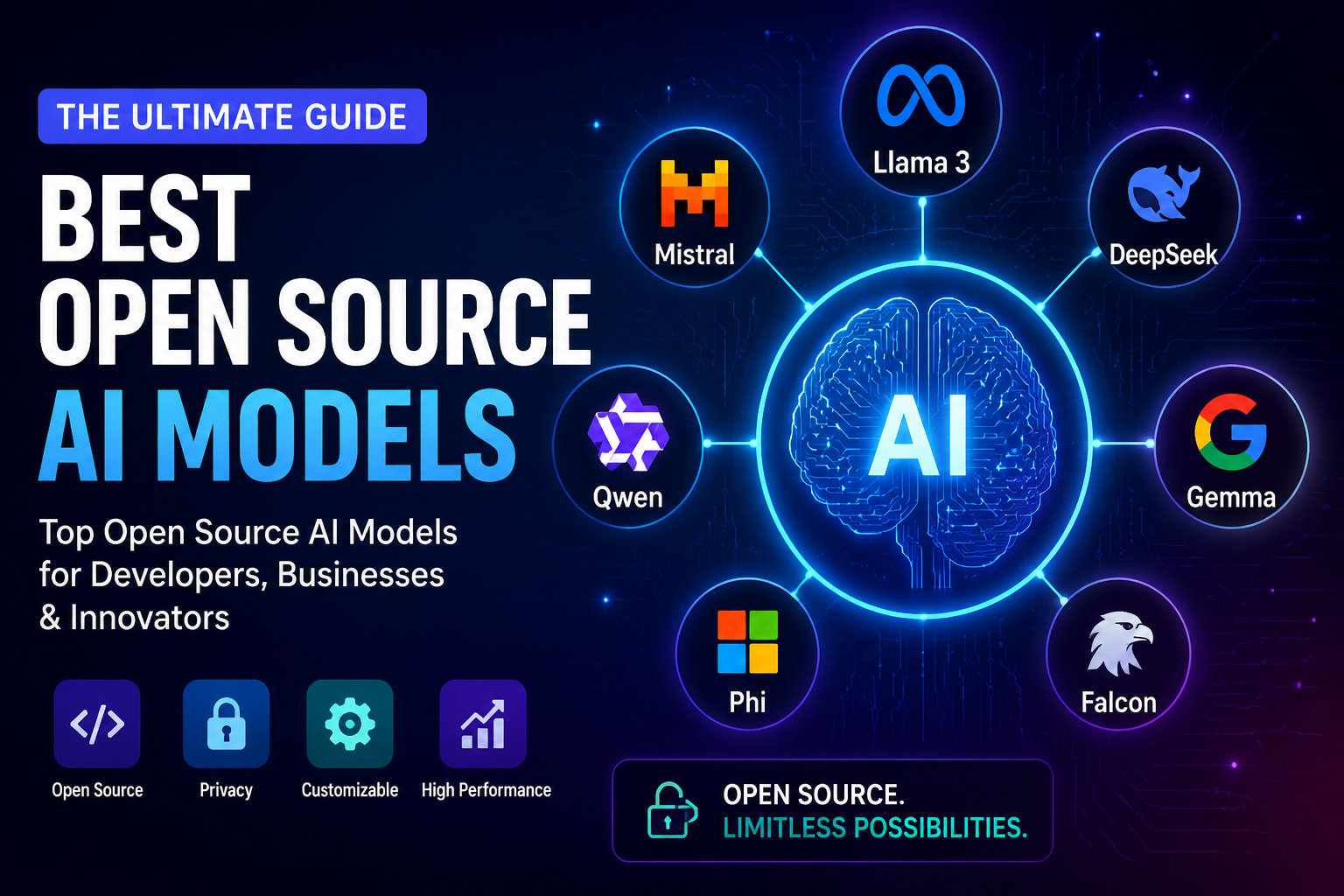
The rapid evolution of artificial intelligence has transformed how businesses, developers, researchers, and individuals build intelligent applications. While proprietary AI models from companies like OpenAI, Anthropic, and Google continue to dominate headlines, Best Open Source AI Models have emerged as powerful alternatives that offer greater flexibility, transparency, and customization.
Open source AI models allow organizations to deploy AI on their own infrastructure, fine-tune models for specialized tasks, improve data privacy, and reduce long-term operational costs. Thanks to communities such as Hugging Face, Meta, Mistral AI, Alibaba Cloud, and others, open-source large language models (LLMs) have become increasingly capable, rivaling commercial solutions across coding, reasoning, content generation, multilingual support, and research.
Whether you’re a developer creating AI applications, a startup seeking cost-effective solutions, a cybersecurity professional implementing secure AI systems, or a business owner exploring automation, choosing the right model is essential.
In this comprehensive guide, we’ll explore the Best Open Source AI Models, compare their strengths, discuss real-world applications, analyze industry trends, and help you determine which model best fits your needs.
What Are Open Source AI Models?
Open source AI models are machine learning models whose architecture, weights, or source code are publicly available for developers and researchers to inspect, modify, and improve.
Unlike proprietary AI systems, open-source models provide greater control over deployment and customization.
Common characteristics include:
- Open model weights
- Community-driven improvements
- Transparent development
- Local deployment support
- Fine-tuning capabilities
- Reduced vendor lock-in
These models power chatbots, coding assistants, search engines, cybersecurity tools, research platforms, healthcare applications, and enterprise AI solutions.
Why Open Source AI Models Are Gaining Popularity
Several factors have accelerated the adoption of open-source AI.
Cost Efficiency
Businesses avoid recurring API expenses by hosting models locally or in private cloud environments.
Data Privacy
Sensitive organizational data never leaves internal infrastructure, making open-source models attractive for healthcare, finance, and government agencies.
Customization
Developers can fine-tune models for:
- Customer support
- Legal analysis
- Medical documentation
- Programming
- Research
- Education
Transparency
Researchers can inspect architectures, identify limitations, and improve safety mechanisms.
Community Innovation
Thousands of contributors continuously optimize performance, benchmark results, and create specialized variants.
Best Open Source AI Models in 2026
1. Llama 3 Series
Meta’s Llama family remains among the most influential open-weight language models.
Strengths
- Excellent reasoning
- Strong multilingual support
- Large ecosystem
- Efficient inference
- Enterprise-ready
Ideal Use Cases
- AI chatbots
- Enterprise assistants
- Document summarization
- Customer support
- Knowledge management
2. Mistral Large & Mixtral
Mistral AI introduced innovative Mixture-of-Experts (MoE) architectures that provide excellent performance while reducing computational requirements.
Advantages
- Fast inference
- Efficient architecture
- High-quality reasoning
- Strong coding ability
- Excellent instruction following
Best For
- AI assistants
- Enterprise applications
- Productivity software
- Automation
3. DeepSeek Models
DeepSeek has rapidly gained popularity due to its coding and reasoning performance.
Highlights
- Competitive programming capabilities
- Mathematical reasoning
- Research-friendly
- Efficient deployment
Common Applications
- Software development
- Code generation
- Bug fixing
- AI research
4. Qwen Series
Alibaba’s Qwen models provide exceptional multilingual support and enterprise capabilities.
Key Features
- Strong language understanding
- Long context windows
- Excellent multilingual performance
- Business-ready deployment
Industry Adoption
- International businesses
- Translation
- AI search
- Knowledge management
5. Gemma
Gemma is Google’s lightweight open model family optimized for responsible AI development.
Advantages
- Efficient deployment
- Mobile compatibility
- Easy fine-tuning
- Strong documentation
Ideal Users
- Students
- Researchers
- Mobile developers
- Small businesses
6. Phi Series
Microsoft’s Phi models demonstrate how smaller models can achieve impressive performance.
Key Benefits
- Lightweight
- Lower hardware requirements
- Fast inference
- Cost-effective deployment
Popular Use Cases
- Edge devices
- Educational AI
- Offline assistants
- Smart applications
7. Falcon
Falcon remains an important option for organizations requiring scalable open-source language models.
Strengths
- High scalability
- Commercial-friendly licensing
- Strong language generation
- Active community
Comparison Table of the Best Open Source AI Models
| AI Model | Best For | Strengths | Hardware Needs | Ideal Users |
|---|---|---|---|---|
| Llama 3 | General AI | Reasoning, multilingual | Medium to High | Enterprises, developers |
| Mistral | Fast AI | Efficiency, speed | Medium | Startups |
| Mixtral | Large workloads | MoE architecture | High | Enterprise AI |
| DeepSeek | Coding | Programming, reasoning | Medium | Developers |
| Qwen | Multilingual AI | Language understanding | Medium | Global businesses |
| Gemma | Lightweight AI | Simplicity | Low | Students, researchers |
| Phi | Edge AI | Small size | Low | Mobile developers |
| Falcon | Scalable AI | Language generation | Medium | Organizations |
How to Choose the Best Open Source AI Model
Choosing the right AI model depends on several factors.
Consider Your Primary Goal
Different models excel at different tasks.
For example:
- Coding → DeepSeek
- Chatbots → Llama 3
- Lightweight deployment → Phi
- Multilingual applications → Qwen
- Research → Gemma
Evaluate Hardware Resources
Some models require multiple GPUs, while others can run efficiently on consumer hardware.
Review Licensing
Always verify licensing terms before commercial deployment.
Consider Community Support
Models with active communities receive:
- Faster improvements
- Better documentation
- More integrations
- Frequent updates
Real-World Applications
Open source AI models power thousands of applications.
Software Development
Developers use AI for:
- Code generation
- Unit testing
- Documentation
- Debugging
Cybersecurity
Security teams implement AI for:
- Threat detection
- Malware analysis
- Security automation
- Incident response
- Log analysis
Healthcare
Hospitals leverage AI for:
- Medical summaries
- Clinical documentation
- Research assistance
- Patient communication
Education
Educational platforms utilize AI for:
- Personalized tutoring
- Content generation
- Language learning
- Assessment support
Business Automation
Organizations automate:
- Customer service
- Email responses
- Document processing
- Internal knowledge bases
- Workflow management
Industry Trends Driving Open Source AI
Several major trends are shaping the AI landscape.
Smaller Yet Smarter Models
Compact models increasingly rival much larger systems through architectural improvements.
Long Context Windows
Modern models can process hundreds of thousands of tokens, enabling analysis of lengthy documents and codebases.
AI Agents
Open-source models are increasingly powering autonomous AI agents capable of planning, executing tasks, and interacting with software tools.
Edge AI
Lightweight models now run efficiently on laptops, smartphones, and IoT devices, reducing latency and improving privacy.
Multimodal Capabilities
Many open-source models now understand combinations of:
- Images
- Text
- Audio
- Video
- Documents
Benefits of Using Open Source AI Models
Organizations increasingly adopt open-source AI because it offers numerous strategic advantages.
Lower Long-Term Costs
Self-hosted deployment eliminates many recurring API fees.
Better Privacy
Organizations maintain complete control over sensitive information.
Full Customization
Businesses can fine-tune models for niche domains and proprietary datasets.
Reduced Vendor Lock-In
Teams are not dependent on a single AI provider.
Faster Innovation
Open communities rapidly introduce improvements, benchmarks, and specialized adaptations.
Transparency
Researchers and developers can inspect model architectures and evaluate behavior more effectively.
Challenges and Limitations
Despite their advantages, open-source AI models present several challenges.
High Hardware Requirements
Large models often require powerful GPUs with substantial memory.
Complex Deployment
Self-hosting demands expertise in infrastructure, optimization, and maintenance.
Fine-Tuning Costs
Training or adapting models can require significant compute resources and time.
Safety and Alignment
Open models may require additional guardrails to reduce harmful or inaccurate outputs.
Maintenance Responsibility
Organizations are responsible for updates, monitoring, security, and performance optimization.
Future Trends
The future of open-source AI looks exceptionally promising.
More Efficient Architectures
Researchers continue to improve model efficiency while reducing computational costs.
Better Multimodal Intelligence
Future models will seamlessly integrate text, images, audio, video, and structured data.
Industry-Specific Models
Expect highly specialized AI models tailored for sectors such as healthcare, finance, manufacturing, legal services, and cybersecurity.
AI on Consumer Devices
Advances in model compression and hardware acceleration will enable sophisticated AI experiences directly on personal devices.
Stronger Security Features
Open-source AI ecosystems are placing greater emphasis on safety, governance, explainability, and secure deployment practices.
Expert Insights and Industry Analysis
The open-source AI ecosystem has matured from experimental research into a critical component of enterprise AI strategies. Many organizations are adopting a hybrid approach, combining proprietary APIs for cutting-edge capabilities with open-source models for privacy-sensitive or cost-sensitive workloads.
Industry benchmarks increasingly show that carefully fine-tuned open-source models can achieve performance comparable to proprietary systems for many domain-specific tasks. At the same time, the rapid pace of community innovation means improvements are delivered more frequently, allowing businesses to iterate quickly and remain competitive.
For developers, the availability of pre-trained checkpoints, optimization frameworks, and extensive documentation has significantly lowered the barrier to building advanced AI-powered applications.
Read More About:AI Automation Ideas for Startups: Complete Guide for 2026
Frequently Asked Questions (FAQ)
1. What are the best open source AI models available today?
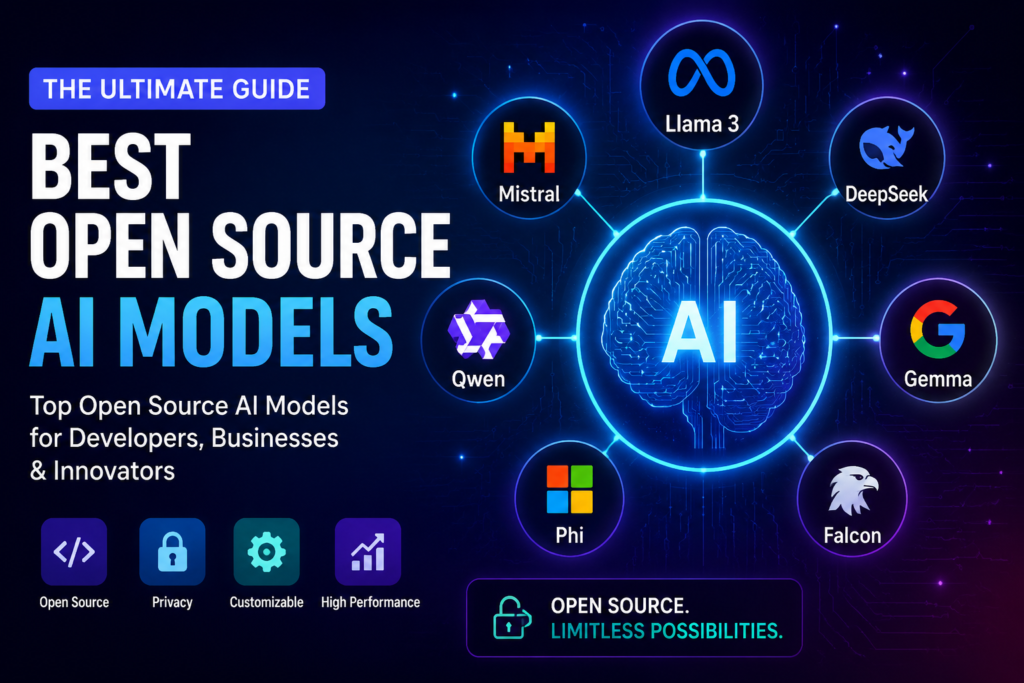
Some of the leading open-source AI models include Llama 3, Mistral, Mixtral, DeepSeek, Qwen, Gemma, Phi, and Falcon. Each excels in different areas such as coding, multilingual support, efficiency, or enterprise deployment.
2. Are open source AI models free to use?
Many open-source AI models are available without licensing fees for research and, in many cases, commercial use. However, users should always review the specific license terms, as restrictions and attribution requirements may vary.
3. Which open source AI model is best for coding?
DeepSeek is widely recognized for its strong code generation, debugging, and programming assistance. Llama 3 and Mistral also perform well for software development tasks.
4. Can businesses safely deploy open source AI models?
Yes. Many businesses deploy open-source AI models on private servers or cloud infrastructure to maintain greater control over sensitive data. Proper security practices, monitoring, and governance remain essential.
5. Do open source AI models require expensive hardware?
Not always. Lightweight models such as Phi and Gemma can run on modest hardware, while larger models may require high-performance GPUs or distributed infrastructure for optimal performance.
6. Are open source AI models suitable for enterprise applications?
Absolutely. Enterprises use them for customer support, document analysis, cybersecurity, knowledge management, software development, and workflow automation. Their flexibility and customization options make them attractive for many industries.
Conclusion
The rise of the Best Open Source AI Models has fundamentally reshaped the artificial intelligence landscape. Organizations no longer need to rely exclusively on proprietary AI services to build intelligent, scalable, and secure solutions. Models such as Llama 3, Mistral, DeepSeek, Qwen, Gemma, Phi, and Falcon provide exceptional capabilities across reasoning, coding, multilingual communication, and enterprise automation.
Selecting the right model depends on your objectives, infrastructure, privacy requirements, and budget. Businesses prioritizing data security may favor self-hosted deployments, while developers can benefit from the flexibility of fine-tuning open models for specialized use cases. As open-source communities continue to innovate, these models are expected to become even more efficient, multimodal, and accessible.
For anyone looking to embrace AI while maintaining greater control, transparency, and cost efficiency, investing time in understanding and deploying open-source AI models is a strategic decision that can deliver long-term value.
Key Takeaways
- Best Open Source AI Models provide flexibility, transparency, and strong customization capabilities.
- Llama 3 remains a leading choice for general-purpose AI and enterprise deployments.
- DeepSeek excels in coding, debugging, and software engineering tasks.
- Mistral and Mixtral offer impressive efficiency with advanced Mixture-of-Experts architectures.
- Qwen stands out for multilingual and global business applications.
- Gemma and Phi are excellent lightweight options for researchers, students, and edge devices.
- Open-source AI supports greater data privacy by enabling on-premises deployment.
- Organizations should evaluate hardware, licensing, security, and community support before selecting a model.
- Open-source AI is driving innovation across software development, cybersecurity, healthcare, education, and business automation.
- Future advancements will focus on multimodal intelligence, edge AI, improved efficiency, and domain-specific AI solutions.